Every few years a game comes along that quietly redefines what “survival” can mean. Solarpunk, the long-awaited debut from the two-person German studio Cyberwave (published by rokaplay), is one of those games — or at least it desperately wants to be. After four years in development and more than a million Steam wishlists, it finally launched on June 8, 2026 across PC, PS5, Xbox Series X|S and Switch 2, arriving day one on Xbox Game Pass. There is no combat here, no health bar draining under a hail of arrows, no night-time monster siege. Instead, there are floating islands drifting through a golden sky, a hand-built airship, a weather-driven power grid, and a pig that will dig up truffles for you if you treat it kindly.
That premise alone makes Solarpunk one of the more distinctive releases of the year. The genre is crowded with crafting-survival games that ultimately boil down to chopping trees so you can build a better axe to chop more trees, and Solarpunk both leans into that loop and tries to soften it into something genuinely restful. The question that hangs over the whole experience — and the one players have been arguing about loudly since launch — is whether “restful” tips over into “thin.” The honest answer is that it does both, depending on who you are and what you came for.
A survival game that refuses to threaten you
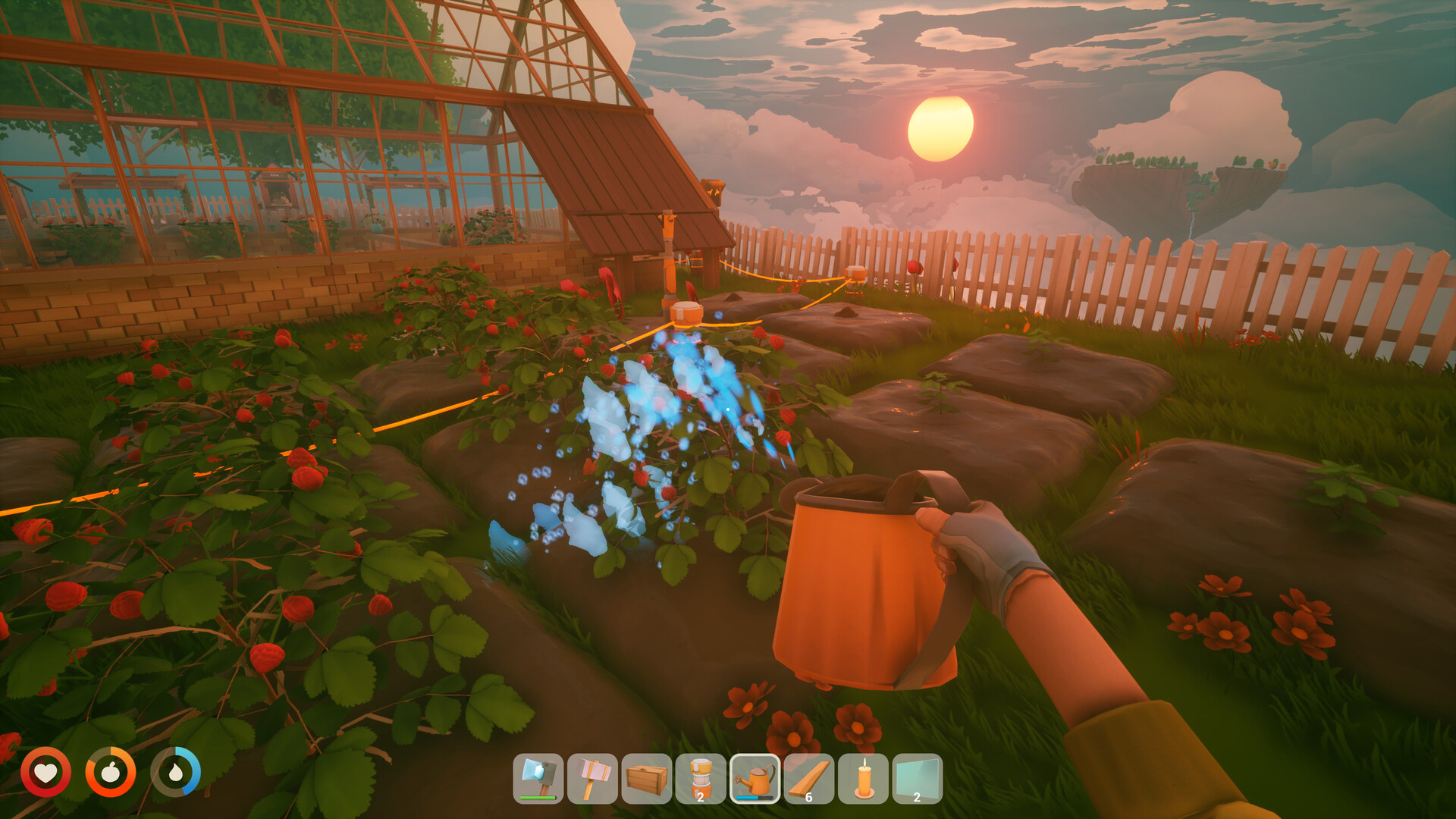
Solarpunk’s core fantasy is appealing in its simplicity: you are a lone caretaker on a cluster of sky-islands, tasked with rebuilding a small, sustainable civilization in harmony with the land rather than at war with it. There is hunger and thirst to manage, and weather that can damage crops or wear you down, but these are gentle pressures, not constant threats. As one Steam reviewer put it after a dozen hours, the game has “only basic dangers like hunger and thirst to really deal with,” and even the storms are “pretty easy to get around.” This is survival as gardening, not survival as horror.
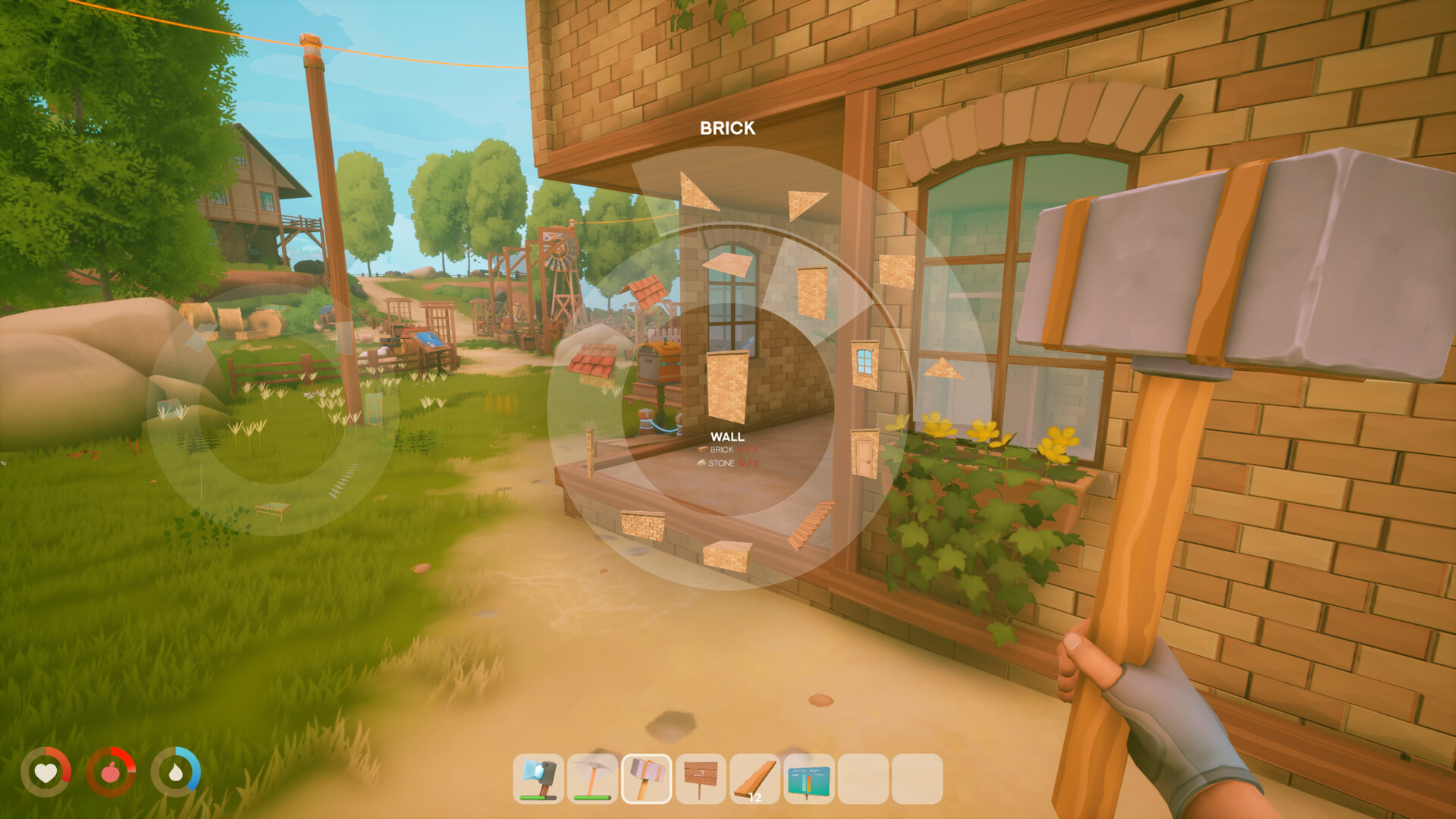
That design choice is deliberate and, to its credit, fully committed. Solarpunk isn’t a combat game with the fighting filed off; it’s built from the ground up around creativity, logistics and atmosphere. The marketing word is “cozy,” and the game earns it. The art direction — soft Unreal Engine 5 lighting, pastel skies, chunky stylized props — is consistently lovely, and the moment-to-moment feel of pottering around your island rearranging planters and power lines is the whole point. If you’ve ever lost an evening to decorating a base in a game and resented being interrupted by a respawning enemy, Solarpunk is built specifically for you.
Building is the beating heart — and it’s excellent
If there’s one thing nearly everyone agrees on, it’s the building. Cyberwave has shipped a construction system with real depth and flexibility, and it is comfortably the strongest pillar of the game. Snapping together greenhouses, workshops, walkways and decorative flourishes is tactile and forgiving, and the freedom on offer is generous enough that players have spent more time landscaping than “playing” in any traditional sense. “I really wanna get into it until I built a whole city on the island,” wrote one player; another simply asked the developers to “add the ability to pinch tradebot’s cheeks.” When the loudest community request is to pet the robot, you know the vibe has landed.
The decoration and base-building loop is the thing that turns Solarpunk from a tech demo into a place you want to live. The islands are vertical and irregular, which makes terracing your farms and routing your infrastructure a satisfying spatial puzzle rather than a flat checklist. Players who have clicked with the game describe it in exactly these terms — “pure cozy fun,” “the perfect relaxing survival game I’ve spent years searching for” — and the throughline is always the same: the joy is in making the place yours.
Airships, weather and the energy puzzle
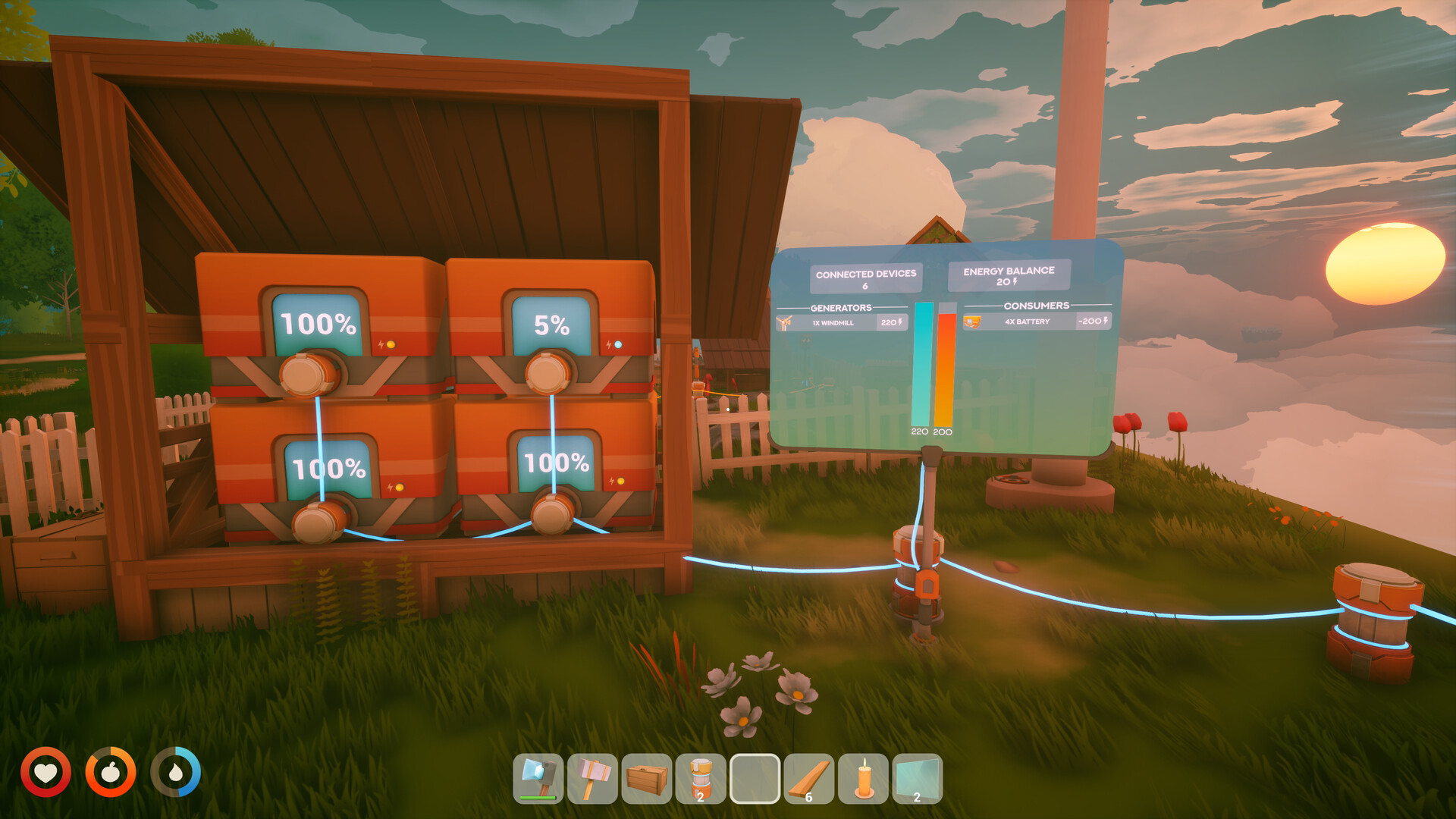
Where Solarpunk distinguishes itself mechanically is its energy system. Power isn’t an afterthought; it’s the spine of progression. You generate electricity from solar panels and wind turbines, and crucially, the weather actively governs your output. A still, sunny day is great for solar but useless for wind; a storm flips that equation and threatens your crops besides. Planning around the forecast — over-building capacity, adding batteries, balancing sources — gives the mid-game a light strategic texture that more than one outlet singled out as the game’s smartest idea. It’s renewable-energy management as a genuine gameplay verb, and it fits the fiction perfectly.
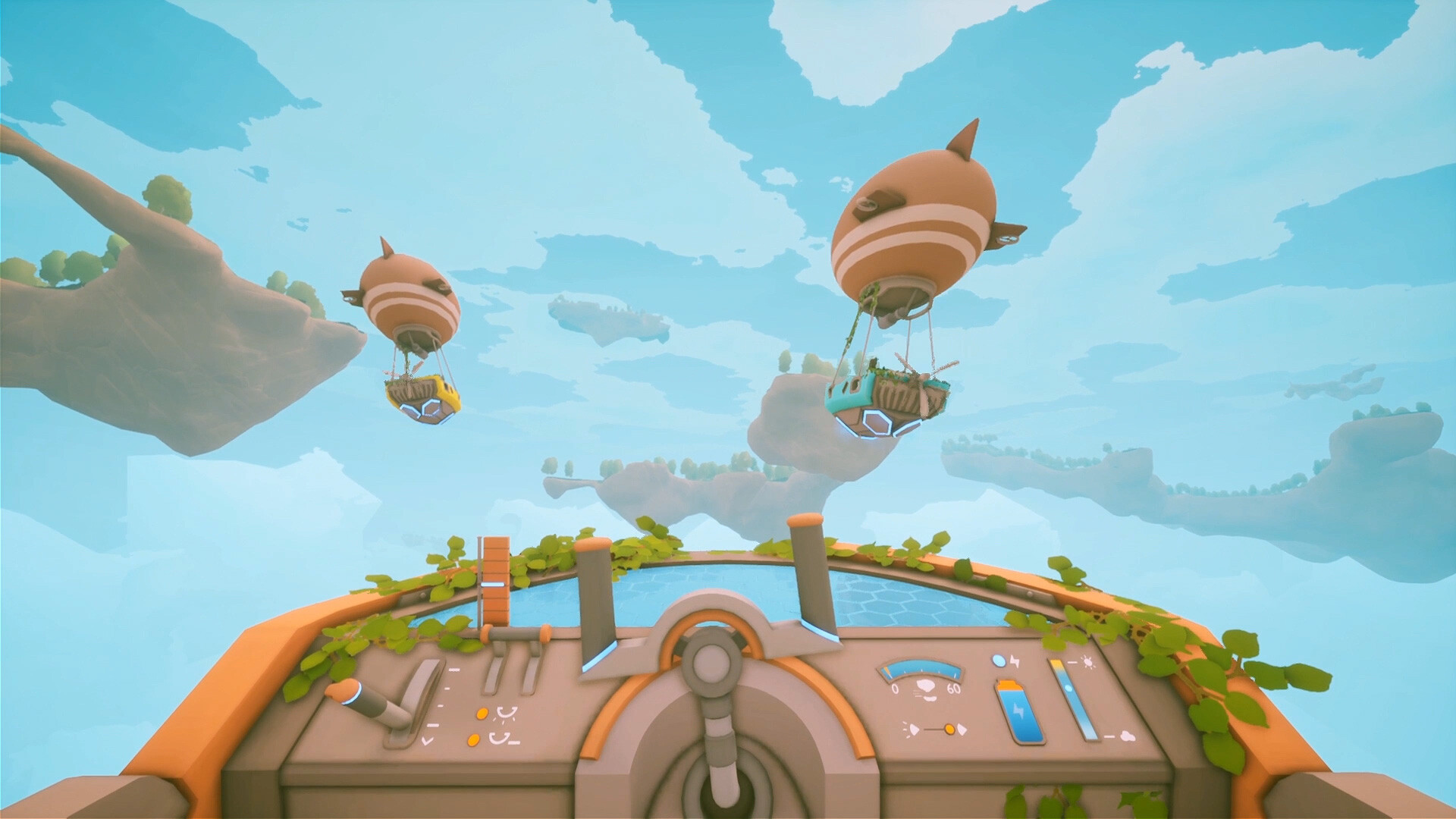
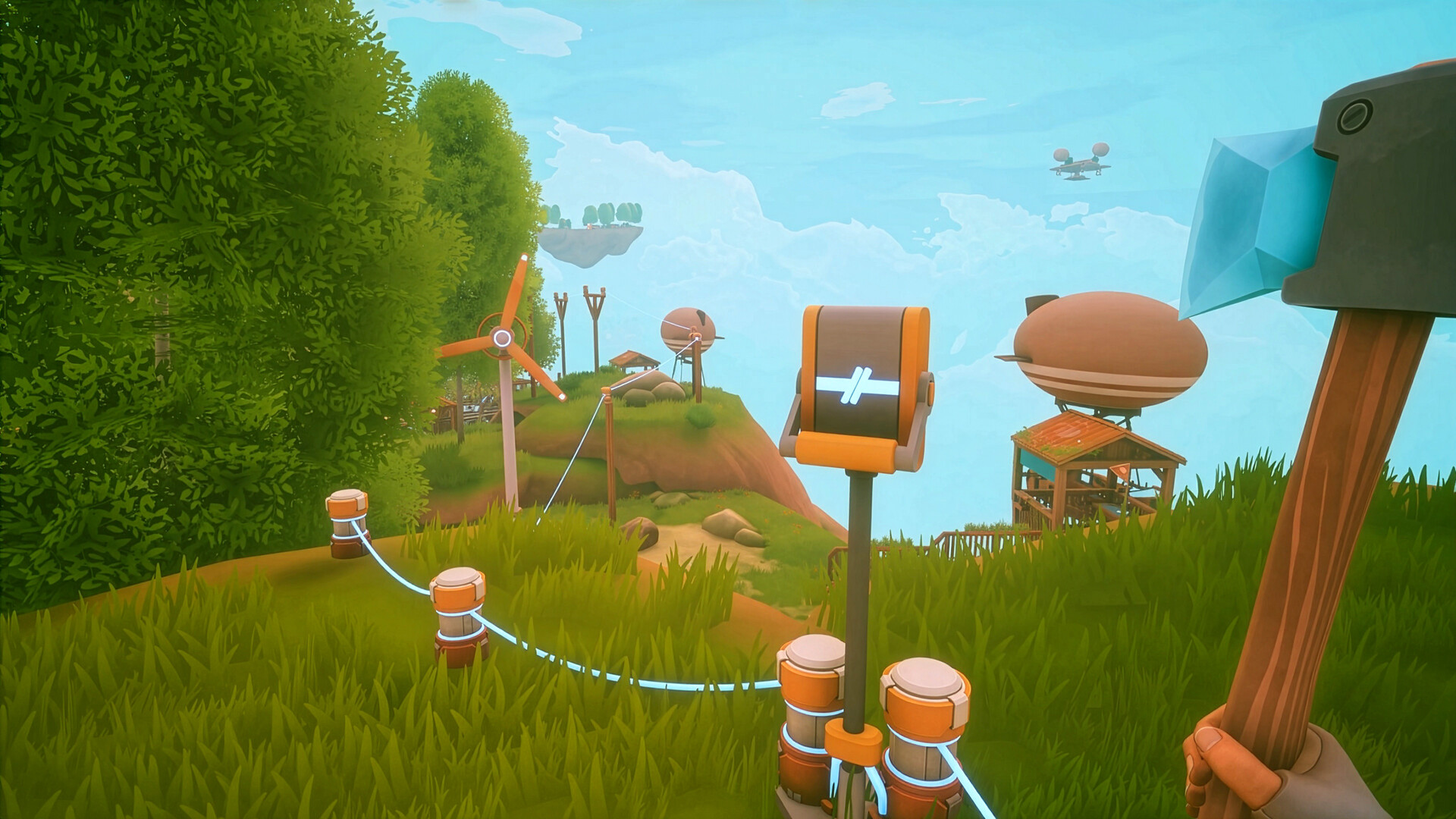
Then there are the airships. Each player can build and fly a personal airship to reach surrounding islands, scout new resources and ferry materials home. Cresting the clouds to discover a new floating landmass is the closest Solarpunk comes to a goosebumps moment, and the comparison players reach for most often is Aloft, with a dash of Raft’s drift-and-gather rhythm. Layered on top is automation: transport drones that you can set to haul resources between nodes, gradually freeing you from manual fetch-quests so you can focus on building and exploring. When the automation finally opens up, the game noticeably blossoms — several reviewers who pushed past ten hours reported the loop becoming “extremely satisfying.”
Coexistence, not exploitation
One of Solarpunk’s quietly lovely ideas is how it handles animals. There’s no factory-farming, no penning creatures up to harvest them; the design ethos is symbiosis. Treat a pig well and it’ll happily root around and dig up truffles for you; the helpful little tradebots that putter around your base became an instant community mascot. It’s a small thing, but it’s the kind of detail that gives the game its soul and sells the “solarpunk” fantasy of living with nature rather than strip-mining it. Players consistently flag these touches — the creatures, the gadgets, the gentle ecosystem — as the bits that made them smile, and they’re a big part of why so many reviews reach for words like “charming” and “wholesome.”
The catch: it can feel like an early-access game wearing a 1.0 badge
Here is where the player reviews diverge sharply from the trailers, and where this review has to be straight with you. For a game that spent four years cooking and shipped as a full release, Solarpunk arrives surprisingly thin. The recurring refrain across negative Steam reviews — and a fair number of positive ones too — is that it “plays like an early access title.” Players cite roughly 20 hours of meaningful content, bare-feeling islands, UI and inventory friction, and sporadic bugs (a few severe enough to cost progress). “Beautiful. Feels empty and slow,” reads one representative line. “Not enough content for a fully released game,” says another, bluntly.
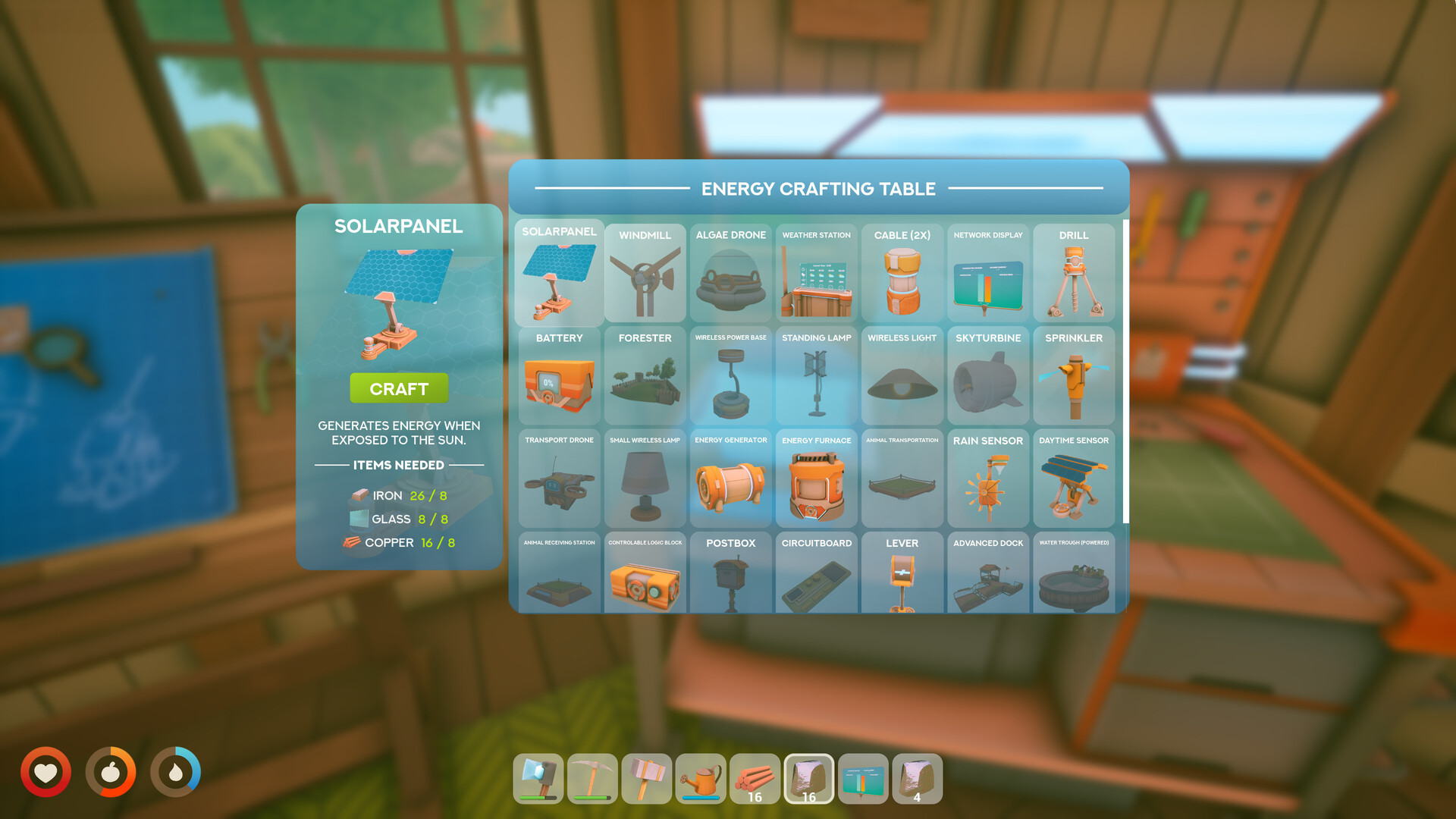
The pacing is the other lightning rod. The opening hours are slow — one player memorably described the early game as a “smack the floor and tree sim” — and progression leans heavily on time-gating. You’ll often find yourself waiting on crops to grow with no way to meaningfully accelerate them, and the math can sting: a recipe might call for ten watermelons when your plots only support growing three at a time. “Boy oh boy do I love watching cotton grow for 15 minutes,” one reviewer wrote, witheringly. There’s a fine line between relaxing and idle, and Solarpunk wobbles across it depending on your tolerance for downtime. To be fair, this is partly by design — the game openly asks you to slow down — but “take your time” and “there isn’t much to do” can be hard to tell apart in the moment.
There’s an interesting wrinkle in how that thinness is perceived, and it comes straight from the community: the demo. Solarpunk’s Steam Next Fest demo was widely beloved — some players sank as many as eleven hours into it — and opinions on the full game often hinge on it. The optimists say the finished release is “even better” than the demo and reward patience; the most cynical insist “the full version is exactly the same as the demo that came out a few months ago,” and feel the four-year wait didn’t add enough on top. Both camps are, in a sense, right: the demo really was that good, and the 1.0 really doesn’t expand on it as dramatically as the hype implied. The practical upshot is wonderful for you as a buyer — that demo is still the most reliable litmus test in gaming right now.
Co-op is the promise that comes up shortest
Four-player co-op was one of Solarpunk’s biggest selling points, and it’s the area where launch reality has disappointed the most. The headline frustration: airships can only be piloted by the player who built them — not “one at a time,” but the builder exclusively — which throws sand into the gears of cooperative exploration. “If the second player wants to fly, you need to build another whole airship,” one co-op group reported. Others found multiplayer simply “underwhelming” relative to the hype, and there’s no cross-play at launch, so mixed-platform friend groups are out of luck. The bones of a wonderful shared cozy sandbox are clearly here, but the connective tissue needs work.
Price, day-one DLC, and the trust question
No honest review of Solarpunk can skip the community’s anger over monetization. The game launched at roughly €22.99 with day-one DLC already on the store, and for a sizeable contingent of players that combination — a release many already felt was content-light, plus paid extras on the very first day — read as a bad-faith move. “It is crazy that these devs have DLC for this game on day one,” fumed one reviewer. The harshest takes questioned whether a four-year, heavily-wishlisted project should ship feeling this slim. It’s worth holding two things in tension here: Cyberwave is a genuinely tiny team, and a lot of the goodwill in the positive reviews is rooted in respect for two people building something this pretty — but goodwill and a “full price, full release” framing are increasingly hard to reconcile when the content runs out at twenty hours.
So who is Solarpunk actually for?
After sifting through both the professional previews and a few hundred player reviews, a clear picture emerges. Solarpunk is for the player who treats a survival game as a place to relax and create, who measures a good evening in how nice their island looks rather than how many bosses fell. For that person — and there are clearly many of them, given the steady stream of “masterpiece,” “most calming game I’ve played in years” and “send help, I’ve been playing for six hours straight” reviews — the rough edges are a footnote against a genuinely special vibe. Fans of Aloft, Stardew Valley’s gentler rhythms, or chilled-out base-builders should wishlist without hesitation.
It is not for the player who wants challenge, density or mechanical friction. If you need a survival game with teeth, or you bristle at progression that asks you to wait, or you’re buying primarily for a seamless four-player co-op campaign, Solarpunk in its launch state will frustrate you — and you might be happier waiting a few content patches, especially since it’s on Game Pass and the free demo remains the single best way to know within an hour whether you’ll bounce off it. The cautious-but-hopeful consensus from critics (“cozy, but needs more time to cook”) mirrors the player base almost exactly.
Verdict
Solarpunk is a beautiful, big-hearted, genuinely original take on cozy survival that absolutely nails its central fantasy of building a sustainable life among the clouds. Its construction system is a delight, its weather-driven energy puzzle is clever, and its no-combat philosophy is a real point of view rather than a missing feature. But it arrives thinner and rougher than four years and a million wishlists led people to expect — light on content, slow by design in ways that sometimes read as empty, hampered by underbaked co-op, and shadowed by a day-one monetization controversy that soured a lot of early goodwill. It’s a lovely game mid-bloom: easy to recommend to the right player today, and likely to be much easier to recommend to everyone a few updates from now.