RGG Studio doesn't usually do half-hour solo showcases. The team behind Yakuza and Like a Dragon typically lets its games slip out alongside fifteen others at a Tokyo Game Show or a Summer Game Fest sizzle reel. So when Xbox cleared a thirty-minute window on May 6, 2026 for a single-game broadcast titled Xbox Presents: A Special Look at Stranger Than Heaven, the framing alone said something. The studio that built one of the most beloved long-running franchises in modern gaming has spent the last six years quietly working on a successor that isn't a Yakuza game, isn't a Like a Dragon spin-off, and is somehow a prequel to both — and Xbox just gave it the kind of dedicated stage Microsoft normally reserves for Halo Infinite.
The half-hour broadcast finally pulled the curtain back on what RGG has been building. The short version is that Stranger Than Heaven is a fifty-year, five-city, action-adventure saga set across pre-war and post-war Japan. The longer version is that it might be the most ambitious thing the studio has ever attempted.
Five eras, five cities, fifty years
The structural conceit of Stranger Than Heaven is the part that's going to dominate the discourse. The game is a single fifty-year saga, told across five distinct time periods and five distinct Japanese cities — each one rebuilt as a fully explorable open environment, each one set in a different decade, each one inhabited by a slightly older version of the protagonist Makoto Daito.
Makoto's journey starts in Kokura, Fukuoka in 1915. Born to an American father and a Japanese mother, he stows away on a ship to Japan as a teenager, fleeing persecution he can't fully outrun. Kokura in 1915 is RGG's vision of a roaring industrial port town — coal smoke, harbor cranes, and a thriving criminal underground that takes Makoto in.
From there the saga steps forward in time. Kure, Hiroshima in 1929 is a shipbuilding port and a yakuza stronghold, the era that turns Makoto from a runaway into a fighter. Minami, Osaka in 1943 drops him into wartime entertainment districts as Japan slides toward catastrophe. Atami, Shizuoka in 1951 is the post-war seaside tourist town under American occupation, where Makoto's mixed heritage becomes both a curse and a passport. And the final era — Shinjuku, Tokyo in 1965 — is where the saga ends, and where the connection to RGG's other series finally crystallizes.
Because here's the wild part: the broadcast confirmed that Makoto Daito eventually becomes Makoto Tojo, the founder and first chairman of the Tojo Clan. Yes — that Tojo Clan. The criminal organization at the center of the entire Yakuza series. Stranger Than Heaven is, in the most literal sense, the origin story of the universe RGG Studio has been building for two decades. Kazuma Kiryu's grandfather's grandfather's mob boss, basically. The reveal lands as the kind of fan-service swing only a studio with this much accumulated lore could pull off, and it instantly recontextualizes every minute of the trailer that follows it.
The combat system is doing something genuinely new
RGG has always been one of the most reliable combat-system iterators in the business — the brawling in Yakuza 0, the turn-based JRPG pivot in Like a Dragon, the action-RPG hybrid in Infinite Wealth — but Stranger Than Heaven is the first time the studio is splitting the controller in half.
The headline mechanic is independent left-and-right control. Makoto's left side and right side are each tied to a separate shoulder button, and the system lets you charge attacks per-side, block with one arm while striking with the other, and pull off cinematic two-handed combinations by timing both inputs together. The broadcast showed Makoto blocking a knife strike with his left forearm while throwing a haymaker with his right, then seamlessly transitioning into a ground-pound that uses both arms together. It's Punch-Out!! by way of Yakuza, and it looks ridiculously good in motion.
The weapon variety is also stepping up. Makoto picks up knives, hammers, and katanas across the eras, with each weapon class behaving differently across the per-arm input system. A katana in 1929 has heft and gore that wouldn't fit Kokura's earlier era, and the system reads the weapon contextually rather than forcing the player to swap movesets manually.
The Showman mechanic is the part nobody saw coming
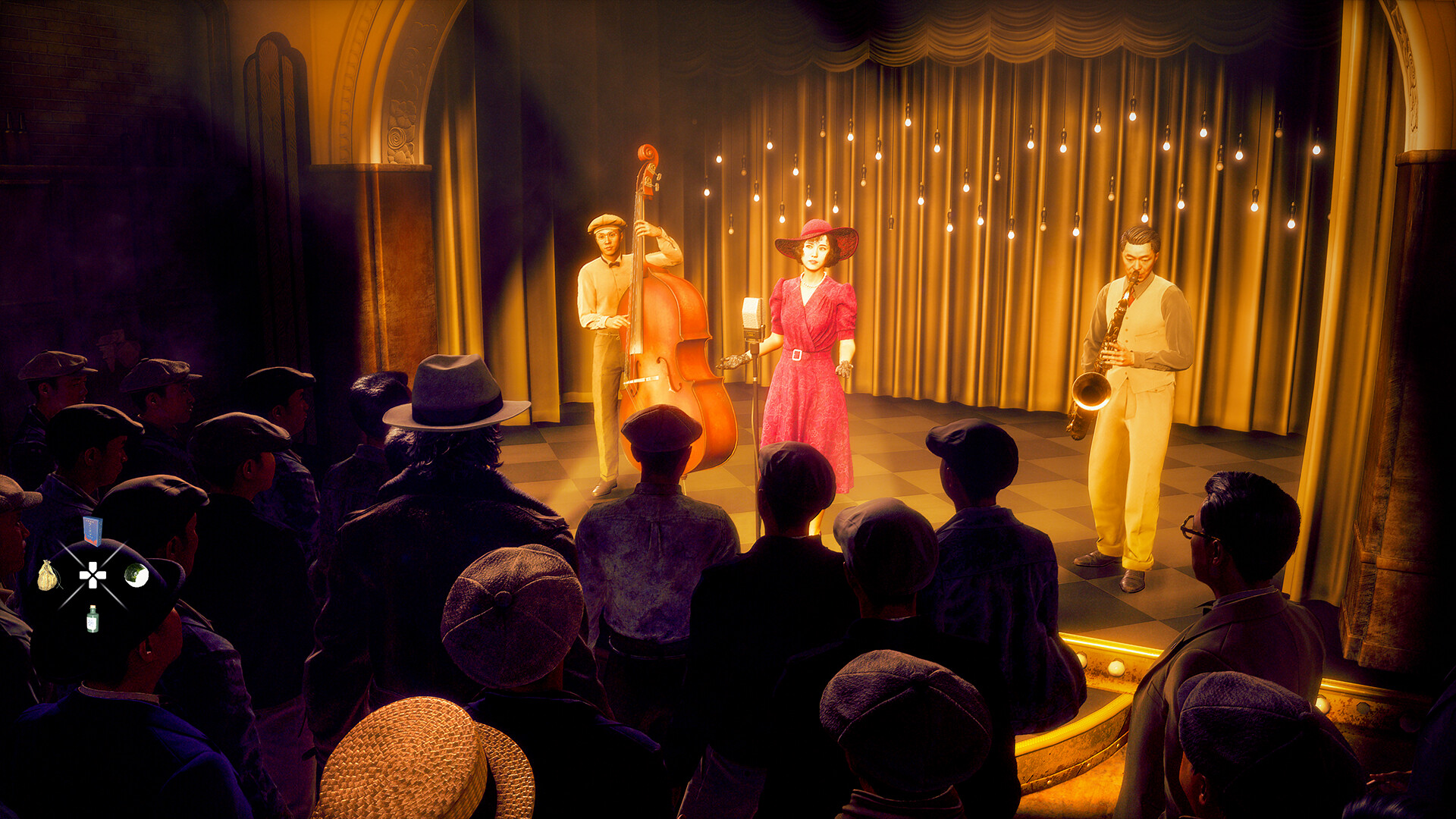
The biggest surprise from the broadcast wasn't the combat — it was the Showman system. Across the saga, Makoto isn't just a fighter. He's a producer, an impresario, a rags-to-riches entertainer who builds and runs theatrical productions across Japan's pre-war and post-war entertainment districts.
Mechanically, the Showman loop is a full-fat sub-game. Makoto walks the city collecting environmental sounds — train horns, market chatter, harbor bells — that he can compose into original music. He scouts performers from each era's local talent pool and recruits them into his troupe. He builds setlists, arranges stages, runs night-of show production, and watches the crowds react in real time. RGG has a long history of these elaborate sub-games (the cabaret club in Yakuza 0, the village management in Like a Dragon: Infinite Wealth) but Stranger Than Heaven's Showman system is structurally tied to the main story rather than sitting beside it as an optional distraction.
A genuinely wild cast list
The other thing the broadcast nailed was the cast reveal. Snoop Dogg plays Orpheus, an American smuggler operating across multiple eras of Makoto's story. Cordell Broadus — Snoop's real-life son — plays a separate character in the same orbit, in what is being framed as a multi-era role with a payoff in the 1965 finale. Tori Kelly plays Suzy, a singer Makoto recruits into his Atami-era show. J-Pop performer Satoshi Fujihara plays the in-game performer Takashi, and Japanese stars Yu Shirota, Dean Fujioka, Moeka Hoshi, Akio Otsuka, Tokuma Nishioka, and Bunta Sugawara round out a roster that genuinely spans Hollywood, J-Pop, and Japanese cinema's old guard. Ado — the masked Japanese vocalist whose One Piece theme work made her a global force — appears on the soundtrack.
The original theme song debuted at the end of the broadcast. It features Snoop Dogg, Satoshi Fujihara, Ado, and Tori Kelly on a single track, blending hip-hop, J-Pop, and traditional Japanese instrumentation in a way that should not work and absolutely does. It's the kind of cross-cultural collaboration that lives or dies on the song actually being good. It's good.
Game Pass day one, Steam and PS5 too
Release info: Stranger Than Heaven arrives Winter 2026 on Xbox Series X|S, Xbox on PC, and Xbox Cloud as an Xbox Play Anywhere title, and lands day one on Xbox Game Pass. The broadcast also confirmed simultaneous launches on Steam and PlayStation 5, which means the SEGA-published title isn't an Xbox console exclusive despite getting the Xbox Presents stage to itself.
That's a notable pivot from how RGG's Western releases have rolled out historically. Like a Dragon: Ishin! and the Infinite Wealth launch were day-one on Game Pass too, but the dedicated half-hour Xbox showcase here suggests Microsoft is paying for a deeper marketing partnership — the kind that gets a game on every Game Pass dashboard tile from now until launch and probably stays there for the entire Game Pass life of the title.
For the rest of us, the math is simple: the studio that built Yakuza 0 has spent six years making the prequel to its own twenty-year mythology, and it's launching day-one on the cheapest subscription on the market this winter. The discourse is going to be enormous. The wait is going to be brutal. And the trailer at the end of the broadcast — the one with all five protagonists from all five eras standing in a row, set to that Snoop Dogg/Ado theme song — is the kind of game-marketing moment that doesn't happen very often.
The Yakuza universe is officially fifty years older than it was yesterday. RGG Studio is back in unfamiliar territory, and it looks like they nailed it.