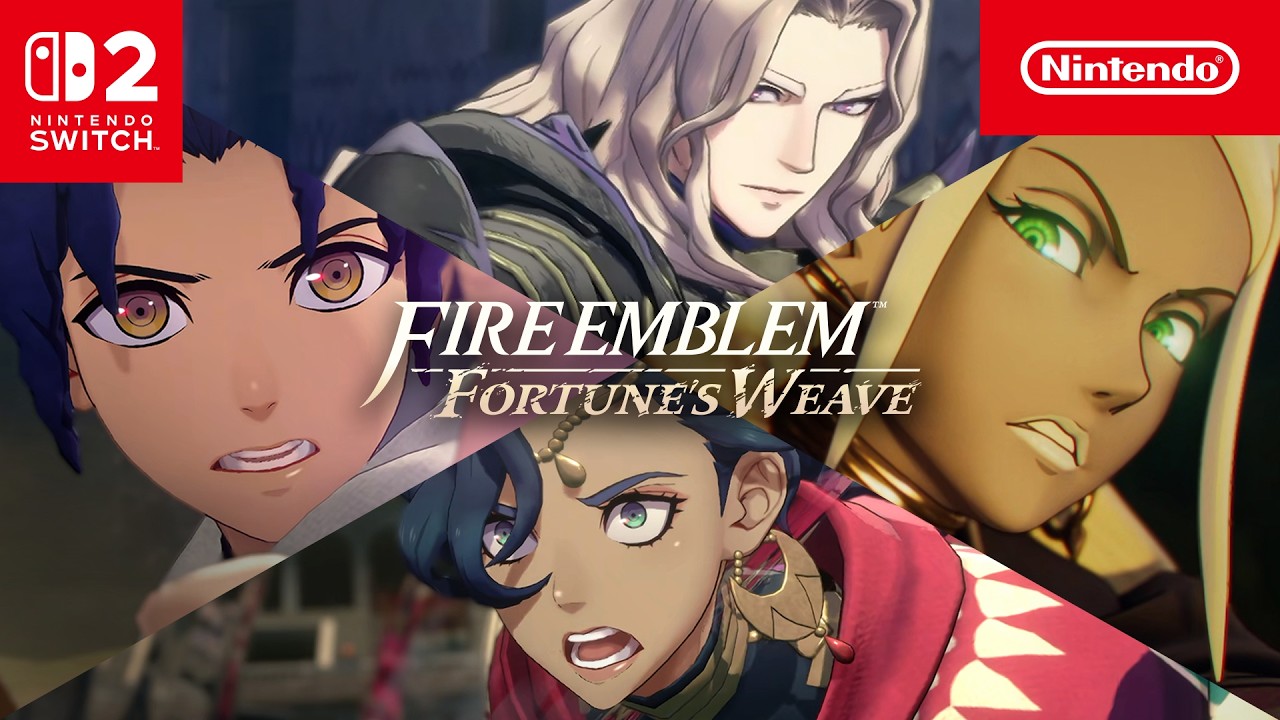
Fire Emblem has spent the last decade pulling in two directions at once. One half of the series wants to be a lean, punishing grid-tactics game about positioning and arithmetic. The other wants to be a sprawling social RPG where you learn everyone's tea order. Fire Emblem: Fortune's Weave is Intelligent Systems' attempt to stop apologising for that split and build a game that does both on purpose, with a time-travel frame holding the seams together. It arrived on Nintendo Switch 2 on 17 September 2026, and it is the eighteenth mainline entry in a series that has now outlived most of the design conventions it invented.
A sequel to the parts of Three Houses nobody visited
Fortune's Weave is set in the Dagdan Empire, a place Fódlan fans have heard about and never seen. Three Houses used Dagda as a rumour, an offscreen power somewhere across the water that other characters mentioned when they wanted to sound worldly. Director Toshiyuki Kusakihara has taken that blank space on the map and filled it in: a continent-spanning empire with three bordering suzerain nations — Saramis, Damascar and Brezarant — orbiting the capital city of Dagsion.
This is a smarter move than another direct sequel would have been. Dagda comes with no continuity baggage, no established noble houses to honour, and no fixed visual language, which frees the team to make it look like nothing else in the franchise. Kusakihara has described the setting as deliberately vibrant and diverse, drawing on ancient Mediterranean cultures, and that choice propagates all the way down through the art direction and the score. The result reads less like medieval Europe with dragons and more like a sun-bleached imperial capital that happens to have gods in it.
The hook is the Heroic Games: a six-month ceremonial combat tournament held in honour of the empire's founding god-emperor, where the victor is granted their heart's desire. That is a tidy piece of structural design. A tournament gives the game a calendar, a ranking, a reason for wildly different people to be in the same city at the same time, and an ending date — all the scaffolding that Three Houses had to build out of a school timetable, but without the homework.
Then the floor drops out. The demon god Balor is revived, and is destined to devastate the land five years after the Games conclude. Your protagonist, the customisable Eshmel — titled the Savior — has come back from those five years in the future with one job: keep four people alive.
Four Flame Lords and a stranger in white
Those four are the Flame Lords, and they are the closest thing Fortune's Weave has to the three house leaders. Cai is a young man trying to free his imprisoned father. Dietrich Gregor Lamine is a Fódlan noble who has crossed the sea looking for opponents worth the trouble. Theodora is a noble working to restore worship of a goddess. Leda is a dancer in disguise, hunting the people who killed her father.
What is notable is how ordinary those motivations are by Fire Emblem standards. There is no crown prince with a continental ideology here, no "which of these three teenagers should rule the world" trolley problem. Kusakihara's stated aim was to build characters who are sympathetic rather than emblematic, whose appeal accumulates over time instead of arriving fully formed in a reveal trailer. Family and the lives people choose for themselves are the load-bearing themes, and each of the four routes is meant to press on them differently.
Eshmel is the joint. Development on Fortune's Weave apparently began with the four leads and nothing connecting them, and the Savior was added midway through to give the disparate perspectives a single spine — the time-travel conceit is, in effect, a narrative repair that became the premise. Kusakihara had originally sketched eight protagonists before Nintendo's Genki Yokota talked him down to four. On the evidence of the finished structure, that was the right call; four routes with a shared, carried-over story is already an enormous amount of game, and eight would have been four ideas stretched over eight.

Two combat systems, deliberately
The biggest mechanical swing is that Fortune's Weave runs two different battle systems and does not treat either as the side dish.
"Matches" are Fire Emblem as you know it: grid maps, units placed before the fight, blue movement ranges and red threat ranges, the whole geometric conversation the series has been having with itself since 1990. Six weapon families are in play — swords, spears, axes, bows, gauntlets and magic — each with its own effects, which is a meaningful expansion over the tight triangle the series often defaults to. Weapon durability is back, but tied specifically to Combat Arts: throw your strongest techniques around and the weapon wears out faster. That is durability as a cost on flashiness rather than durability as a tax on existing, and it is a far better version of the idea.
"Clashes" are the other half, and they are a genuine departure: party-based dungeon encounters built around four-unit squads with combination attacks fuelled by a limited pool of Link Points. The reference points here are old-school Dragon Quest and Final Fantasy rather than anything in Fire Emblem's own history, and they exist to serve the dungeon crawling the team has reintroduced from Fire Emblem Echoes: Shadows of Valentia.
The risk is obvious. Two combat systems in one game usually means one good system and one that players tolerate between the good parts, and dungeon sections have historically been where Fire Emblem's pacing goes to die. The argument in Fortune's Weave's favour is that Clashes are not a reskin of Matches with the grid removed — different squad size, different resource, different tempo — so they at least have a distinct reason to exist. Whether four-unit Link Point squads hold up across a full route is the single largest open question about the game's design, and it is the kind of question only a long campaign answers.
Blaze Arts charge you for the highlight reel
Blaze Arts are the Flame Lords' signature moves, and they are the most interesting number in the game. They do the things you want a super move to do — large-scale attacks, dramatic repositioning — and they cost health to use. Overuse them and the lord's maximum health drops for the rest of that engagement, permanently, no take-backs within the battle.
This is a genuinely good piece of tactical design, because it makes the cinematic option a resource-management decision instead of a reward. Most games in this genre gate their spectacle behind a meter that fills up, which trains players to use the big move the instant it is available. Fortune's Weave instead asks whether this is the turn worth burning a permanent chunk of your lord's survivability on. It turns the flashiest button in the game into the one you hesitate over, and hesitation is what tactics games are made of.
It also interacts with the series' oldest tension in a productive way. Fire Emblem lords have always been simultaneously your best unit and your most fragile liability. Blaze Arts formalise that: the more heroically your lord fights, the closer they get to dying.
Fortuna's Blessing, and the rewind conversation
The rewind is here, in limited form, available during Matches — Fortuna's Blessing, granted by the goddess guiding Eshmel's mission. Fire Emblem has been shipping some version of this since Echoes, and the discourse around it is exhausted, so the more useful thing to note is how this one is framed: it is a divine favour inside the fiction, not a menu toggle, which at least puts the safety net in the same narrative world as the rest of the design.
What the publicly available material does not settle is how Fortune's Weave handles permadeath and difficulty tiers — the Classic and Casual split the series has used for years is not spelled out in the storefront listing or the feature breakdown. That is a real gap for the audience that cares most, and anyone deciding between this and their backlog on the strength of how brutal it is will want that confirmed before they buy.
Dagsion is a hub with a job
The capital is the game's home base: shops, recruitment, divine blessings, and inns where resting converts into experience. Outside it, a world map carries Skirmish encounters and additional vendors, which is the classic Fire Emblem grinding valve — welcome if you want it, ignorable if you do not.
Progression runs through a three-tiered class system, with new tiers unlocking exclusive abilities and passive effects, and advancement handled through Certification Exams taken in Dagsion. Tying class change to a physical place and a deliberate act rather than a level-up prompt is a small thing that does a lot of work: it makes the capital somewhere you plan trips to rather than somewhere you scroll past.
The neatest touch is that each Flame Lord bends exploration around their own personality. Cai tames mounts. Dietrich locates enemies. Theodora recruits soldiers. Leda squeezes extra rewards out of inns. These are not cosmetic route differences — they change what the overworld is for depending on whose story you are in, which is exactly the kind of variation that makes a four-route structure worth replaying instead of merely re-watching.
The one-save file, and why it is there
Here is the compromise that will annoy people, and it deserves to be stated plainly rather than buried: Fortune's Weave limits you to a single automatically saved file. The reason is structural — story carries over between routes, and the team hit technical constraints making that inter-route continuity work alongside multiple saves.
Understanding the reason does not make it painless. A single auto-save removes the oldest Fire Emblem ritual there is: the save-scum. It also means a household sharing one Switch 2 cannot keep two campaigns going, and it means no parking a finished route to revisit later. For a series whose community has always treated save files as a form of expression — the ironman run, the no-deaths run, the deliberately stupid run — this is the sharpest edge on the whole package, and it is a design consequence rather than an oversight, which makes it permanent.
Flamenco, and a deliberate break from Three Houses
Almost the entire senior creative team came over from Three Houses: Kusakihara directing, Masahiro Higuchi producing, Chinatsu Kurahana on character art, Takeru Kanazaki as sound director, with Nintendo's Genki Yokota and Kenta Nakanishi producing and supervising alongside. That continuity could easily have produced Three Houses again in a different hat. It has not, mostly because of the two disciplines most responsible for how a game feels before you understand it.
Kanazaki has built the score around flamenco, blended with what he has described as "strange-ancient" and "wonder-ancient" motifs, explicitly set against the sound of Three Houses. A guitar-forward, percussive, Mediterranean-inflected Fire Emblem soundtrack is not a small change; the series' musical identity has been choral-orchestral for so long that simply moving the instrumentation reorients everything.
Kurahana's character work faces the harder problem, and Eshmel is the proof of it — an entirely white costume that has to carry a personality, reportedly through many revision cycles. White is the worst colour to give a protagonist in a game full of armour and heraldry, because it refuses to say anything about faction or role. That it works at all, reading as otherworldly rather than unfinished, is the most technically impressive thing in the character lineup.
What Nintendo is charging, and what the box says
Fortune's Weave is $69.99 digitally, 27.5 GB installed, single-player only on one system, rated T by the ESRB for Fantasy Violence, Mild Language, Suggestive Themes and Use of Alcohol. It supports HDR output, linear PCM surround, cloud saves through Nintendo Switch Online, and Nintendo Account family-group lending, and it ships in nine language options including Japanese, Korean, both Chinese scripts and the major European languages. A Dagdan Collection special edition bundles an artbook and merchandise.
One line on the storefront deserves flagging: the listing carries an In-Game Purchases notice. On a single-player, seventy-dollar mainline Fire Emblem, that tells you an expansion pass or paid add-on content is part of the plan, and prospective buyers should factor it in rather than be surprised by it in three months. The series has a long history of substantial paid post-launch content, and nothing about a $69.99 price tag suggests that is changing.
Who this is actually for
If what you wanted was a tighter, meaner, map-focused Fire Emblem stripped of hub management, this is emphatically not that game — Fortune's Weave doubles down on the hub, the exploration, the calendar and the cast. If what you wanted was Three Houses' social simulation with a bigger cast, it is not quite that either; the tournament frame and the four-route structure point toward narrative momentum rather than a school year of routine.
What it is, on the evidence of its own design, is the most structurally ambitious Fire Emblem since Three Houses and possibly the most ambitious the series has attempted: four playable perspectives with carried-over story, two combat systems, three class tiers, a hub, a world map, dungeons, and a time-travel frame binding them. Ambition on that scale is also where the risk sits. Games with this many systems live or die on whether the connective tissue holds across sixty-plus hours, and the two places most likely to fray are the Clash dungeons and the pacing of four routes through one capital city.
The verdict
Fortune's Weave is the work of a team that looked at its own biggest success and declined to run it back. The setting is new, the score is a deliberate break, the tournament structure is a better engine than a school calendar, and Blaze Arts are the smartest single mechanic Intelligent Systems has added to this series in years — a spectacle button with teeth. The four-lord structure gives it genuine replay logic rather than route-shaped cosmetics.
Against that: a single auto-save file is a real and permanent restriction on how people have always played these games, the storefront's In-Game Purchases notice sits awkwardly on a $69.99 single-player release, and running two combat systems in parallel is a bet whose payoff depends entirely on whether the weaker one earns its screen time. Those are not small caveats. But they are the caveats of a game reaching well past what was safe, on hardware and in a series where safe would have sold perfectly well.
Score: 86 / 100.