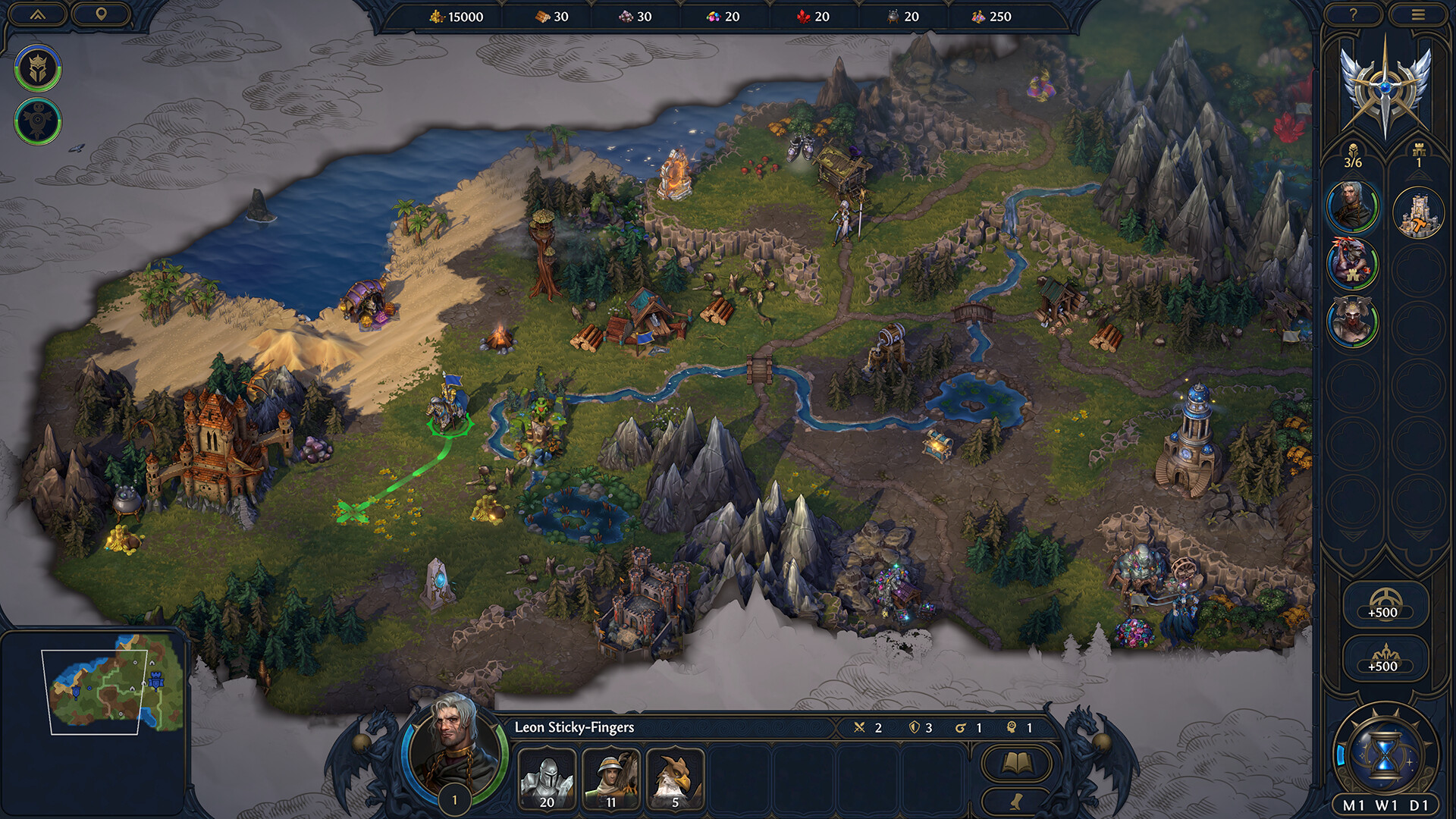
The hardest thing about reviewing Heroes of Might and Magic: Olden Era is admitting, before you've written a sentence, that the bar it has cleared is the lowest one in modern strategy gaming. "Make a Heroes game that doesn't suck" has been the franchise's stated objective for a quarter century, and four publishers, three engines, and a dozen attempts later, the answer always came back the same: not yet, not this one, maybe the next. So when Unfrozen — a small Cyprus-based studio whose biggest prior credit was the unrelated card-roguelike Iratus: Lord of the Dead — flipped Olden Era's Early Access switch on April 30 and the discourse simply vanished, replaced by 250,000 copies sold in 24 hours, something had genuinely shifted.
I have spent the last 96 hours playing this game with the kind of focus normally reserved for things like "finishing a thesis" or "keeping a houseplant alive," and I am here to tell you that the discourse vanished for a reason: Olden Era is the first new mainline-feel Heroes game in 27 years that does not ask you to grade it on a curve. It is not a remake of Heroes 3. It is not a love letter to Heroes 3. It is a sequel to Heroes 3 in the way that Crusader Kings 3 is a sequel to Crusader Kings 2 — built by people who internalized the original's design philosophy at the muscle level, decided which compromises were load-bearing and which were vestigial, and then quietly produced something that is mechanically richer and structurally more disciplined than the version of the formula your nostalgia is comparing it to.
That said, this is Early Access. There are seams. Two of the six factions are visibly not finished. The campaign content stops abruptly at what I'm pretty sure is the second act break. And the lore choices around the Hive faction are going to start a small civil war among diehards. We'll get to all of that. But the headline answer to "is this the Heroes game we have been waiting for since 1999" is yes, with footnotes — and the footnotes are smaller than you think.
The 27-Year Itch
For readers who don't carry the franchise's history in their bones: Heroes of Might and Magic 3, released in 1999 by New World Computing, is the canonical "good Heroes game." It is also, for a non-trivial number of strategy fans, the canonical good turn-based game, period — a tactical-strategic hybrid where you build castles, recruit fantasy armies on weekly cycles, lead heroes around an adventure map collecting resources and artifacts, and resolve battles on a hex grid where unit positioning, initiative order, and the spell book in your hero's pocket matter more than raw army size.
What followed Heroes 3 was a 25-year drought. Heroes 4 (2002) tried to put the heroes onto the battlefield as combatants and broke the army-building loop. Heroes 5 (2006), made by Russian studio Nival under Ubisoft, was a competent 3D rebuild that lacked some intangible feel. Heroes 6 (2011) and Heroes 7 (2015) were both rushed and buggy, the latter so visibly underbaked that Ubisoft quietly stepped back from the franchise for the better part of a decade. Might and Magic Heroes: Era of Chaos happened on mobile. Might and Magic Heroes Online happened on browsers. Heroes of Might and Magic 3 HD Edition happened, controversially, with the wrong version of the original game as its source. The franchise, as a creative force, was effectively dormant.
Olden Era is the first game in the series since 1999 that earns adjectives like "brilliant" and "triumphant return" without those adjectives being load-bearing on a sentimental subordinate clause. That alone is news. The 27-year gap is not just the running joke; it's the actual measurement of how long the genre has been waiting.
Why Unfrozen Was The Right Studio
The decision to hand the franchise to Unfrozen — over, presumably, multiple internal Ubisoft pitches and at least one rumored Frostpunk-developer-led prototype — looked strange when it was announced in 2023. Unfrozen had shipped exactly one game, Iratus: Lord of the Dead, a Darkest Dungeon-adjacent dark fantasy roguelike where you played the necromancer recruiting and managing a small undead party. It is a perfectly fine game. It is not a Heroes game. There was nothing in the studio's portfolio that suggested they could engineer a faction-balanced 4X with adventure-map exploration and a spellbook with 60 entries.
The strange decision was correct. Unfrozen's core team, it turns out, came out of the modding scene around Heroes 3 — the H3-HotA community, specifically, which spent two decades quietly producing the version of Heroes 3 that the original developers would have shipped if they'd had more time. The studio's design lead has talked, in pre-release press, about being able to recite Heroes 3's mana cost tables from memory. That kind of obsessive, archeological knowledge is exactly what a project like Olden Era needs at the helm. It's the difference between a sequel built by people who liked the original and a sequel built by people who have been mentally living in the original for fifteen years and can tell you exactly which of its quirks are virtues and which are bugs that nostalgia has hardened into virtues.
The Six Factions, Or: Yes, They Are Distinct
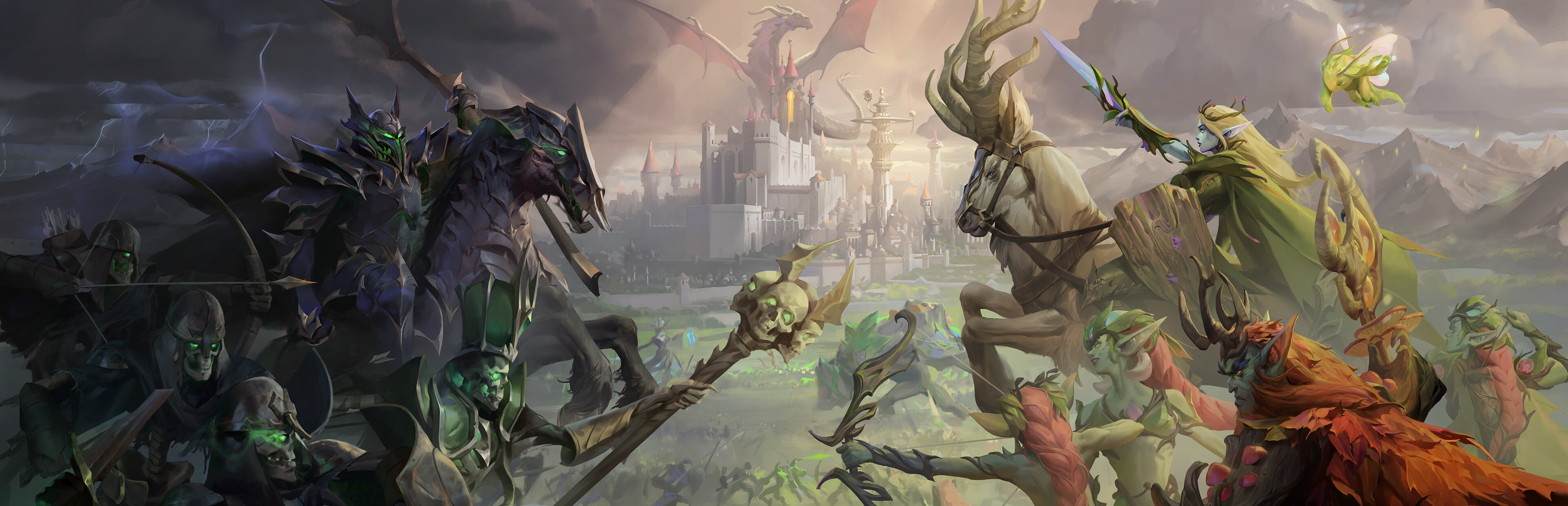
Olden Era ships, in Early Access, with six factions: Temple, Necropolis, Sylvan, Dungeon, Hive, and Schism. The traditional series complaint that factions feel mechanically interchangeable does not apply here. Each one teaches you a different game. I am going to spoil this slightly because the factional distinctness is, more than anything else, the proof that Unfrozen actually built a sequel rather than a reskin.
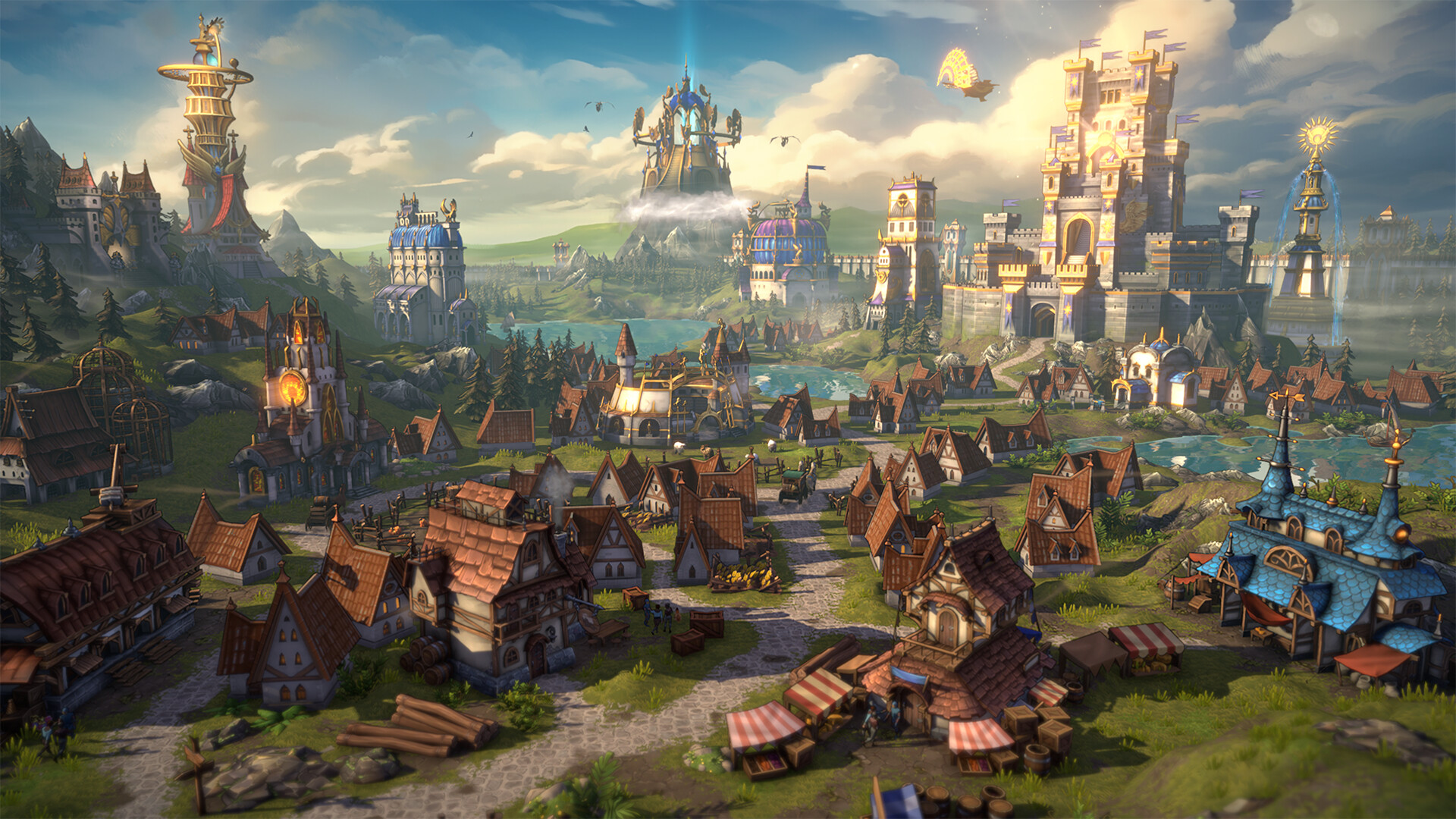
Temple is the human faction, and it plays as the closest thing to Heroes 3's Castle on the menu — knights and clerics, holy magic, predictable scaling, a core army that wants to brawl in a phalanx with priest support behind it. It's the recommended starter faction in-game, and rightly so: every system you'll need to learn is here, presented without exotic edge cases. The wrinkle Unfrozen has added is the Inquisition mechanic — a small economy where stack kills generate "faith" tokens you can spend on stack-wide buffs mid-battle. It changes how you weigh trades, and once it clicks, going back to a faction without it feels like one of your hands is tied.
Necropolis is the undead faction, returning from the series as the canonical "resurrect your dead enemies" archetype. The big change here is that Olden Era has retired the old "corpse counter at the bottom of the map" mechanic and replaced it with a cleaner per-stack resurrection budget. You no longer have to micromanage the morgue. The Necropolis economy now rewards aggressive expansion in a way Heroes 3's Necropolis never quite did, and the faction's late-game lich line scales aggressively into the kind of board-clearing you remember.
Sylvan is the elf-and-druid forest faction, and it is the one that surprised me most. On paper it's the standard "ranged + nimble + nature magic" archetype. In practice, Sylvan units share a faction-wide "Grove" ability that lets allied stacks adjacent to a Druid receive a regenerating shield each turn. Played at the high end, Sylvan armies move around the battlefield as a coordinated braid — Druids in the middle, ranged at the wings, melee out front — and the formation discipline that emerges is unique to this faction. It's the most explicitly tactical of the six.
Dungeon is the chaos-magic faction — beholders, minotaurs, hydras, the works. It's the most directly Heroes 3-coded of the six and exists primarily to give returning players something familiar. Dungeon's hero abilities lean into spell damage, the Dragon line at tier 7 is appropriately terrifying, and a well-played Dungeon hero in late game is, frankly, broken. Multiplayer balance patches will get to it.
Hive is the new "insectoid corruption" faction. It is mechanically interesting — a swarm-based playstyle where you trade individual unit power for stack quantity and a shared "Hive Mind" mechanic that auto-targets the weakest enemy stack — and it is also, I think, the biggest creative misstep in the game so far. We'll get to it.
Schism is the abyssal-cult faction, and it is the most ambitious of the six. The Schism's gimmick is that its stacks resurrect into different units when killed — a Cultist that dies might come back as an Acolyte, an Acolyte might come back as a Communicant, and so on, each transformation governed by a system Unfrozen calls Abyssal Communion. In practice, fighting a Schism army means watching the same enemy stack go through three or four mechanical identities over the course of one battle. It's brilliant in concept, the most tactically dense faction Olden Era ships, and currently, in EA, the most balance-broken of the six.
The factional asymmetry, more than anything, is the achievement. Olden Era did not ship six skins of the same faction. It shipped six honest-to-god different games glued together with shared adventure-map and economy primitives, and that took real design effort.
Combat Feels Like Heroes 3, Until It Doesn't
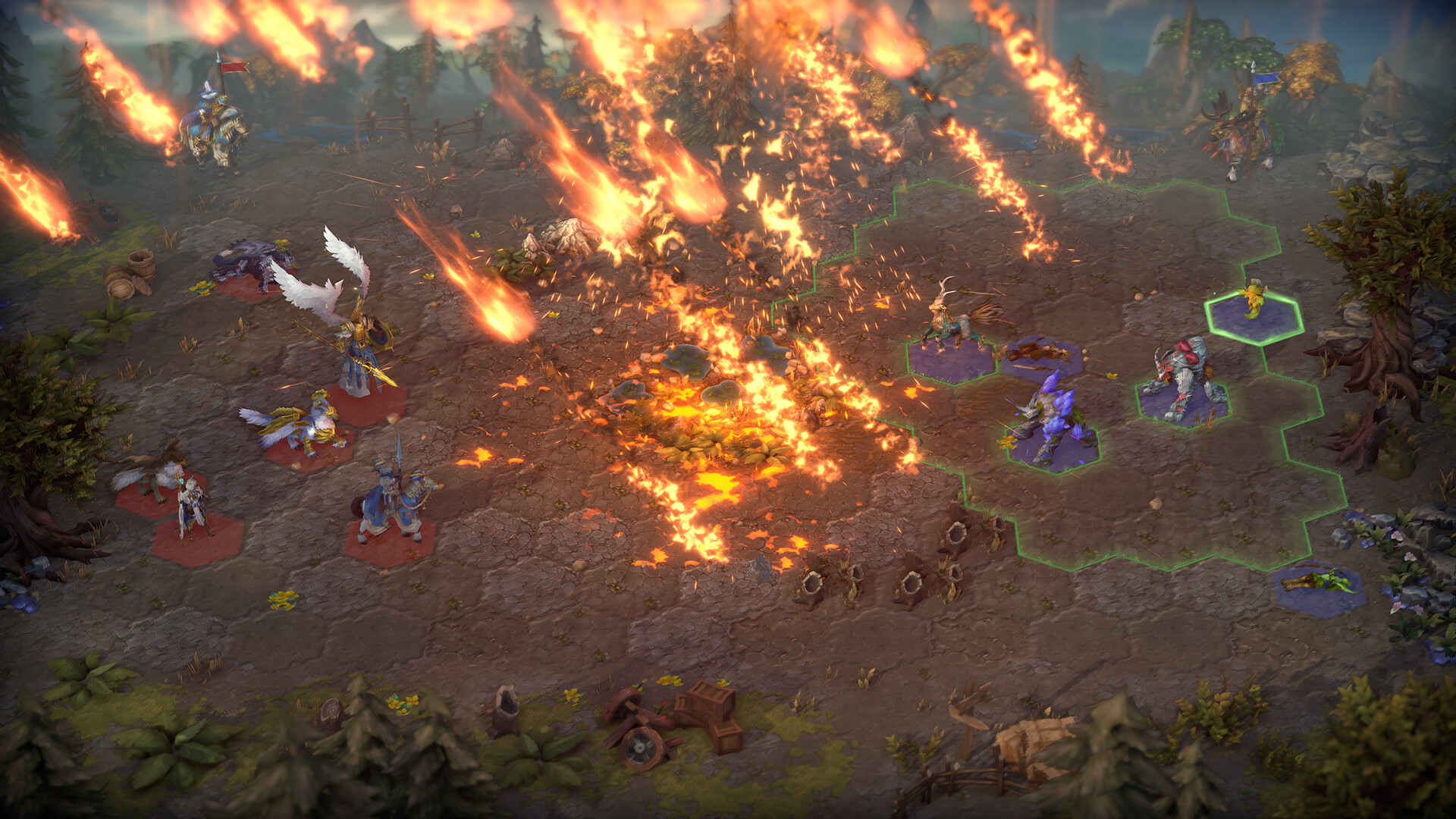
The combat system is where the most surface-level comparisons to Heroes 3 hold up. You enter a battle on a hex grid, you have an initiative order at the bottom of the screen, your hero stands on the side and casts spells, and stacks take turns based on speed and morale. If you played Heroes 3, your muscle memory transfers in about ninety seconds.
What's different is everything underneath. Olden Era has retired the old "speed determines turn order, attack is a binary, then you wait" model and replaced it with a more Final Fantasy Tactics-style continuous initiative timeline, where individual actions consume different amounts of "turn budget." A heavy hammer swing might cost more turn time than a quick stab, and faction-specific abilities — the Inquisition tokens, the Grove shield, the Abyssal Communion transformations — slot into the timeline as scheduled events you can plan around.
This sounds finicky. In practice, it makes battle decision-making richer without making it slower. A typical Heroes 3 battle was "will this stack reach that stack first." A typical Olden Era battle is "will this stack reach that stack first, and if I delay my hero's spell by one initiative tick, can I get it to land after my Druid's Grove proc but before the enemy's caster turn." That second question is where the actual strategy lives.
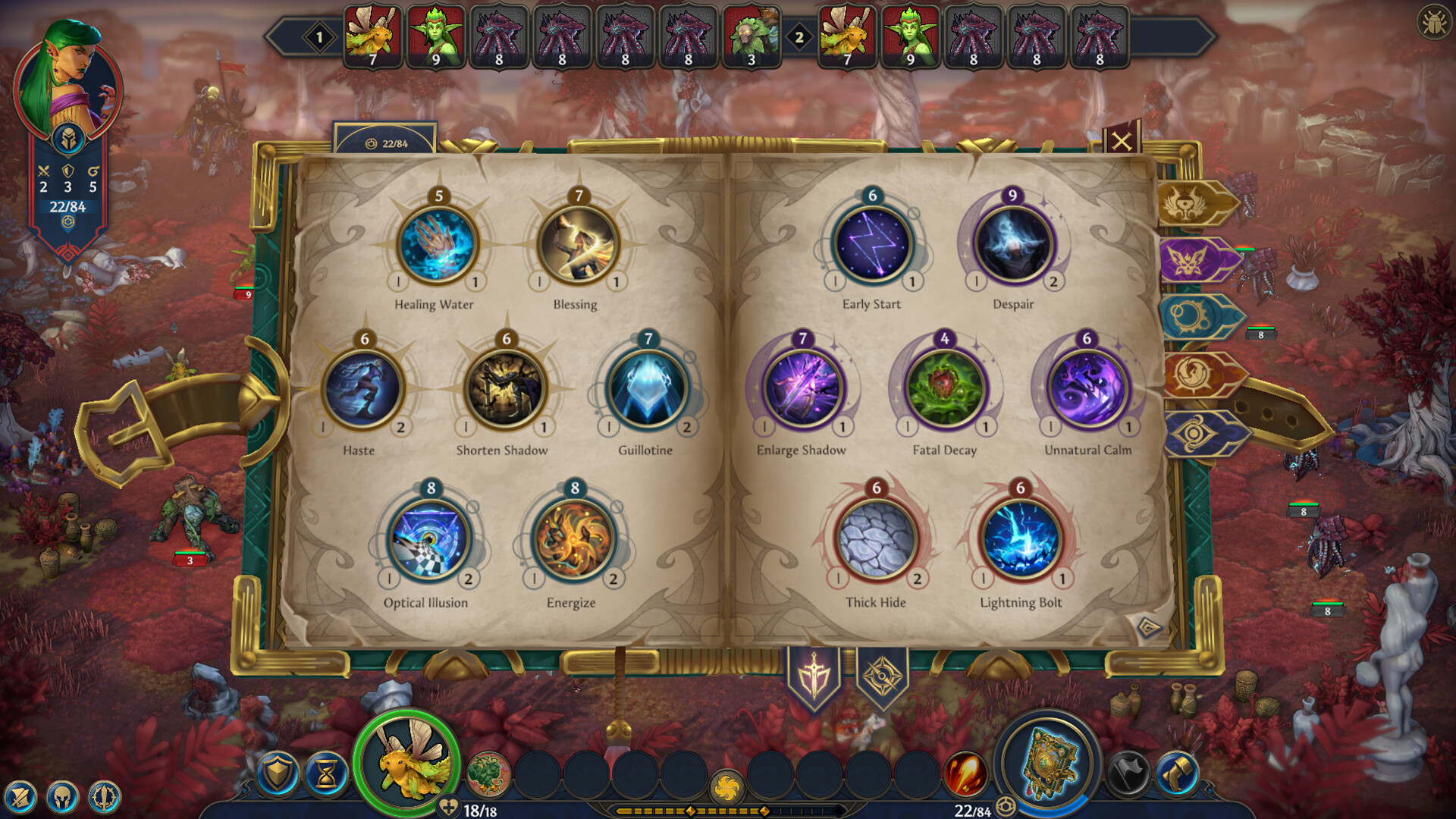
The spellbook has 64 spells in EA, organized into four schools (Earth, Air, Fire, Water plus a fifth Abyssal school for Schism). Casting cost is mana-based, mana regenerates slowly between battles, and your hero's school masteries gate which spells they can learn. The system is recognizable. The wrinkle, again, is that Olden Era allows in-battle spell combinations — chain Lightning Bolt and Drench in sequence and you do bonus damage, chain Slow and Berserk and the target attacks its own allies. There are roughly 40 documented combos, and at the high level of play, knowing them is the difference between winning and losing.
The Adventure Map Is Better Than It Has To Be
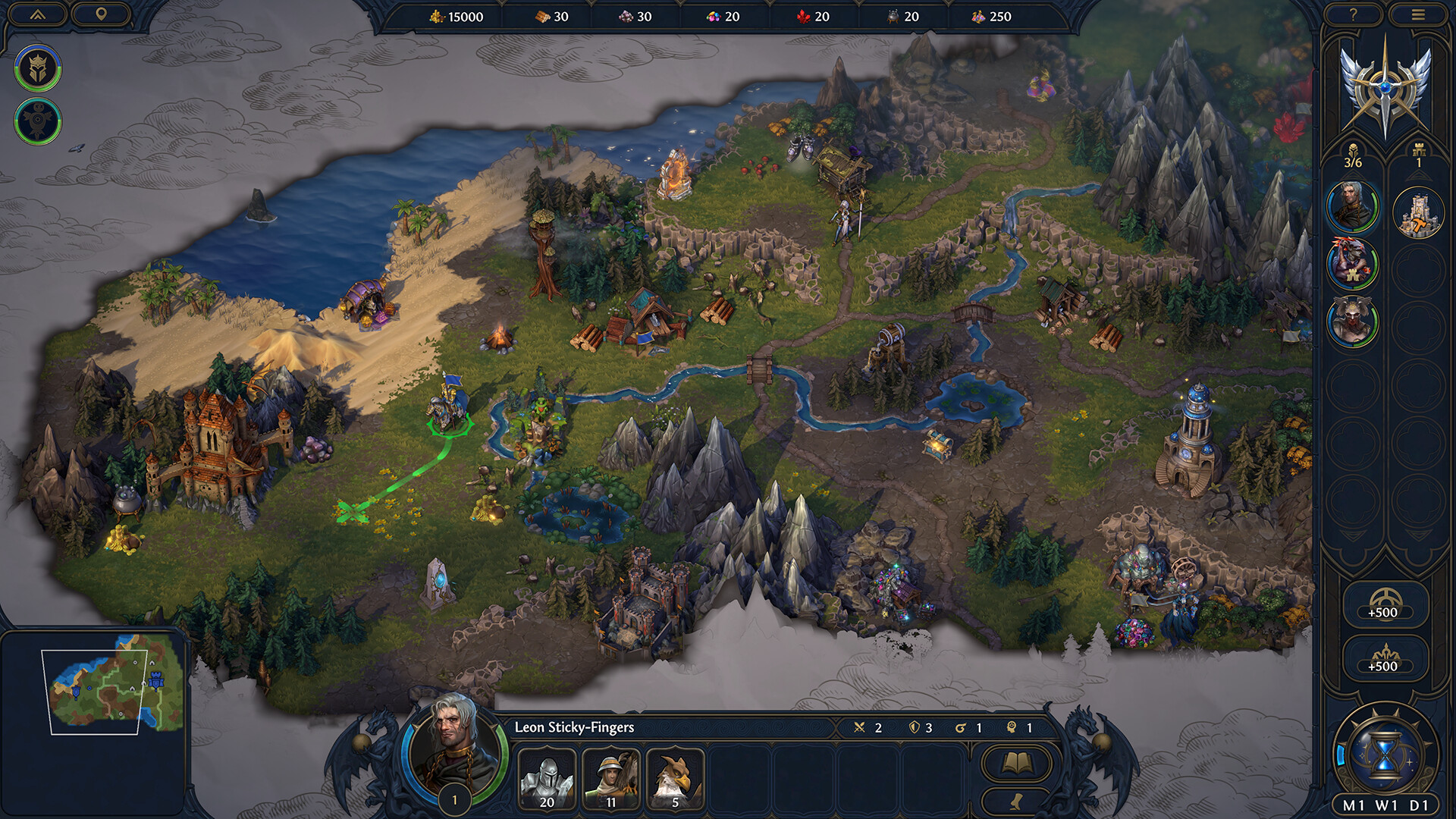
Outside of battles, Olden Era's adventure map is the system that shows the most clear-headed thinking from Unfrozen. The classic Heroes pattern — explore, collect, build, fight — is preserved completely. What's been added is what the studio is calling Faction Laws.
Faction Laws are a small civic-policy layer that runs in the background of every game. Each faction has access to a tree of opt-in policies — "Tax Caravans Heavily," "Conscript Peasants," "Negotiate With Orcish Tribes" — that produce ongoing modifiers, weekly rather than one-time. They cost a resource called Authority that you accumulate slowly. The policies stack, conflict, and have to be actively maintained.
What this does, structurally, is give the late-game adventure map something to do. Heroes 3's late game was famous for being "win the war or surrender," with most of the actual decisions happening in the first thirty turns. Olden Era's Faction Laws layer keeps the strategic decision space open all the way through to the final week, because the policies you've enacted in week eight are still affecting your week-twenty economy and your hero loadouts.
It's the kind of thing that, in twenty hours, you barely notice. In sixty hours, when you're playing your fourth campaign on Hard, it's the system that's quietly running the game you don't realize you're playing.
The Hive Problem
The Hive faction is the Achilles' heel of the launch. There are two separate problems, and they reinforce each other.
The mechanical problem first: Hive's tier-1 and tier-2 units (Spiders, Parasites, Worker Drones) are too weak to clear early-map neutral stacks without losses. This is fixable, and Unfrozen has already acknowledged it in the EA roadmap — a 1.0.1 patch in early May is reportedly buffing tier-1 Hive damage by 15% and tier-2 health by 10%. Combat balance in Early Access is supposed to be in flux. This is normal.
The lore problem is harder. The Hive replaces what, in classic Heroes lore, was the Inferno faction — interdimensional invading demons (the Kreegans) who served as the canonical evil-on-arrival enemy across multiple Heroes and Might & Magic games. Unfrozen has, for reasons that are partly cleaner-storytelling and partly partly licensing, swept all of that away and substituted insects. Mutated, sapient, hive-minded insects, but insects.
For lore-pilled diehards — and there are a lot of them in this community — that is a small tragedy. The Might and Magic universe has a long, weird, science-fantasy backbone (it's a setting where ancient "Ancients" left magic-coded technology behind, where dragons and starships coexist) and the Kreegan invasion was the canonical bridge between the two. Replacing them with bugs strips the world of its weirdest, most distinctive identity beat. Olden Era is, on its own terms, a more legible setting for new players. It is also, on franchise terms, less interesting than what came before.
I land on this fence: the Hive is mechanically fine and will be balanced by patch. The lore decision is going to age poorly. Diehards are right to be unhappy about it. New players will not notice and will not care.
Schism Is Brilliant And Also Currently Broken
Schism is the most ambitious thing in Olden Era and the faction I will probably play the most when balance lands. The transformation system — Cultists into Acolytes into Communicants into Abyssal Beings — produces battles that have a temporal arc you don't get anywhere else in turn-based strategy. You're not just resolving a tactical engagement; you're watching the enemy army evolve over the course of the engagement.
It is also currently, in Early Access, the most balance-fragile faction in the game. The Cultist tier (T1) is significantly weaker than the corresponding tier-1s of the other five factions, which means that Schism's first three weeks of the campaign are punishing in a way that feels less like "hard mode" and more like "the team forgot to tune the early game." The obvious question — why can't Schism kill its own units to trigger transformations? — currently has an unsatisfying answer: the Communion mechanic is set up so you can't self-sacrifice, which means the strongest theoretical play with the faction is locked off.
The 1.0.1 patch is reportedly addressing both. As of this writing (May 3, 2026), Schism is the faction I would tell people to wait two weeks before playing seriously.
Multiplayer Is In, And It Works
Olden Era ships with online multiplayer at launch — 1v1, 2v2, 3v3, and a free-for-all up to six players. The multiplayer client uses simultaneous-turn resolution (the so-called "Simultaneous Turns" mode pioneered by Heroes 3 HotA), which means in practice that 2v2 sessions can resolve in 90 minutes rather than the 4-hour endurance trials Heroes 3 multiplayer was known for.
Matchmaking is functional but bare. There's no ranked ladder yet, no ELO, no replays — those are on the roadmap for Q3 2026. Hot-seat multiplayer (couch play) is in. Cross-platform is not, because there is no other platform: this is a PC-exclusive release on Steam and PC Game Pass, and Microsoft has not committed to bringing it to console.
The map editor is in the launch build, which is the single biggest thing for the franchise's long-term health. Heroes 3's player-made map ecosystem is what kept the game alive for 25 years, and Olden Era has explicitly committed to Steam Workshop integration in a Q3 patch. If the modding community shows up — and I have no reason to think it won't — this game has a 20-year tail in front of it.
The Early Access Reality Check
What's missing, and you should know before you buy: the campaign content stops at what I'm calling, with some confidence, the second of an eventual five acts. The story currently follows the minotaur Gunnar's rise as the architect of the Hive corruption across Jadame, and the EA campaign cuts off at the end of his ascension to power, before the world-defending coalition campaigns kick in. Unfrozen has committed to monthly content drops through the end of 2026, with the full campaign landing alongside 1.0 in roughly Q1 2027.
Performance is good. On a Ryzen 5 5600X with an RTX 3070 at 1440p, the game holds 60 fps essentially everywhere, with rare drops in late-game battles where there are 200-plus units on the field. Steam Deck performance is reportedly stable at 30 fps with medium settings, though I haven't tested this personally. Load times are unremarkable.
Bugs are present but minor. I encountered three crash-to-desktop incidents over 96 hours of play, all of them in the campaign mode and all of them related to the same scripted event in the Necropolis chapter. Save corruption: zero across my time with it, though long Schism campaigns are where I would be most careful. Quicksave often.
Visuals, Music, And The Touch That Matters Most
The art direction is the soft spot people will argue about. Olden Era is rendered in a 2.5D style — hand-painted backgrounds, 2D sprite-style unit art with limited 3D rotation — that is deliberately, unmistakably channeling Heroes 3 rather than the 3D fully-animated approach of Heroes 5 through 7. It would be easy to call that style choice "safe" or "backwards-looking." I think it's the correct choice for this specific project. The franchise needed a sequel that did not feel like a foreign object, and the visual continuity with Heroes 3 makes it instantly legible to returning fans without sacrificing modern UI affordances.
The music is the unexpected highlight. Composer Yulia Spektor, who Unfrozen poached from the Russian games scene mid-production, has produced a 4-hour soundtrack that explicitly cites Paul Romero's iconic Heroes 3 score in the faction themes without being subordinate to it. The Necropolis main theme is the kind of melody you find yourself humming six hours after closing the game. It's worth the price of admission on its own.
Voice acting is solid across the board, with Unfrozen splurging on the campaign cast (the actors playing Gunnar and his lieutenants are recognizable from the Pillars of Eternity and Disco Elysium voice rosters). Hero portraits are unusually expressive, with subtle animation states that change based on hero condition. It's a small touch and it adds up.
The Verdict
Heroes of Might and Magic: Olden Era is, with the qualifications above, the best Heroes game since 1999. That sounds like damning with faint praise — the bar has been on the floor for 27 years — but it is, mechanically and structurally, also the most disciplined turn-based strategy launch of 2026 so far. The factional asymmetry is real. The combat system has more depth than any prior Heroes game. The Faction Laws layer is a meaningful contribution to the genre. The multiplayer works.
The Early Access framing is the asterisk. Two factions need balance work; the campaign is two acts short; Steam Workshop is on the roadmap rather than at launch. None of those are deal-breakers if you're the kind of person who enjoys getting in early on a strategy game and watching the patches roll in. If you want a 1.0 experience with all the boxes checked, wait until Q1 2027.
If you have ever in your life put more than 100 hours into a Heroes of Might and Magic game, buy this now. If you have not, but you are curious about whether the genre still has anything to teach 2026 strategy gaming: same answer. The Heroes franchise has been in the wilderness for 27 years. Unfrozen has gotten it home. 87/100.