For nearly twenty years, fans of the wizarding world waited for a video game that did the Hogwarts fantasy justice. The early 2000s gave us a steady stream of movie tie-ins — competent enough for their era, but built around adapting specific scenes from the films rather than building out the world itself. The 2010s gave us LEGO Harry Potter, Hogwarts Mystery on phones, and a long, painful silence. By the time Avalanche Software's Hogwarts Legacy was finally announced in 2020, the bar had quietly shifted from 'make a great Harry Potter game' to 'just please give us something we can actually live in.'
In February 2023, after multiple delays and a development cycle that visibly grew in scope, Hogwarts Legacy arrived and immediately became the bestselling game of the year. Three years later, with two major free updates, photo mode, performance improvements across the board, and a comfortable home in the Game Pass and PlayStation Plus rotations, it has settled into its place as the definitive wizarding world video game — flawed, occasionally repetitive, but absolutely overflowing with the kind of detail and atmosphere that only a team genuinely in love with the source material could deliver.
This review revisits Hogwarts Legacy in May 2026, three years and several updates after launch, on a current-gen PC with the Summer 2024 patch and the more recent quality-of-life improvements applied. The game is now also temporarily free on the Epic Games Store, which makes this the perfect moment to ask the question that has been chasing the title since launch: is Hogwarts Legacy actually as good as the hype, or did its cultural moment do most of the heavy lifting?
The short answer is yes. The longer answer is that Hogwarts Legacy is one of the most atmospherically rich open-world RPGs of the past decade, hampered by some predictable Ubisoft-checklist pitfalls and a third act that runs out of energy. It is, in other words, exactly the game most of us hoped it would be — a deeply satisfying tour through the wizarding world that occasionally forgets it's also supposed to be a game.
The Castle
You know how Hogwarts is going to look. Everyone does. The films defined it, the books described it, the theme parks recreated it. The challenge for any video game version of Hogwarts isn't accuracy — it's making the place feel alive in a way that books and films can only suggest.
Avalanche absolutely nails this. From the moment your character enters the Great Hall for the welcome feast, Hogwarts Legacy makes the case that its version of the school is the best one ever rendered in any medium, period. The Floo Flame fast-travel network is generous, but you'll still find yourself walking everywhere because the castle keeps revealing new corridors, hidden passages, and quirky little details. Portraits gossip about each other. House points are tallied on giant hourglasses in the entrance hall. The kitchens are below the Great Hall exactly where they should be. The Astronomy Tower has a working telescope. The Defence Against the Dark Arts classroom has the cursed teacher's office one floor up.
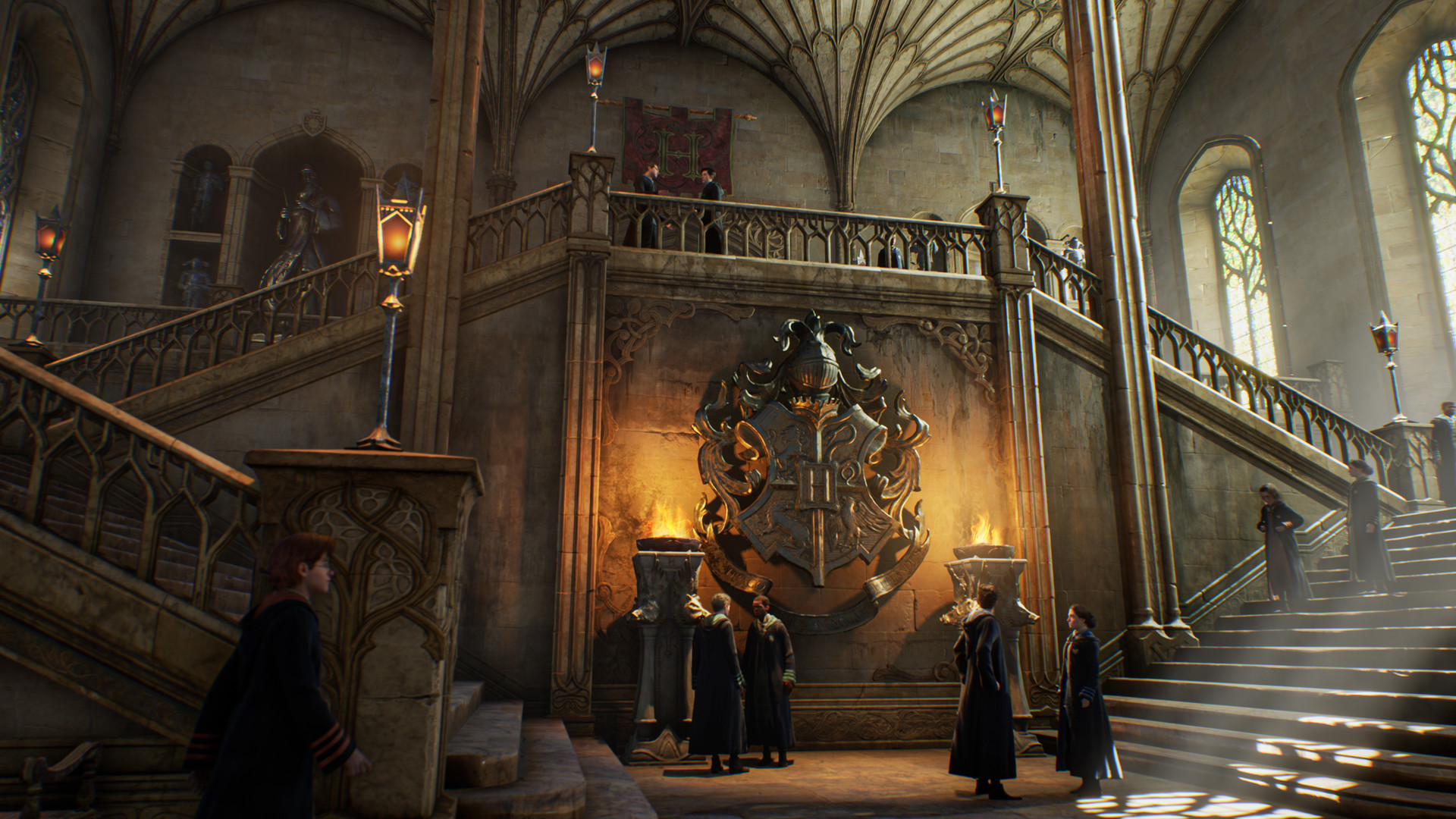
What sells it, more than the geographic accuracy, is how the castle reacts to time. Daytime Hogwarts is bright and bustling — students moving between classes, prefects on patrol, ghosts gliding through walls on their way to whatever ghosts do. Nighttime Hogwarts is something else entirely, a place of long shadows and quiet wonder where you can hear the gargoyles whispering and watch moonlight pour through the stained glass windows. The lighting model deserves special mention here: Hogwarts at sunset is the kind of thing that makes you stop playing the game just to look at it.
The Room of Requirement, which unlocks midway through the main story, becomes your home base and personal sandbox. You can decorate it with conjured furniture, raise magical creatures in attached vivariums, brew potions, grow plants, and craft gear. It's not the deepest base-building system ever made, but it's tied directly into the wizarding fantasy in a way that makes it satisfying. Watching your tame Niffler chase a Galleon around your custom-decorated chamber while a Phoenix preens itself in the rafters is the kind of moment Hogwarts Legacy specializes in.
Outside the castle, the Forbidden Forest, the lake with its giant squid, the Quidditch pitch (you can't actually play Quidditch, more on that later), the greenhouses, and Hogsmeade are all here and all detailed to the same standard. Hogsmeade in particular punches above its weight as a hub town, with quest-givers, shops for every category of gear, and a working economy that gives you a reason to dip back in regularly.
If you grew up wanting to wander Hogwarts, Hogwarts Legacy is the realization of that wish at a fidelity that genuinely surprised me. It's the kind of environmental storytelling that the rest of the open-world genre has been chasing for years.
Combat and the Spell System
The biggest surprise of Hogwarts Legacy is how good combat feels. Pre-release, most of us assumed that wizard combat would either be a glorified third-person shooter (point wand, fire spell, dodge) or a clunky attempt at melee with magic accents. What Avalanche actually built is something between Devil May Cry and Marvel's Spider-Man: a fast, fluid, combo-heavy spellcasting system that rewards creative loadout-building and aggressive play.
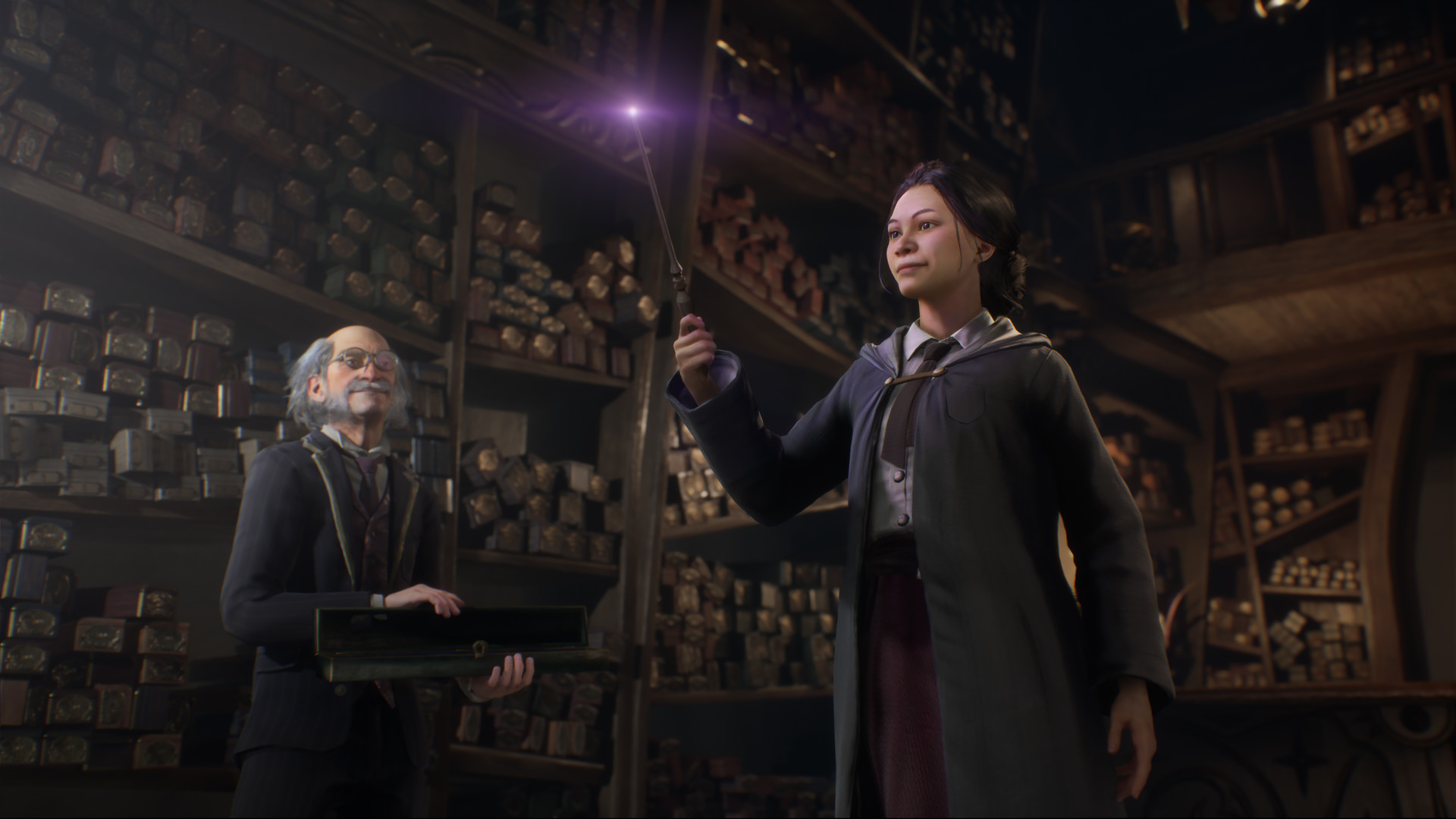
You have four spell slots that you swap between on the fly, mapped to the face buttons (or hotkeys on PC) plus a modifier. By the late game, you have access to 26 spells, divided into damage, control, force, and utility categories. The system clicks once you understand that spells are designed to chain together — Accio yanks an enemy toward you, Levioso lifts them off the ground, Incendio ignites them while suspended, Diffindo finishes the combo with a slashing kill. Different enemy types have different colored shields that require specific spell categories to break, which forces you to actually use your full toolkit rather than spamming one favorite.
The Unforgivables — Avada Kedavra, Crucio, and Imperio — are unlockable through a specific quest line, and using them has zero mechanical penalty. (There's no morality system to speak of, which is a notable design choice and one of the more controversial ones.) Once you have access to all three, fights become almost too easy if you lean on Avada Kedavra. But discovering that you can chain Imperio onto an enemy, turn them against their allies, then finish the fight with Avada Kedavra at full charge feels like the kind of dark wizard fantasy the game was clearly designed around.
The talents system is the weakest part of the combat package. You earn talent points by leveling up, and you spend them in a five-track tree (Spells, Dark Arts, Core, Stealth, Room of Requirement). Most talents are passive flat bonuses — slight damage increases, faster cooldowns, etc. — rather than transformative changes to how spells work. By the time you've unlocked everything by the late game, your combat power has crept up steadily without ever fundamentally changing. A New Game Plus mode added in 2024 helps with this by raising the talent cap and adding a few new options, but the underlying tree could have been deeper from the start.
Stealth gameplay exists, but it's surprisingly underbaked. There are stealth sections in some quests, and the Disillusionment Charm (an invisibility-style spell) lets you sneak past enemies, but the AI is rudimentary and you can usually just choose between sneaking through a section or kicking the door down. I almost always chose the latter once I had Petrificus Totalus as an instant-kill takedown — combat is too fun to skip.
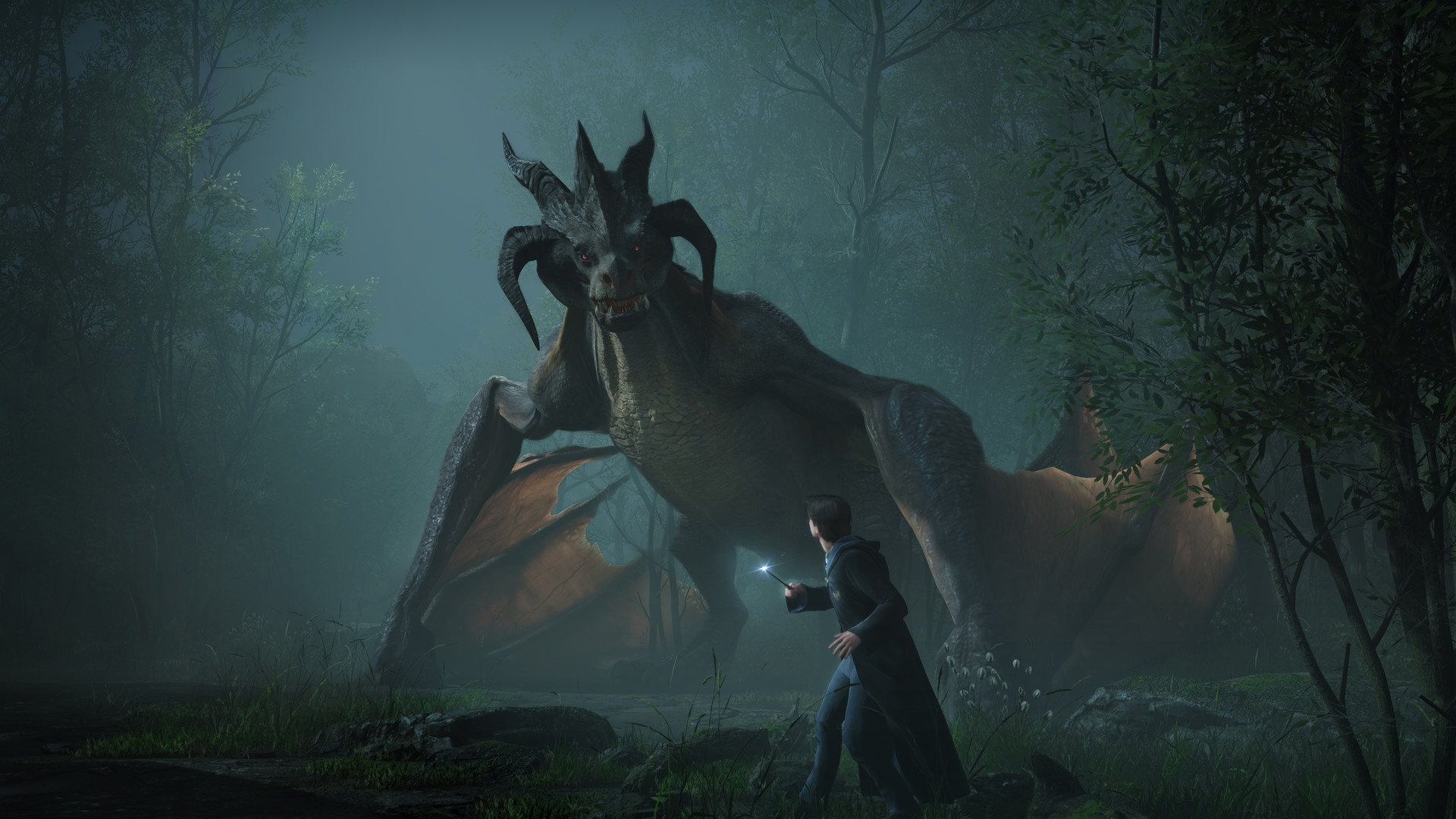
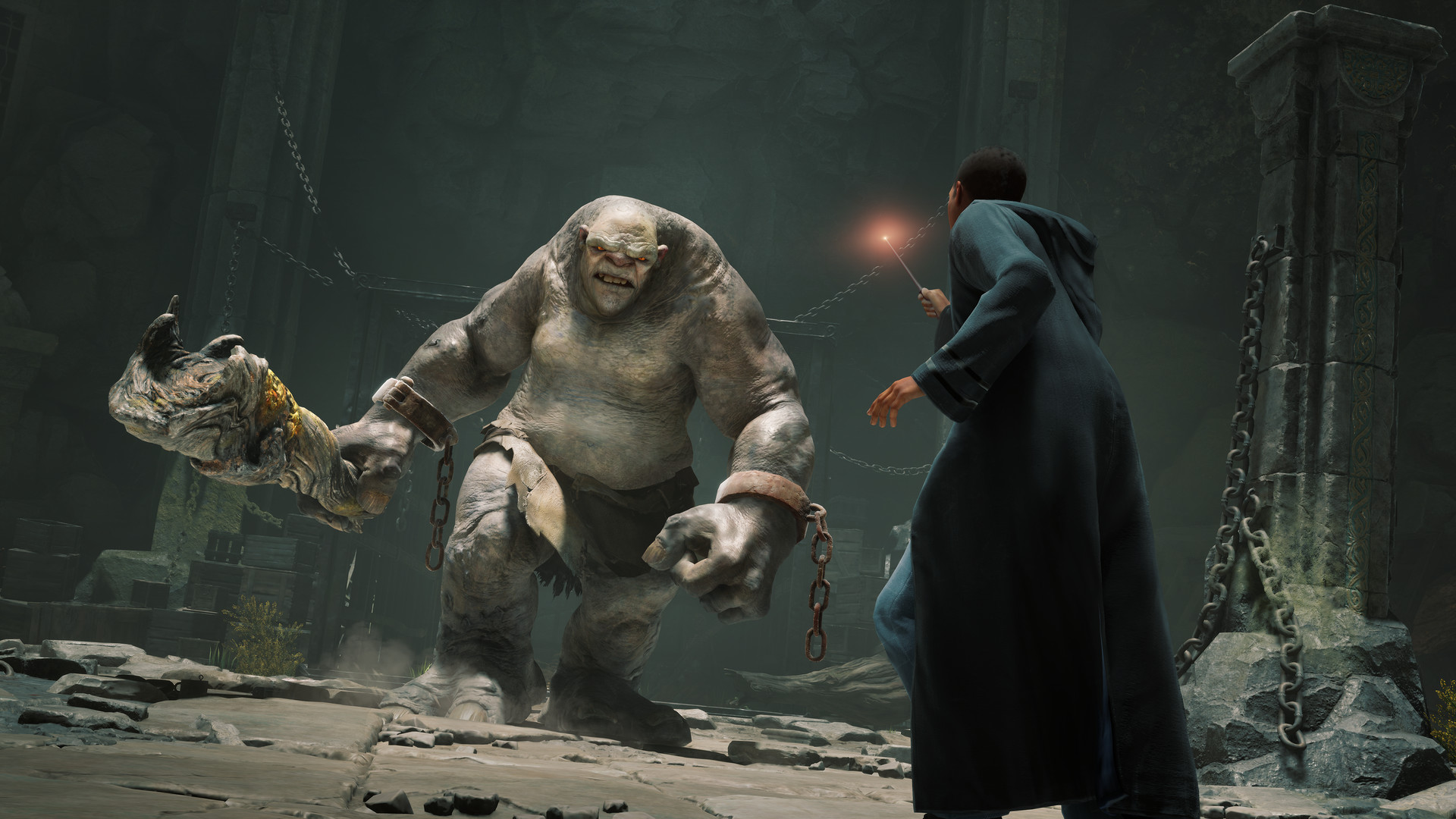
Boss fights are the standout combat experience. The Trolls, Dark Wizard duels, the Inferi swarms, and especially the dragon fights and the late-game Pensieve Guardian sequences all push you to use the full spell rotation under pressure. There's a specific multi-phase boss fight against a giant spider in a cavern below Hogsmeade that I would put in the top tier of action-RPG boss design, full stop.
Where combat falls short is in encounter variety in the open world. Bandit camps, dark wizard outposts, and Loyalist resistance battles all blur together after the first dozen or so. The system is deep enough to keep being fun, but the situations you're throwing it at start to feel familiar. This is a common open-world problem, but it's worth flagging.
Story and Characters
Hogwarts Legacy's story is the most uneven part of the experience. The premise is strong: you play a fifth-year transfer student who has been awakened to 'ancient magic' — a forgotten branch of magic tied to a long-dormant power that's now threatening to upend the wizarding world. Your character is investigated by Professor Fig, an academic specialist on the subject, while a goblin rebellion led by Ranrok and a parallel dark wizard plot led by Victor Rookwood threaten to coalesce into a much bigger crisis.
The setup gives the game permission to send you everywhere — into ancient ruins, through the Forbidden Forest, into goblin strongholds, across the Highlands to investigate strange magical phenomena. The first two acts move briskly. The dungeons (called Trials) tied to ancient magic are the structural backbone of the main story, and they're consistently the most memorable set pieces in the game — vault-like chambers full of magical puzzles, environmental storytelling, and genuinely impressive vistas that other open-world RPGs would build entire areas around.
The middle act stalls. After your fourth or fifth Trial, the rhythm becomes predictable: Fig sends you somewhere new, you investigate, you complete a Trial, you learn slightly more about the ancient magic, and the cycle repeats. The goblin rebellion plot deserves better treatment than it gets — Ranrok is a compelling antagonist on paper but the game keeps him at arm's length until very late, and the writing of goblin culture has been criticized for leaning on uncomfortable real-world tropes. Hogwarts Legacy doesn't really know what to say about goblin grievances, so it mostly says nothing, which is a missed opportunity given how much narrative real estate the rebellion takes up.
The companion characters carry the story when the main plot sags. You have three primary companions, each tied to a recurring quest line: Natsai Onai, a Gryffindor who acts as your moral compass; Poppy Sweeting, a Hufflepuff with a deep connection to magical creatures; and Sebastian Sallow, a Slytherin whose family situation drags him toward forbidden magic. Sebastian's questline in particular is one of the best things in the game — a multi-chapter character study about grief, family, and moral compromise that ends in genuinely difficult choices. It's the part of the story that points at what Hogwarts Legacy could have been if every thread were given the same care.
Side conversations and ambient writing are uniformly excellent. The students at Hogwarts have hopes and fears about their classes, the war in Europe, their families, and their futures. NPCs in Hogsmeade gossip about each other across multiple visits in ways that build out a sense of community. The professors are warm, distinct, and well-acted, with Professor Weasley (the deputy headmistress) and Professor Fig in particular getting strong performances.
The final act of the main story drops the ball badly. After a strong build-up, the climax leans on a series of combat encounters that don't escalate meaningfully and a final confrontation that feels rushed. There's a major late-game choice that's framed as deeply consequential but barely affects anything in the moment-to-moment world. The post-credits epilogue is a shrug. After thirty hours of careful world-building, the conclusion feels like a draft.
That said, even at its weakest, the writing maintains a consistent tone — earnest, character-driven, willing to engage with darker themes when needed. It's not Witcher-tier, but it's well above the bar set by most open-world RPGs of the same scale. And the moments when it's working — Sebastian's storyline, the Trials, the major story dungeons — are some of the best wizarding world fiction in any medium since the original books.
The Open World
Hogwarts Legacy's open world extends far beyond the castle. Outside the school grounds, the Highlands stretch in every direction with hamlets, ruins, dungeons, dark wizard camps, Merlin Trials (open-world puzzles), Treasure Vaults, Bandit Camps, and creature dens. The map is roughly the size of Skyrim's, which is to say substantial without being overwhelming.
The world is beautiful. Avalanche's environment art is consistently strong, with painterly lighting and excellent atmospheric effects. The fog rolling off the lake in the morning, the autumn leaves falling in the courtyards, the way snow accumulates on the roofs of Hogsmeade's buildings — small touches that add up to a genuinely lived-in feeling. Each region has its own visual identity, from the bright coastal villages of the south to the snowy mountain passes of the north.
The downside is structural. The world is built on the now-familiar Ubisoft template: an icon-cluttered map full of small activities, repeating objectives, and collectibles that you tick off as you travel. There are 91 Field Guide pages scattered across the map, 95 Demiguise statues, 32 Merlin Trials, 26 Treasure Vaults, dozens of bandit camps, and so on. Most of these reward minor cosmetics, gear with stat differences too small to matter, or completion percentage. By the 40-hour mark, the appeal of clearing the map starts to wear thin even if the activities themselves aren't bad.
Merlin Trials are the most successful of the open-world activities. Each one is a small environmental puzzle that asks you to use specific spells in clever combinations to solve a riddle and activate a Merlin glyph. They're varied, well-designed, and always solvable in 30 to 90 seconds, which makes them perfect 'while traveling' content. By comparison, the Treasure Vaults are almost all variations on the same dungeon template, and the Bandit Camps are pure combat encounters that don't add much to the world.
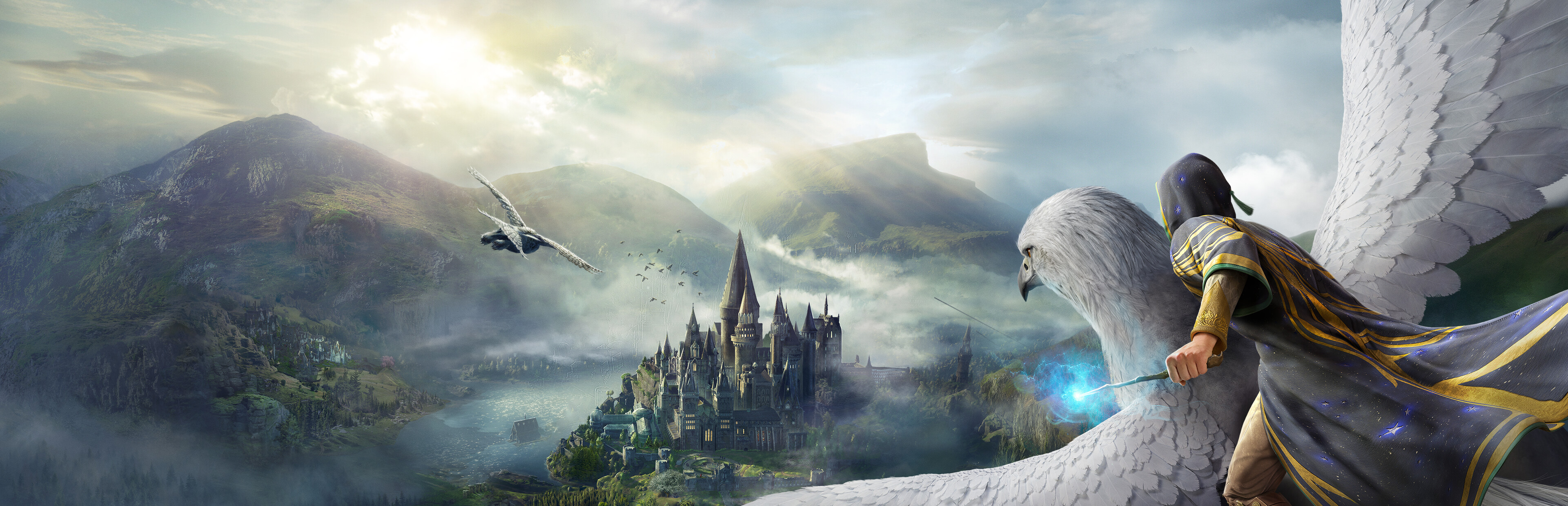
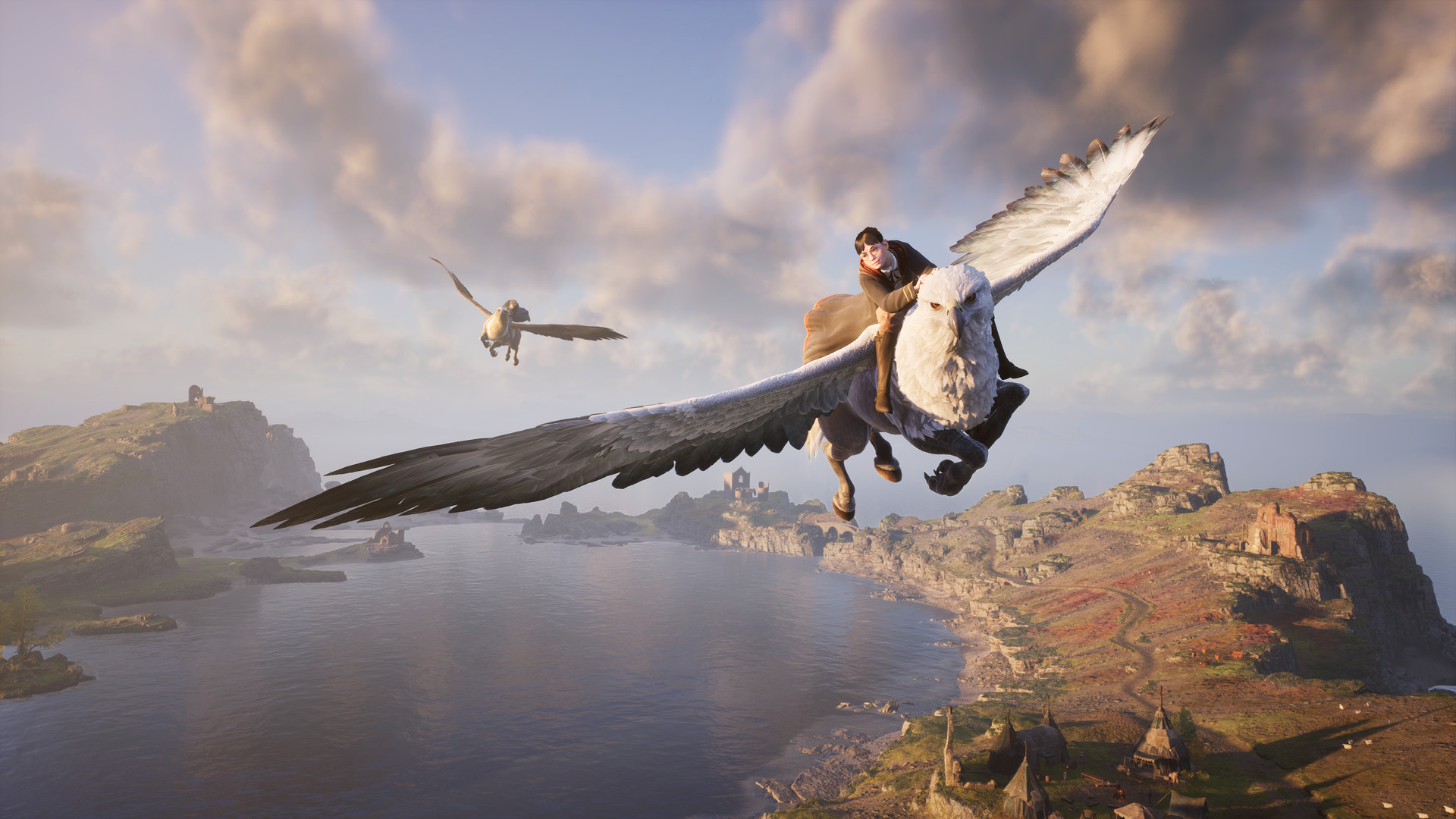
Mounts arrive surprisingly late, but once you have access to brooms and to flying creatures (Hippogriffs, Thestrals), open-world traversal becomes one of the highlights of the game. Flying low over the Highlands at dusk, with Hogwarts visible in the distance and the lights of Hogsmeade flickering below, is the kind of 'this is what we wanted from a Harry Potter game' moment the experience is built to deliver. Brooms can be customized and upgraded at a Hogsmeade shop, with subtle handling differences that mostly come down to top speed but feel meaningful.
The lack of Quidditch as a playable mini-game is the biggest open-world omission. The pitch is there. The brooms are there. The flying mechanics are good enough to support it. But you can never actually play Quidditch, which feels like an obvious DLC hook that the game never followed up on. Avalanche has been mum about it across three years, and at this point it seems unlikely to ever materialize.
Side content quality varies dramatically. Some side quests are throwaway fetch tasks. Others — the 'In the Shadow of the Estate' series, the 'Scrope's Last Hope' line, the various professor-specific assignments — are excellent multi-chapter stories with their own dungeons, characters, and rewards. The main hint is to read the quest titles and descriptions carefully: anything tied to a named professor or to one of your three main companions is going to be worth your time.
Spellcraft and Progression
Outside of combat, the spell system is the engine that makes the open world feel coherent. Spells like Accio (pull), Depulso (push), Lumos (light), Reparo (mend), and Wingardium Leviosa are not just combat tools — they're the keys to environmental puzzles, secret passages, and dungeon traversal scattered everywhere. Hogwarts has hundreds of these little interactions tucked into corners, and the satisfaction of stumbling into a dead-end corridor and realizing your newly learned spell is the answer never quite goes away.
Progression in spells is gated mostly through classes — story missions framed as Charms class with Professor Ronen, or Defence class with Professor Hecat, etc. These are short, punchy mini-tutorials that give you a new spell and a low-stakes practice scenario. They're well-paced as a delivery mechanism, even if the actual classroom experience is light: you're not really attending Hogwarts in any deep sense, you're attending Hogwarts as an excuse to learn new tools for the open world.
Beyond spells, the gear progression system is competent but not exciting. You collect armor pieces (which exist mostly as cosmetic items with stat differences), and you can apply Traits — equipment modifiers crafted from materials gathered around the world — to give pieces extra effects like 'increased damage to Beasts' or 'reduced cooldown on Diffindo.' Late-game theorycrafting is satisfying for a while, but the gear rolls and trait combinations don't have the depth of a dedicated loot RPG. By the endgame, most players will have settled on a build and stopped engaging with the system meaningfully.
Potions and plants form a parallel crafting system. You grow plants (Mandrakes, Venomous Tentacula, Chinese Chomping Cabbages) in your Room of Requirement or in greenhouses, and you brew potions (Wiggenweld, Edurus, Maxima, Invisibility, Focus) for combat support. Both systems are useful in fights against tougher enemies and in specific puzzles, but the auto-restocking shop in Hogsmeade means you'll mostly just buy what you need rather than maintaining a personal supply chain.
The Beast capture system, tied to the Field Guide and the Vivarium back at the Room of Requirement, is the most charming side activity. You hunt down nests of beasts (Mooncalves, Nifflers, Hippogriffs, Diricawls, Thestrals, Phoenixes, etc.), capture them with your trusty Nab-Sack, and release them into your private vivariums where you can brush them, feed them, and harvest materials from them for crafting. It's pure cozy-game territory and a welcome reprieve from the combat focus elsewhere.
Technical Performance
At launch in February 2023, Hogwarts Legacy had real performance issues, particularly on PC with traversal stutters and on the Switch where the port was widely considered subpar. Three years later, after multiple patches culminating in the Summer 2024 update and subsequent quality-of-life improvements, the game runs significantly better.
On a modern mid-range PC (RTX 4070, Ryzen 7 5800X, 32GB RAM, NVMe SSD) running at 1440p with Ultra settings and DLSS Quality, I had a steady 80-100 FPS through the open world and 60+ FPS in dense Hogwarts interiors. The traversal stutter from launch is mostly fixed; you'll occasionally get a brief hitch when streaming new areas, but it's the kind of thing you only notice if you're looking for it.
PS5 and Xbox Series X both support 60 FPS Performance modes and 30 FPS Quality modes. The Performance mode is the way to play — the visual difference between modes is small, and combat fluidity benefits enormously from the higher framerate. Series S is locked to 30 FPS.
Ray tracing on PC and consoles improves reflections (especially in puddles and the lake) and indirect lighting in the castle. It's a noticeable visual upgrade but it tanks frame rates substantially without DLSS or FSR support, which were both added in patches.
The Switch version remains the weakest. Even with Switch 2 backwards compatibility improvements, the original Switch port has obvious resolution and framerate compromises. If Switch is your only option, the game is still playable, but every other platform is a better experience.
The 2024 Summer Update added photo mode (which is great), broom and gear customization improvements, accessibility features including a colorblind mode and full button remapping, and a new Boggart questline. The mode-toggle for performance vs. quality was rebalanced. Subsequent patches added a New Game Plus mode that raises the level cap, gives you access to all gear immediately, and adds modest new endgame challenges. Cumulatively, these updates have transformed the launch experience into something noticeably more polished.
What's Aged Well, What Hasn't
Three years on, the things that hold up about Hogwarts Legacy are exactly what you'd hope: the atmosphere, the castle, the spell system, the standout side content, and the sheer joy of existing in the wizarding world. Returning players in 2026 will find a game that's been carefully tended and that holds up against the open-world RPGs released since.
The things that haven't aged as well are also predictable. The Ubisoft-checklist open-world structure feels increasingly dated as the genre has moved toward more curated, less icon-heavy designs (see Tears of the Kingdom, Death Stranding 2, Indiana Jones and the Great Circle). The talents tree's flatness is more obvious now compared to the deeper systems in games like Avowed or Final Fantasy XVI. The lack of Quidditch and the absence of meaningful house-specific differences — your Hogwarts house is essentially cosmetic — are missing features that the community is still asking about three years later.
The cultural conversation around the game has also evolved. The controversy around J.K. Rowling's politics and the resulting boycott calls were inescapable at launch and remain a real factor for many players. The game itself includes content (the goblin rebellion plot) that leans on tropes many players will find uncomfortable. None of this is new, but it's worth acknowledging that for some readers, the question of whether to buy or play the game is more complicated than just 'is it good.' If you're approaching this purely as a game, it absolutely holds up. If you're navigating the surrounding context, that's a personal call that the review cannot make for you.
Verdict
Hogwarts Legacy is the wizarding world game that two decades of fans had given up hoping for. It's a sprawling, atmospheric, deeply detailed open-world RPG that finally treats Hogwarts and its surroundings as a place worth living in rather than a backdrop for licensed adventure mechanics. The combat is genuinely good. The castle is unforgettable. The companion stories — Sebastian's especially — are some of the best character writing in any RPG of recent memory.
It's also a game with real flaws. The story stalls in the middle and rushes at the end. The open-world structure leans too heavily on tired checklist design. The progression systems don't deepen the way you'd want them to in a 60-hour RPG. The lack of Quidditch and meaningful house differences are still the biggest missed opportunities of the package.
But the things Hogwarts Legacy gets right are the things you can't manufacture: a sense of place, a sense of wonder, and a careful, loving recreation of a world that millions of players grew up dreaming about. Walking the corridors of Hogwarts at twilight, brewing a potion in a candlelit alcove, soaring over the Highlands on a broom while the sun sets over the castle — these are the experiences the game was designed to deliver, and it delivers them with authority.
Three years and several updates later, Hogwarts Legacy is the most polished it's ever been, the most accessible (currently free on Epic Games Store as of this writing), and the most clearly the definitive wizarding world video game. If you've been waiting, the wait is over. If you played it at launch and bounced off, the patches have meaningfully improved the experience. And if you've never been a Harry Potter fan, the open-world RPG underneath the license is good enough to stand on its own merits.
It's not a perfect game. It might not even be a great one if you stripped away the wizarding world wrapping. But within the world it inhabits, Hogwarts Legacy is essential — the rare licensed game that justifies its license and then keeps going.