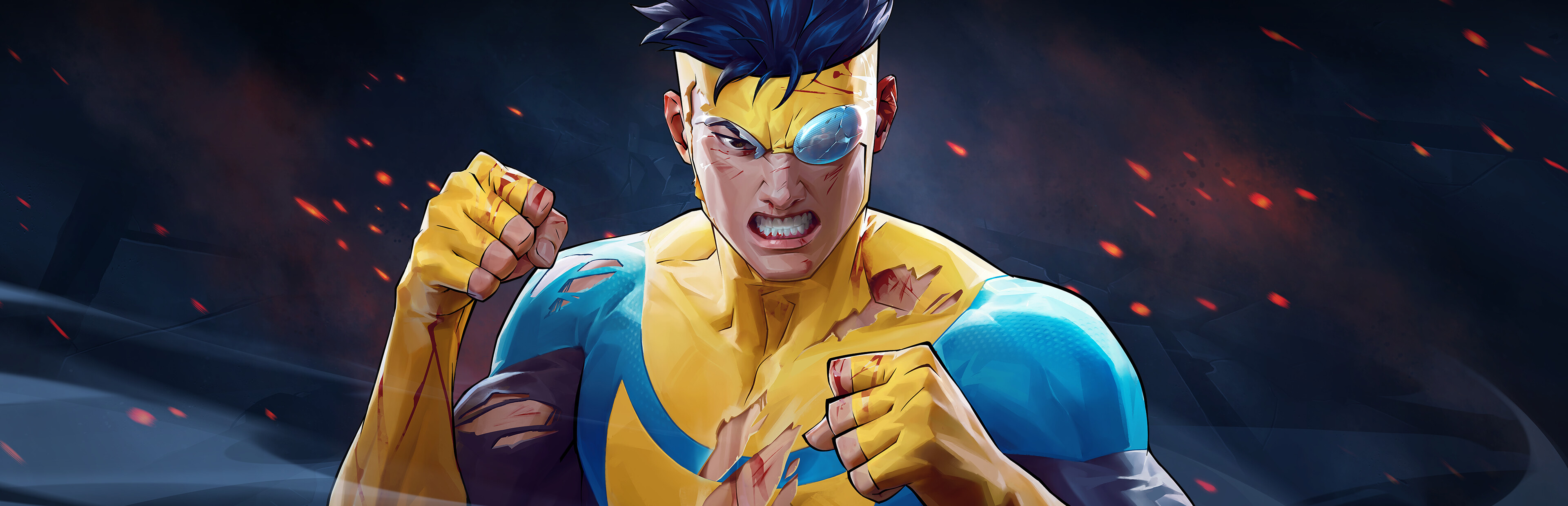
There's a particular kind of fighting game that comes out roughly once a console generation and immediately divides the audience into two camps: the people who get exactly what it is, and the people who wanted it to be something else. Invincible VS, the brand-new 3v3 tag fighter from a Los Angeles studio called Quarter Up, is one of those games. After two weeks of playing it across PS5, Xbox Series X, and Steam, I'm fairly certain that almost every disagreement people are going to have about it boils down to which of those two camps they're standing in.
If you went in expecting a comprehensive single-player package — a sprawling story mode rivaling NetherRealm's, dozens of unlockable extras, the kind of meaty content stack that justifies a $50 fighting game in 2026 — you are going to leave disappointed, and you have every right to feel that way. The story mode is short, the offline modes are thin, and there are entire categories of expected content (a robust mission ladder, a deep tutorial, a real character bio collection) that simply aren't there.
If, on the other hand, you came in expecting a focused, mechanically dense, deeply-systems-driven tag fighter that treats Robert Kirkman's gleefully gory superhero universe as an aesthetic skin over the kind of FGC-pleasing combat engine the genre hasn't seen since Dragon Ball FighterZ, you are going to be very, very happy. Because that's the game Quarter Up has actually built. And once you understand that's what it is, it becomes much easier to see why the people loving it are loving it harder than almost anyone has loved a licensed fighter in years.
Who is Quarter Up, and why does that matter?
It matters more than you'd think. Quarter Up is the in-house development arm of Skybound Games — Robert Kirkman's media company, the publisher behind The Walking Dead and the producer of the Invincible animated series — but the studio's actual DNA isn't a media-company DNA. The team Skybound brought in is largely populated by veterans of Killer Instinct (2013), the Iron Galaxy/Double Helix reboot that quietly turned out to be one of the most influential fighting games of the last fifteen years.
If you spent any meaningful time with Killer Instinct, you can feel that team's fingerprints all over Invincible VS. The way characters move on the ground. The way combo paths breathe when you're holding a long string and the opponent is looking for the read. The way the meter system rewards both extension and resource preservation. The combo breakers — they're called Heroic Strikes here — that turn what would be passive eat-the-combo moments into active, two-way mind games. Even the way the announcer leans into hits with a specific cadence is recognizable to anyone who put hours into KI's lab back in 2013.
That heritage is doing two things at once. It's giving the game a level of mechanical confidence that licensed fighters almost never have, because the people building it have shipped a fighting game before and learned what works and what doesn't. And it's quietly setting expectations for the playerbase: this is not a casual party fighter with comic-book characters bolted on. It is an FGC-shaped game that happens to wear a comic-book skin. The story mode being short isn't a betrayal of the design philosophy. It's almost a tell — the time and money went into the parts of the game the developers most wanted to nail.
The combat: a tag system that actually understands the genre
The 3v3 tag fighter is a genre that Capcom defined with Marvel vs. Capcom and that Arc System Works refined with Dragon Ball FighterZ. It is also a genre that almost every other developer who has tried it has gotten subtly, fatally wrong — usually by leaning too far into one extreme. Either the game becomes so combo-centric that watching one mid-skill match feels like watching a single 40-second clip of one character beating up a target dummy, or it becomes so defensive-tools-light that whoever lands the first hit decides the round.
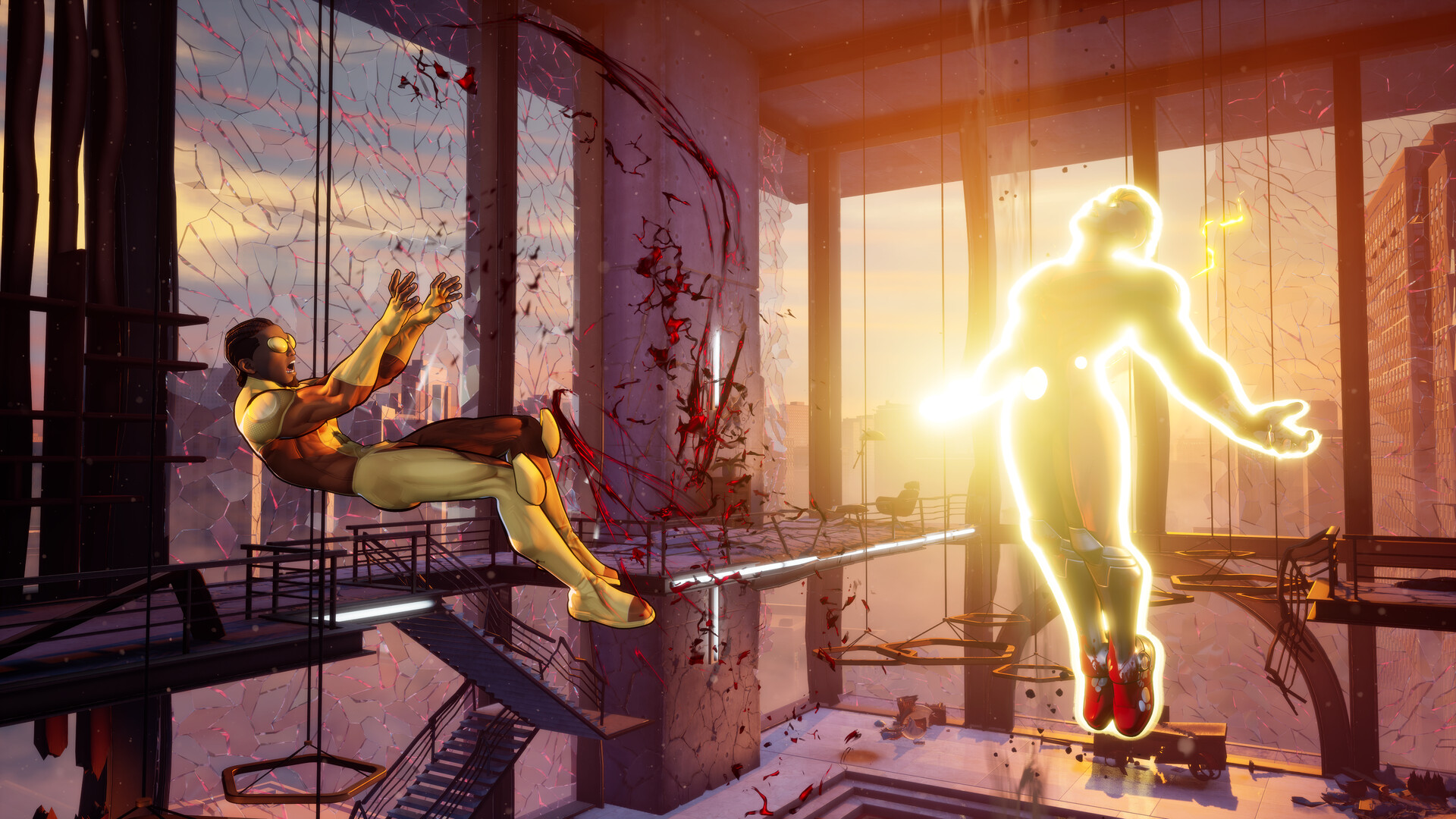
Invincible VS does the much harder thing, which is to give both sides of the equation real weight. Offense feels great here. Tags are fast, with a slight floaty hang time that lets you set up character-specific extensions; assist calls cover meaningful screen space; the basic chain combo system uses a simplified Marvel-style Light/Medium/Heavy/Special structure that anyone who has played a tag fighter in the last twenty years will pick up in five minutes. But defense is where the design quietly shines. Heroic Strikes are the combo breaker layer — context-sensitive moments where the defender can spend bar to interrupt a combo with an attack that itself can be baited and blown up if the attacker reads it correctly. Counter Tags let you blow up the moment the attacker calls in their second character, swapping yours in safely if you guess right and getting punished hard if you guess wrong. Assist Breakers cover the assist-call layer that has historically been the most frustrating part of tag fighters for new players.
Stack all that together and you get a defensive economy that's unusually rich. Every long combo in this game is a series of decisions for both players. The attacker is choosing whether to spend meter on a guaranteed extension or save it for a bigger payoff later. The defender is deciding whether to sit in the combo and recover bar, blow a Heroic Strike now, or wait for the inevitable assist call and snipe it with a Counter Tag. Two players who actually understand the systems play matches that look completely different from two players who don't, in a way that's becoming rarer in a genre increasingly designed around making everyone feel competent.
The game's not perfect at this. There's a noticeable balance gap between the top-tier characters (Omni-Man and Battle Beast in particular have absurd damage output for their resource cost) and the bottom of the roster (Bulletproof, weirdly, struggles to get anything going). Some of the combo paths feel under-explored — a few characters seem to want a specific assist call to bridge their bread-and-butter extension, and the game doesn't really teach you that. The Heroic Strike timing window feels a touch generous in casual play, which makes higher-level matches feel like both players are blowing breakers at the same moments rather than reading each other.
But none of that breaks the system. It's the kind of release-window roughness every fighting game ships with, and the kind that consistent patching can address — and Skybound has been making the right noises about an active balance schedule, with Quarter Up confirming a competitive-focused roadmap that includes a major balance pass within the first eight weeks of launch.
The roster: 18 characters, real personalities, no filler
Eighteen characters at launch is, by modern fighting-game standards, a perfectly fine number. Street Fighter 6 had eighteen. Mortal Kombat 1 had twenty-two but with a lot of overlap. Tekken 8 had thirty-two and several of those were near-clones. The number itself isn't the problem. The question is whether the eighteen feel like eighteen distinct fighters or like nine fighters and nine variants of those nine.
On that question, Invincible VS lands much closer to the good answer than the bad one. The launch cast is:
- Invincible (Mark Grayson) — the protagonist, the rushdown all-rounder, the obvious starting pick for new players. His core string is straightforward, his movement is excellent, and his super arc lets him close gaps in ways most of the cast can't. He's also the character the game most clearly built around: most story-mode missions feature him, the tutorial uses him, and the menus default to him.
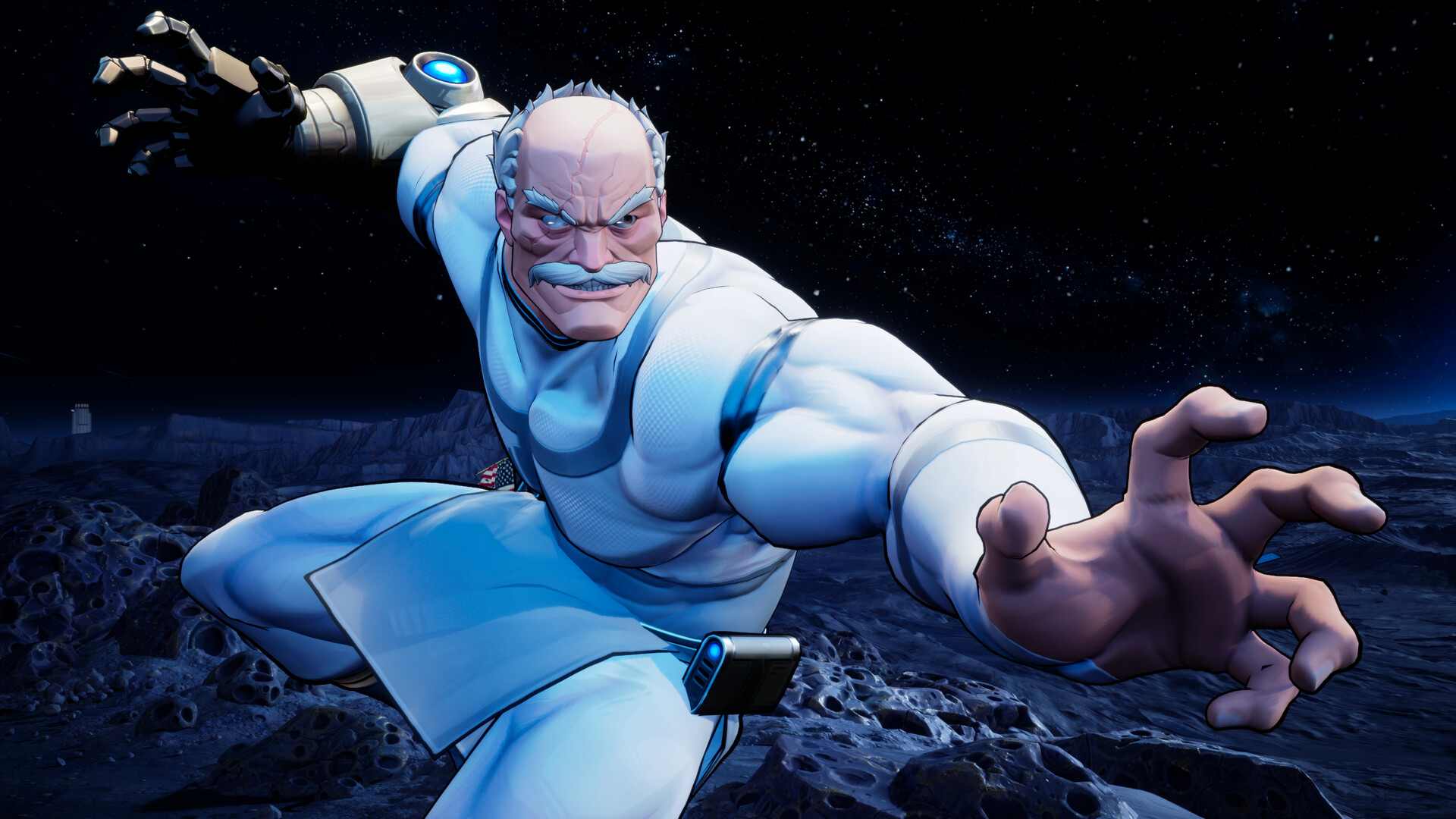
- Omni-Man — heavy-hitter with terrifying damage output and a deliberately oppressive command-grab game. He plays slow but every confirm is enormous. The kind of character competitive players are already gravitating toward because his risk/reward ratio is unusually generous.
- Atom Eve — the zoner, with a kit built around managing space using projectiles and matter-manipulation special moves. She is the answer to the Invincible/Omni-Man rushdown question and one of the most rewarding characters to learn for players who like keepaway gameplay.
- Battle Beast — the grappler-mixup hybrid, terrifying up close, with a command grab that ignores most defensive options on a successful read. Probably the strongest character in the launch meta.
- Conquest — heavy bruiser with armored normals and a damage-trade-focused playstyle. Incoming as DLC but available in story-mode encounters, which has been a point of confusion in the playerbase.
- Allen the Alien — flight-based mid-ranger with a kit centered around coverage assists and aerial pressure. The character that benefits most from being the second slot in a team composition.
- Anissa — Viltrumite stand-in for Omni-Man's playstyle but tuned around mobility rather than raw damage. Excellent point character in a fast team.
- Bulletproof — the projectile-focused tactical fighter, currently considered the bottom of the launch tier list but with a kit that suggests buffs are coming.
- Cecil Stedman — the unique non-superpowered character, built around teleporters and gadgets. Plays unlike anyone else on the roster.
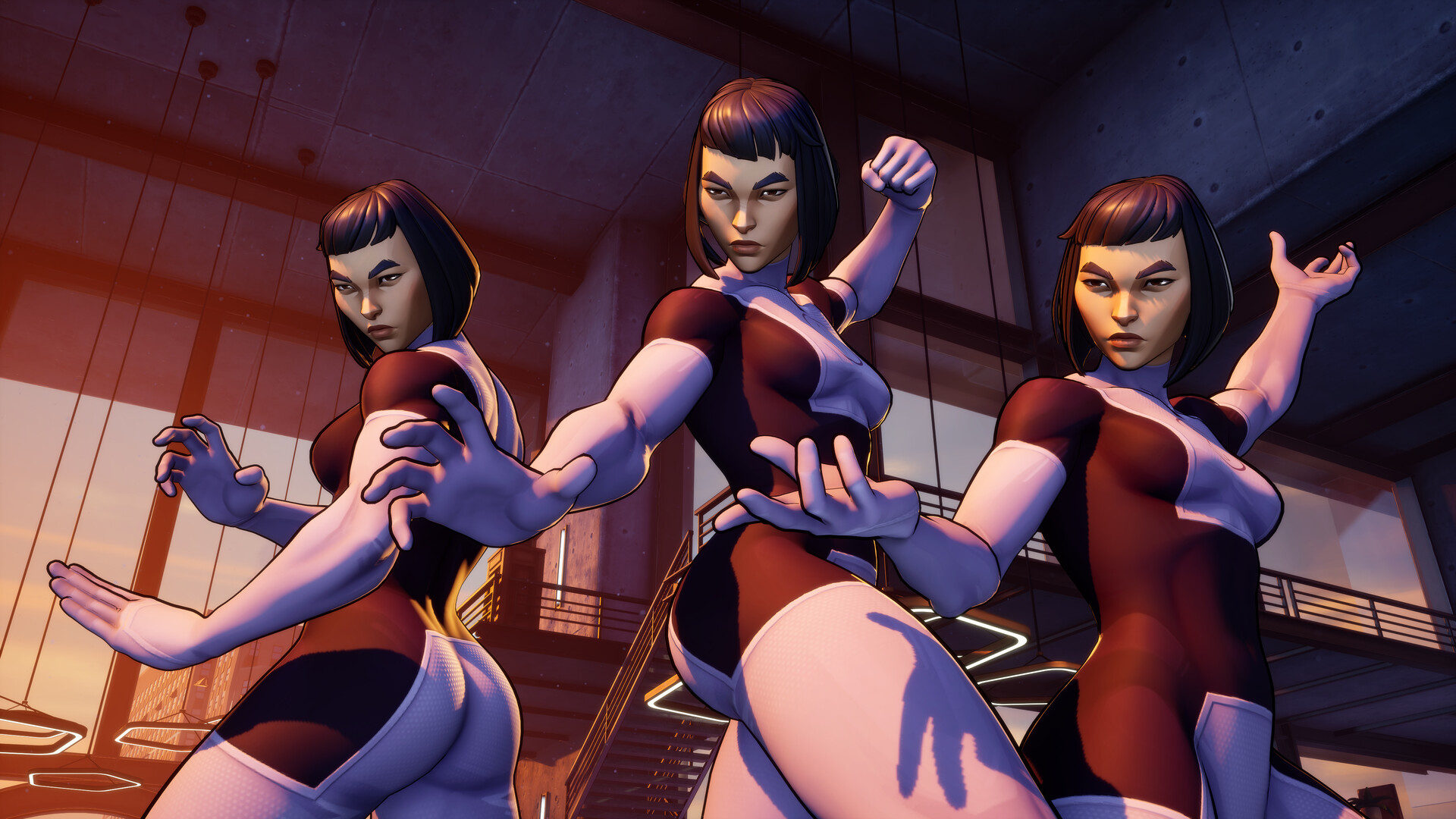
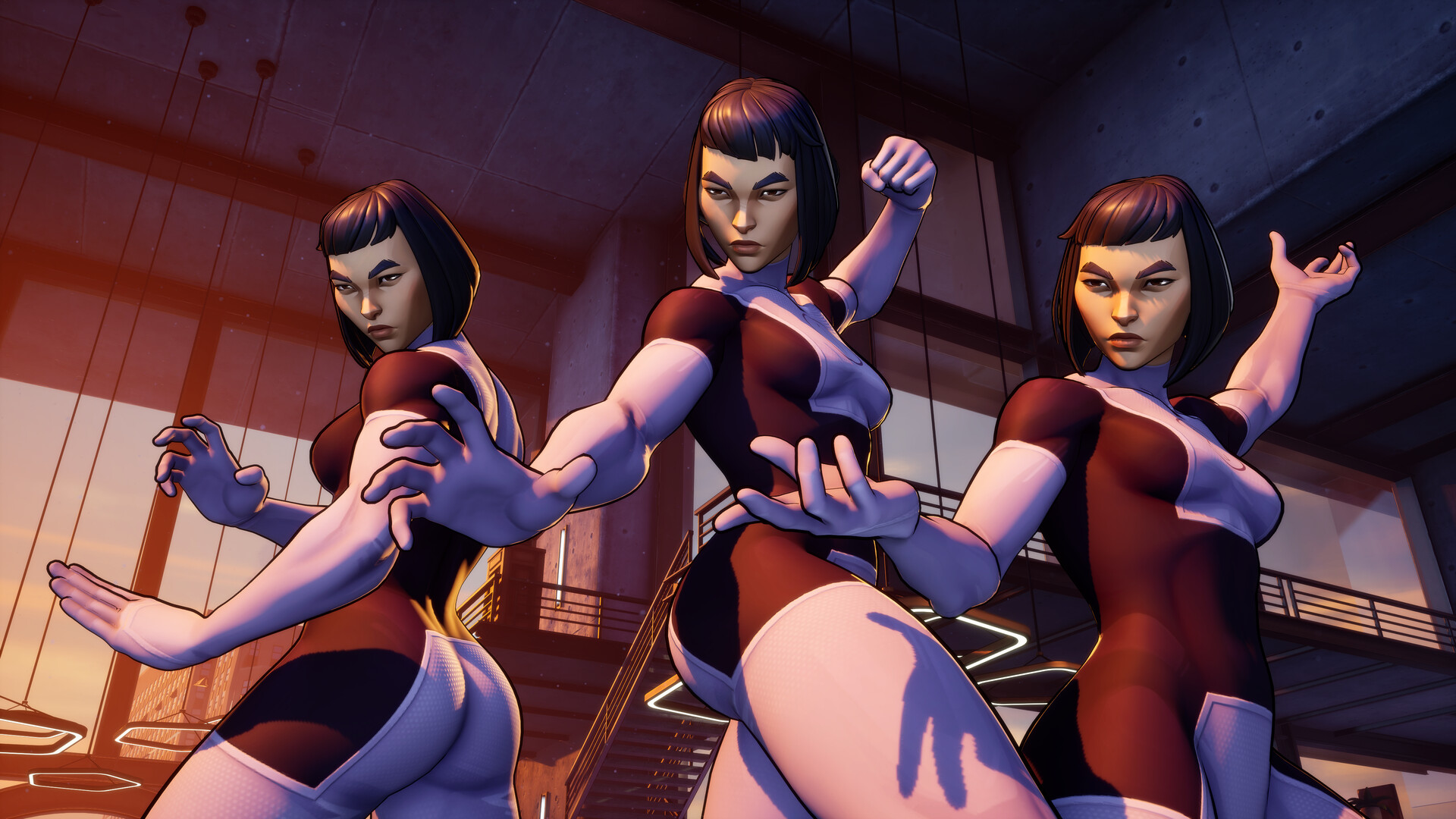
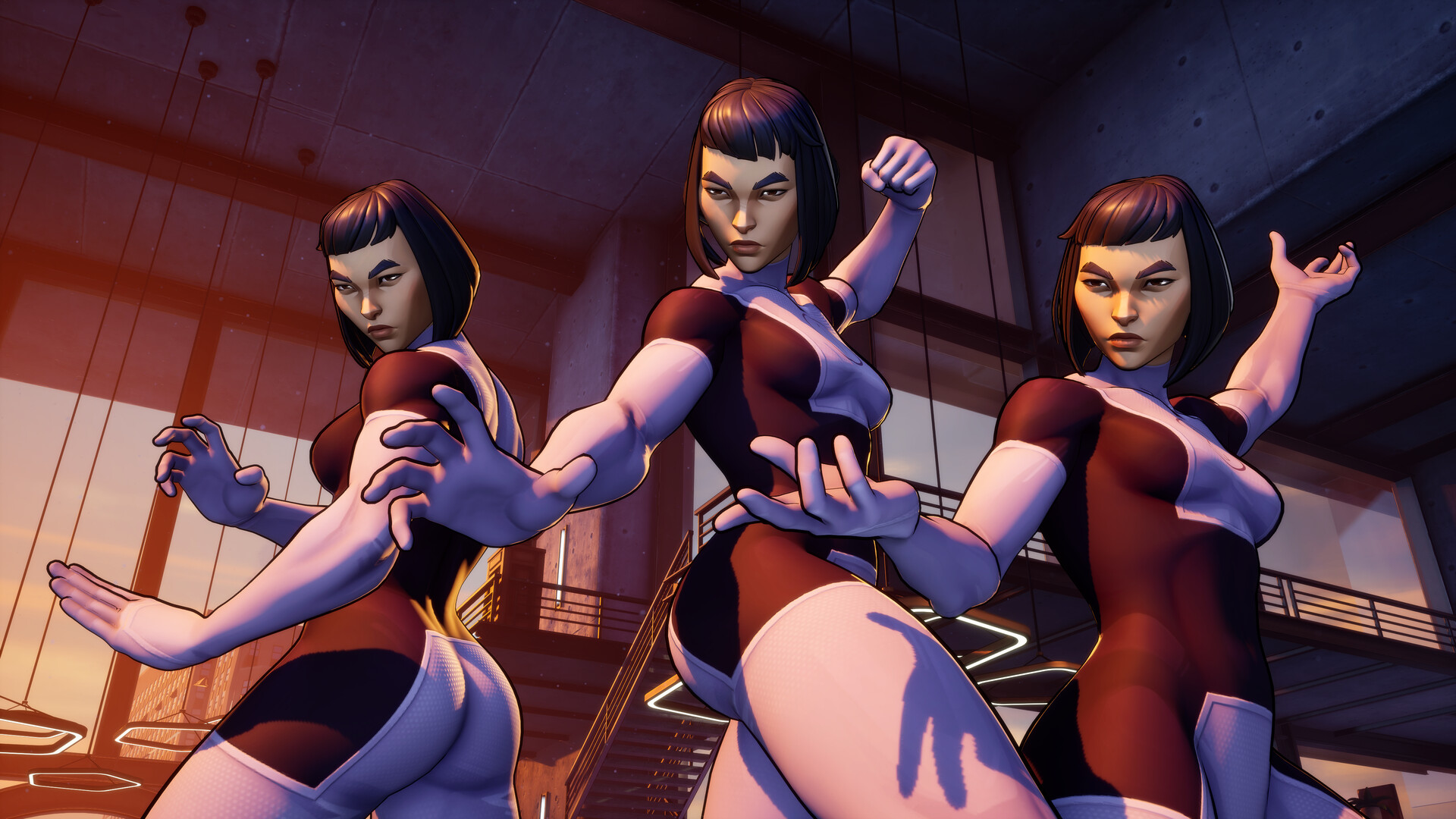
- Dupli-Kate — clone-summon mechanics, one of the most lab-intensive characters in the game, and the reason a third of the high-level Twitch streams in the past two weeks have been people in training mode.
- Ella Mental — the original character created for the game, voiced by Tierra Whack, designed by Robert Kirkman and Cory Walker. A psionic character with a kit unlike anything else, and the most controversial part of the roster (more on her in a moment).
- The Immortal — heavy-hitting traditional bruiser, intentionally pitched as a more accessible alternative for players who want Omni-Man's playstyle without his execution requirements.
- Lucan — Viltrumite warrior with a hybrid pressure-grappler kit.
- Monster Girl — transformation-based hyper-aggressive rushdown, with a meter mechanic tied to her form.
- Powerplex — energy projection, mid-range pressure, surprisingly accessible.
- Rex Splode — explosive ordnance specialist, screen-control playstyle, one of the most fun characters to watch at high level.
- Robot — gadgeteer with summons, the most setup-heavy character in the game.
- Thula — Viltrumite warrior optimized for tag synergy.
- Titan — rock-form bruiser, the purest grappler archetype on the roster.
- Universa — gravity-manipulation control character, technically labeled as a launch-window addition rather than DLC.
The interesting design choice here is that despite having three Viltrumites in the launch cast (Omni-Man, Anissa, Lucan, Thula — actually four), each one feels mechanically distinct. They all have flight, they all have heavy damage, but the way they generate offense and the resources they want to spend differ enough that you'd never call them clones. That's the kind of detail work that signals the dev team cared.
The Ella Mental conversation
Original characters created for fighting games based on existing licenses have a long, often-disappointing history. Most of them feel like an obligation — somebody high up in the rights chain wanted to make sure the studio was creating IP rather than just adapting it, so a character was bolted on, and that character ended up as the one nobody wanted to play. Ella Mental, despite being clearly built around exactly that kind of pitch, has somehow ended up as one of the most interesting characters in the launch roster, and the reason for that is mostly down to who Quarter Up handed the character to.
Tierra Whack — the rapper, whose 2018 album Whack World was one of the most quietly influential debuts of the last decade — is a genuinely surprising voice actor. She brings a stage cadence to Ella's dialogue that none of the other roster members have, in part because the rest of the cast is doing the relatively traditional voice-acting-for-a-superhero-show thing and Whack is just… being Tierra Whack on camera. Robert Kirkman and Cory Walker designed Ella to fit into the existing comic-book canon (she's now slated to appear in the comic series proper later this year) but the in-game version of her is its own thing. Her psionic kit is mechanically unlike anything else on the roster — telekinetic projectiles that can be redirected mid-air, a defensive mind-control move that lets her hijack an opponent's input briefly, and a super that visually rewrites the stage during the cutscene. She's polarizing, and people are going to argue about her balance for the entire first patch cycle, but the choice to put a real artist on a real character and let that personality bleed into the design has produced something memorable.
Story mode: the part everyone is going to argue about
OK. The story mode. Let's talk about it honestly.
The pitch — that the story is positioned as a "bonus episode" sitting between season 3 episodes of the Prime Video animated series — is genuinely cool on paper. The execution is roughly twenty-five to thirty minutes of original cinematics with the show's actual voice cast (J.K. Simmons returning as Omni-Man, Gillian Jacobs as Atom Eve), interspersed with fight sequences that, depending on how quickly you clear them, take maybe another forty-five minutes total. So a complete story-mode run is somewhere between seventy-five minutes and two hours, and the full clear is firmly in the "one Saturday afternoon" window.
That run-time is, on its own, not the problem. Plenty of fighting games have shipped with shorter story modes and people have been fine with them. The problem is that the story does several things very well — the cinematic direction is excellent, the fights are well-paced, the writing genuinely feels like an Invincible episode rather than a video-game cutscene — and then ends abruptly, on a cliffhanger that explicitly sets up future content. The villains, a faction of aliens called the Technicians who are harvesting battle energy from a captured asteroid base, are dispatched in a third act that's two scenes long. The cliffhanger isn't a thoughtful "season finale" cliffhanger; it's the narrative version of a "to be continued" card, with no indication of when (or if) the continuation is coming.
That's the part that has driven the negative reactions. Not the run-time, not the budget, but the feeling that this was originally pitched as a longer thing and got truncated late in development, with the back third never properly written. People who have spent the past year following the show's character arcs feel like they were promised an episode and got a teaser. Anyone who measures story modes by content stack — the NRS-style branching paths, the multiple character viewpoints, the unlock-extras-by-completing-each-character's-route structure — will feel like they were given the bones of a story without the meat.
None of that is wrong. The story mode is short, ends abruptly, and could have been twice as long without breaking anything. If your primary purchasing question is "how many hours of single-player content do I get for $50," you should not buy this game at full price. Wait for a sale, or wait until Skybound ships the inevitable Story Mode 2 that the cliffhanger is setting up.
If, however, you're buying the game for the multiplayer and treating the story as a bonus, the story is enjoyable enough that I came out the other end annoyed it was over rather than annoyed it existed. That distinction matters.
The other modes: thinner than they should be
Beyond Story, Versus, and Training, the offline content gets thin fast. Arcade Mode is a per-character ladder, with each character fighting through six bouts before getting a brief end-of-arcade card (mostly stills with a paragraph of text — no animated endings, which is one of the most disappointing absences). It works, but it's the bare minimum a fighting game in 2026 should ship with.
There's no proper Mission Mode, which is a glaring absence in a tag fighter that genuinely needs to teach players the systems. The training mode itself is excellent — frame data display, hitbox visualization, recording dummies, save/load combo states, all of it — but it's a tool, not a structured curriculum. Casual players who want to be taught the game don't have a great place to go for that, which is a problem because Invincible VS's mechanics actually do reward learning.
There's a "Codex" of character bios, which is a few paragraphs each plus a still image — fine, perfunctory. There's a customization layer with unlockable color palettes, character titles, and announcer voices, with most of the unlocks tied to completing arcade runs or hitting milestone match counts online. The customization is shallow but functional; nothing like the elaborate cosmetic systems of Tekken 8 or the Marvel-Disney-style outfit unlocks of MK1.
What you don't get and probably should: an animated character intro/ending arcade structure, a proper trial mode that teaches each character's bread-and-butter combos, a survival or tower mode for offline grinding, a replay theater that lets you save and rewatch online matches, and any kind of meaningful single-player meta progression. These are absences that are easy to patch in, and the developer roadmap suggests a lot of them are coming, but they aren't there at launch.
Online play: the rollback is genuinely excellent
This is the part where the Quarter Up team really does deliver on its FGC-pedigree promise. Invincible VS ships with the kind of rollback netcode that has, until very recently, been the exclusive province of Capcom and Arc System Works releases. Matches against opponents on the other side of the country feel essentially identical to local play. International matches (I tried opponents in Europe and Japan from a North American connection) range from "completely playable" to "near-perfect," depending on the route.
The matchmaking itself is structured around a Battle Hub-style lobby system — you're not just queuing for ranked, you're walking a character around a virtual hangout, sitting down at virtual cabinets to fight people, watching matches in progress, that kind of thing. It's a clear lift from Street Fighter 6's Battle Hub and it works the same way. Ranked is structured as a season-based ladder with monthly rewards and a clear set of skill tiers; casual is a quick-match queue that uses an MMR system but doesn't expose the number to you.
Crossplay is on by default across PS5, Xbox Series X|S, and PC, and crossplay can be toggled off in settings if you want to restrict matches to your platform. There's also crossplay between PC platforms (Steam, Microsoft Store) which is a small detail but a welcome one. The lobby system supports up to eight players and has the standard suite of casual room features (training mode in lobbies, spectator mode, custom rule sets).
The biggest online weakness right now is matchmaking speed at lower hours. North American prime time matches in less than ten seconds; Europe and Asia at off-peak times can hit a minute. That's a function of population, and it'll either resolve as the playerbase grows or become a permanent issue. As of this writing, the population is healthy enough that the issue is mostly limited to the smallest skill brackets.
Presentation: a comic-book art style done with confidence
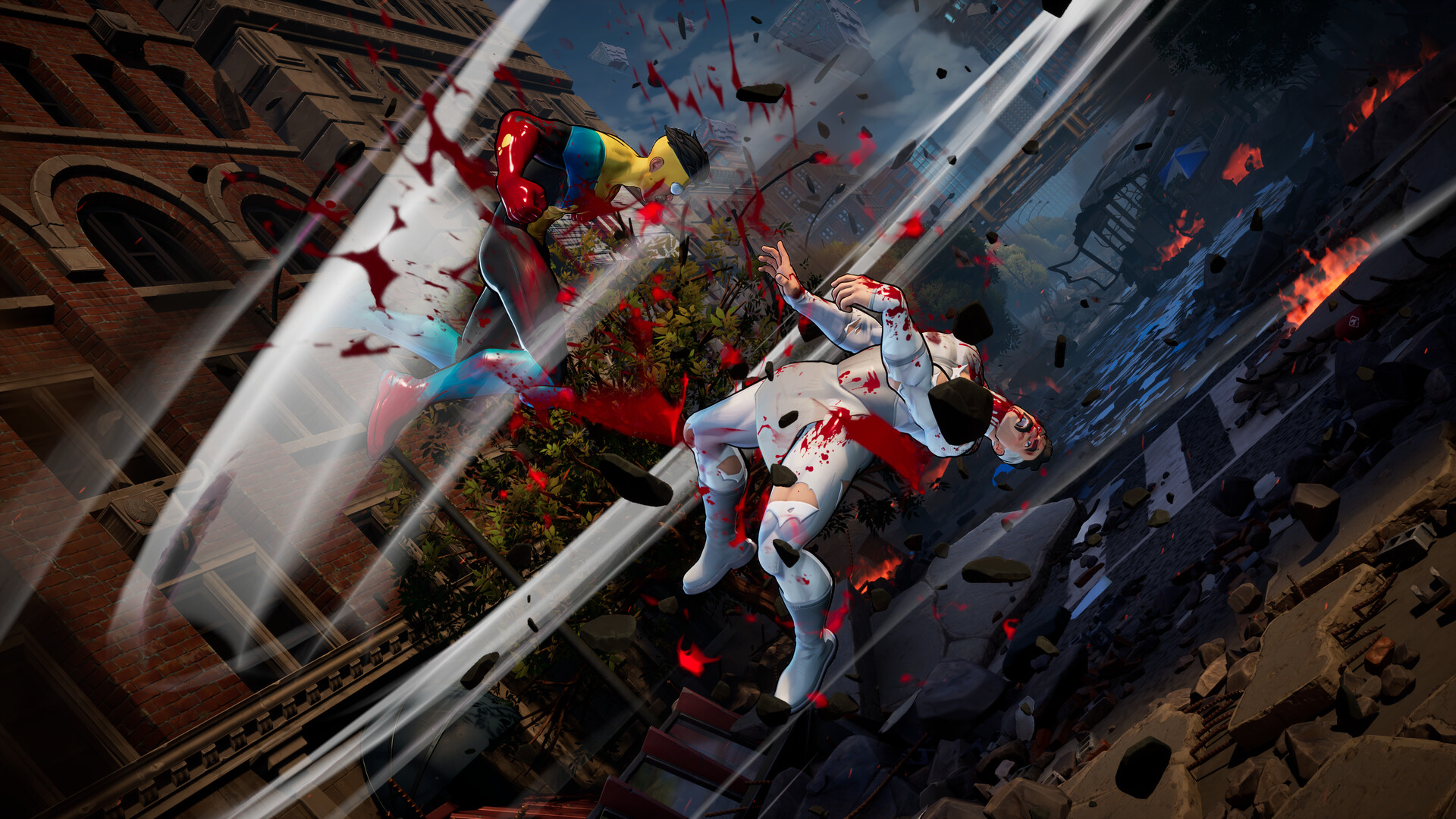
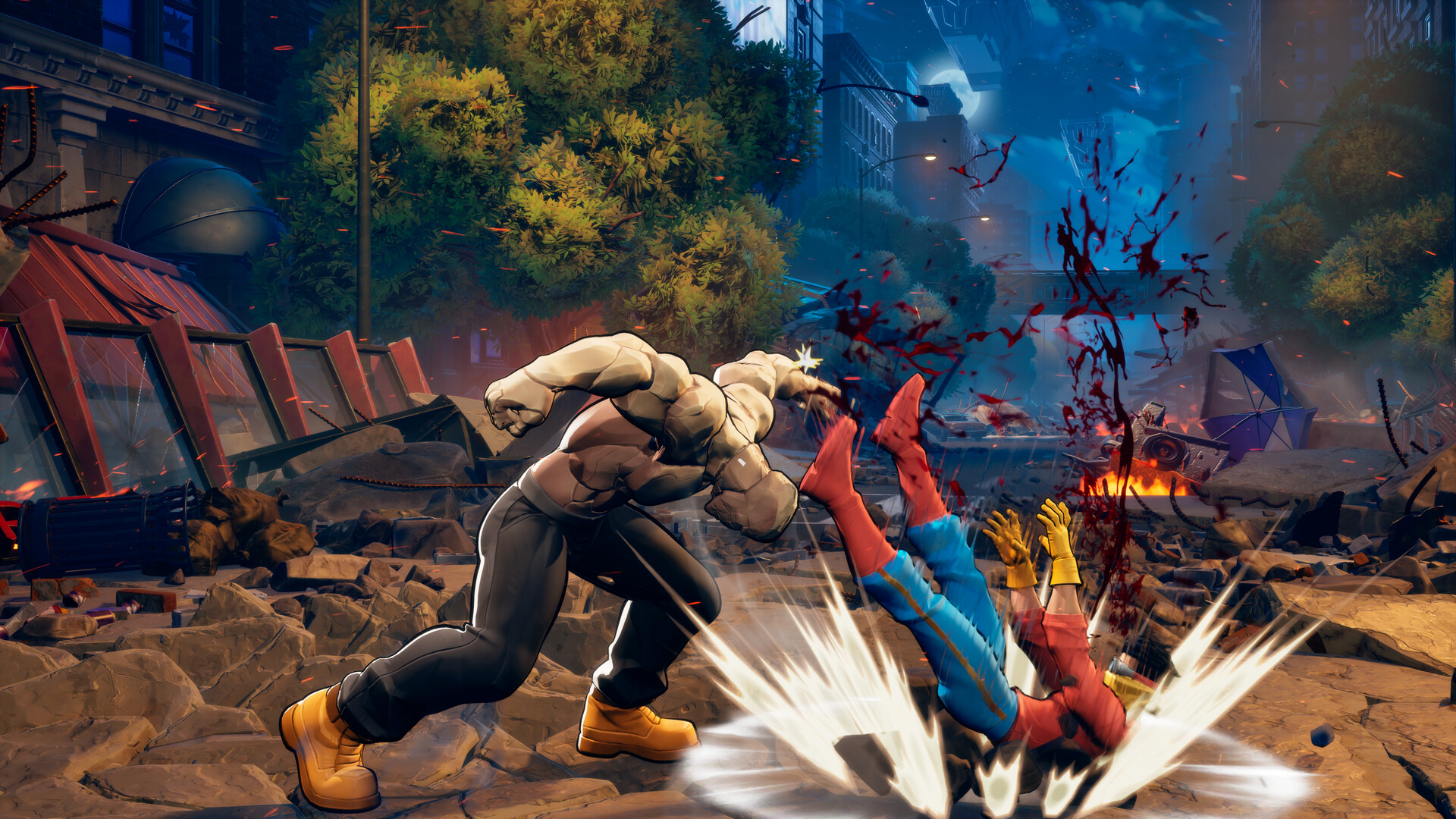
Visually, Invincible VS commits to its source material harder than most licensed fighters bother to. The character models are stylized cel-shading rather than the realistic-pseudo-cinematic look Mortal Kombat has trained the audience to expect, and they look like they walked off the page of a Cory Walker panel. Character animation has more frames than is typical for the genre — the Quarter Up team has clearly invested in the kind of in-betweens that make individual moves read clearly even at 60fps. Hit effects use comic-book-style impact bursts; specific moves have on-screen onomatopoeia overlays during the supers; the camera work during super finishers borrows from the show's editing rhythm rather than the more cinematic Capcom-style cutaways.
The gore, which is the part of the source material that defines its identity, is implemented with what I'd call appropriate restraint. Standard moves don't produce gore. Super finishes (especially "Ultimate" finishers) absolutely do, with limbs separating and characters being run through and the kind of comic-book brutality that earned the animated show its TV-MA rating. There's a setting to dial it down or off entirely for players who'd rather not see it, which is a thoughtful inclusion.
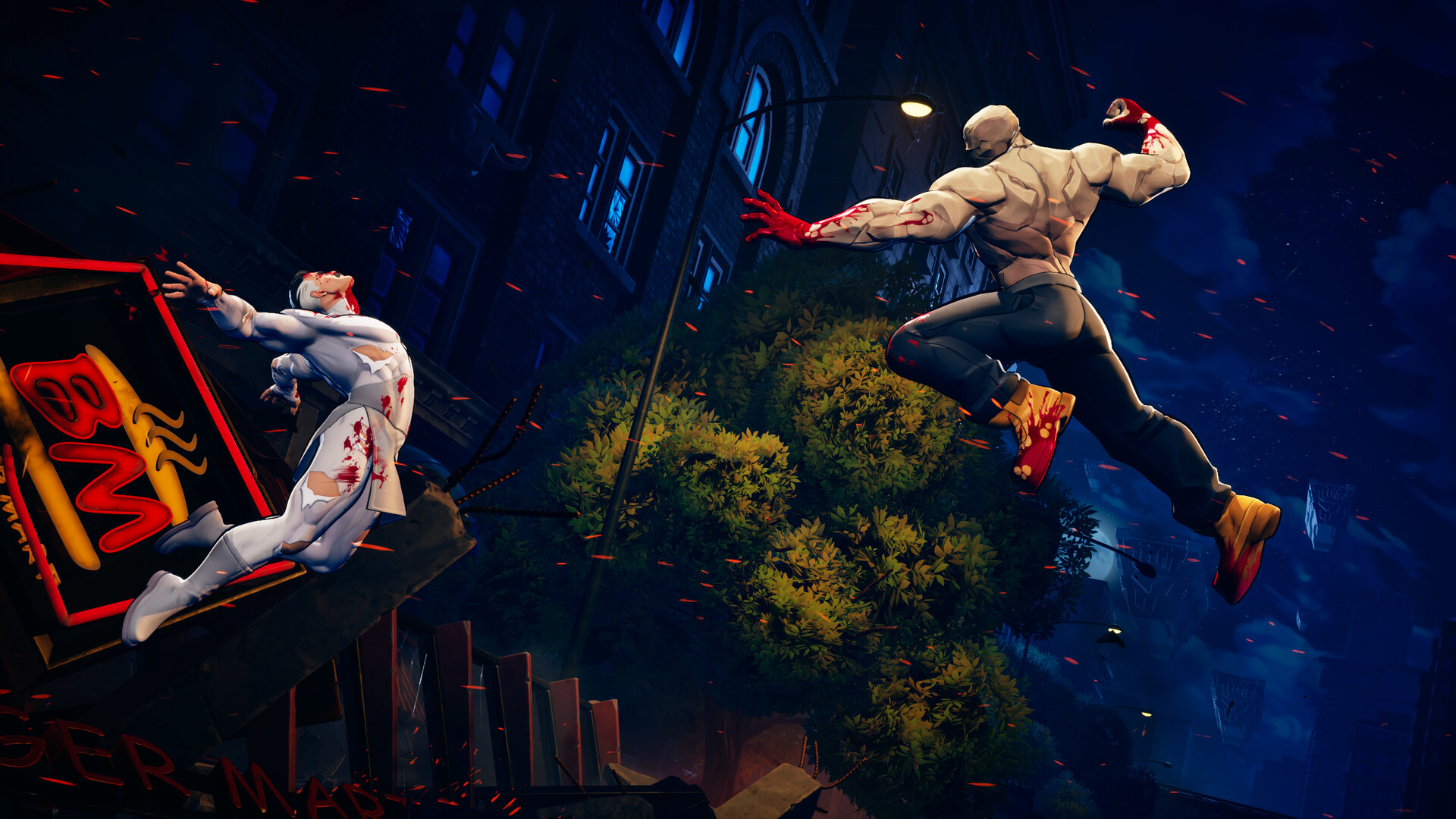
Stages are mostly drawn from show locations — Mark's house, Upstate Farm, Cecil's GDA headquarters, the Mauler twins' lab, a few cosmic-scale battle arenas. There's a smaller-than-expected number of them (eight at launch, with a handful more confirmed for the post-launch roadmap), but the ones that are there are detailed enough that you don't notice the limitation immediately.
The soundtrack is a mix of original synth-and-orchestra-fusion compositions that lean into the show's musical palette, with a small number of licensed tracks reserved for big story moments. It's not the kind of soundtrack you'll be putting on outside the game, but it serves the matches well and the boss-fight tracks in particular have weight to them.
Voice cast: the win is bigger than the loss
The headline is that J.K. Simmons returns as Omni-Man, Gillian Jacobs returns as Atom Eve, and roughly two-thirds of the launch cast brought back their show actors. That's a higher hit rate than most licensed fighters manage, and Simmons in particular is a delight — Omni-Man's between-round dialogue and special-move callouts are clearly being delivered by an actor having fun, which translates directly to the screen.
The miss is real, though. A handful of characters have replacement voice actors, and at least one of those replacements (which I'll leave unnamed because the discourse around it has gotten weirdly personal) is noticeably less polished than the show version. If you're someone for whom voice continuity is the deal-breaker, that may be the deal-breaker, but it's a relatively small fraction of the roster and the impact is limited to a handful of dialogue lines you'll hear maybe twice per match.
Tierra Whack as Ella Mental, as I mentioned earlier, deserves specific praise. She brings something to the game that nobody else in the cast brings — a performance that feels like it's emanating from a real person rather than from a character actor doing their job well. Whether you'll like Ella as a character is going to come down to taste, but you'll remember her either way.
Performance and platforms
I tested the game across PS5, Xbox Series X, and Steam (RTX 4070 / Ryzen 7 7800X3D). Performance is solid across all three. The game is locked at 60fps in matches with no perceptible drops; menu performance and Battle Hub navigation are both responsive; loading times are short on all three platforms.
The Steam version has a small number of platform-specific options (uncapped framerate, ultrawide support, more granular graphics settings) but none of them are necessary for a good experience. The PS5 version has DualSense support that uses the haptic motor for hit feedback in a subtle but effective way; the Xbox Series X version is essentially identical to the PS5 version mechanically and performs the same. There's been some early discourse about input lag differences between platforms, but in my testing they were within the noise floor.
Crossplay performance, as mentioned, is excellent. The same can't quite be said for cross-progression — your unlocks and customization don't sync across platforms, which is an annoying omission for a 2026 release.
Where this lands compared to the genre
The honest comparison case is Dragon Ball FighterZ. Both games are 3v3 tag fighters with comic-book-adjacent IPs, both lean into accessibility-with-depth design philosophies, both shipped with content stacks that the FGC immediately embraced and casual players found a little thin.
FighterZ aged into a defining genre release because Arc System Works supported it for years post-launch, the competitive scene grew around it, and the deep parts of the system kept producing new ideas as the meta evolved. That's a path Invincible VS could plausibly walk, but it's a path that requires sustained developer commitment that hasn't been earned yet — Quarter Up is a brand-new studio, this is their first release, and we don't yet know what their post-launch support looks like in practice.
The other comparison is the recent Marvel vs Capcom Fighting Collection — not because the games play the same way, but because the audience for Invincible VS is clearly drawing on people who came back to the genre via that release. There's a wave of FGC-curious 30-somethings who picked up MvC2 again after the collection hit, found out their reflexes still worked, and have been looking for a new tag fighter to put hours into. Invincible VS is, mechanically, the closest thing to "MvC2 reimagined for 2026" that's come out since FighterZ.
A closer look at three top-tier loops
To make the systems-level praise more concrete, let me walk through three character gameplans that illustrate why this game's combat is winning over genre veterans.
Omni-Man's positional damage. Omni-Man's bread-and-butter combo doesn't look impressive on the surface — a five-hit string into a ground bounce, into a tag-out, into the second character's launcher. What makes him terrifying is that he can convert almost any stray hit into that same ending, and the corner version of the routing tacks on roughly forty percent extra damage at the cost of one bar of meter. Skilled Omni-Man players spend the first thirty seconds of every match grinding their opponent toward the corner with a deliberately slow approach, refusing to throw out anything risky, waiting for the panic-button mistake. When it comes — and against most players it will — the punish is round-defining. Watching a high-level Omni-Man player feels less like watching offense and more like watching a chess clock tick down.
Atom Eve's space control. Eve's kit is built around a projectile suite that covers low, mid, and high angles, with an air-to-ground special that controls jump-ins and a parry-style move that converts a successful read into a full counter combo. The advanced layer is the way her assists interact with her zoning — calling in a Robot or Cecil assist while throwing the right projectile creates two-piece coverage that's genuinely difficult to navigate without spending meter. Eve players don't combo you to death; they slowly grind you down with a wall of small interactions until you make a mistake, then convert with a touch-of-death that reminds you she has burst damage when she needs it.
Dupli-Kate's setplay. Dupli-Kate is the lab character — the one whose ceiling looks higher than her current skill floor would suggest, and the one most likely to break the early meta as players figure out her optimal routing. Her kit is built around summon clones, each of which functions as a temporary persistent assist that she can layer on top of her own offense. The result, in skilled hands, is a setup-and-stall game where she puts a clone on the screen, runs a mixup, and tags out into a second character whose offensive options are buffed by the clone's ongoing pressure. There are reportedly seven-figure-damage routes already being labbed for her that the designers either didn't know about or didn't think would matter; either way, she's the character most likely to dominate the second wave of the meta as labbing catches up.
The competitive scene, two weeks in
It's early, but the competitive scene's reception is already telling. The Skybound-backed Invincible VS Pro Tour announcement (which dropped alongside the launch) confirmed a $500,000 prize pool spread across regional events, with the first major scheduled for late June. Top-50-tournament-ranked Marvel vs. Capcom and Dragon Ball FighterZ players have been streaming the game heavily — the kind of organic buy-in that you can't manufacture with marketing dollars.
The early tier list discussions are reading like the early discussions around any tag fighter: Battle Beast and Omni-Man at the top, a healthy middle tier, a few characters that need help. None of that is unusual; most fighting games at the two-week mark have a similar early-meta picture. What matters more is that the systems-level discourse has been about how to extract more from the mechanics rather than complaints that the mechanics are broken. That's the marker of a game with depth.
Who is this game actually for?
Trying to be honest about audience fit, here's how I'd think about the buying decision:
You should buy this at full price if: you've put twenty-plus hours into a tag fighter at any point in the last decade and you've been waiting for the next one to get hooked into. You enjoy training mode for its own sake. You watch fighting-game tournaments on Twitch. You're willing to grind out the early meta in exchange for being there when the patch cycle starts shifting things around. You read comic books, watch the Invincible show, or both.
You should wait for a sale if: you're a casual fighting-game player who buys these games for the cinematic story modes and unlock galleries. You bounced off Dragon Ball FighterZ because it felt too combo-heavy. You don't currently have anyone you regularly play fighting games with, online or local. You're a fan of the show but unfamiliar with the FGC.
You should probably skip it if: you actively dislike tag fighters as a subgenre and prefer 1v1 games like Street Fighter or Tekken. You've never enjoyed an FGC-shaped fighting game. The amount of resource management on the screen at any given moment fundamentally bothers you. Both of those are valid preferences and Invincible VS is unlikely to convert you.
Verdict
Invincible VS is two games, and which one you bought is going to determine whether you walk away from it satisfied or annoyed.
If you bought it as a single-player package, it's a 65/100 game with an excellent twenty-five minutes of cinematics surrounded by the bare-minimum offline content. If you bought it as a fighting game — as a multiplayer-first, training-mode-first, online-first piece of FGC product — it's an 85/100 game with one of the best tag systems the genre has produced this decade.
The fair score, threading those two valid responses, is somewhere in the 75-80 range. I'm landing on 78. The combat engine is genuinely excellent, the roster is well-distinguished, the rollback netcode is reference-quality, and the presentation captures the show's identity better than almost any licensed fighter has captured its source. The single-player content is thin, the story mode ends on a frustrating cliffhanger, and the absence of structured tutorials and missions is a real flaw that a game built around teaching its systems shouldn't have shipped with.
If you're a tag-fighter player who has been looking for the next thing to grind for the next year, this is unambiguously that. If you're a casual fighting-game fan who buys these games for the story modes, wait for the inevitable bigger Year 1 content drop or for a sale that brings the price closer to the actual content density. And if you're a fan of the show first and a fighting game player second, lean toward the second-priority audience: this game rewards investment in a way most licensed fighters don't, and the show-respecting elements are real even when the content stack is light.
Quarter Up has, with their first release, made the case that they belong in the conversation about fighting-game studios. That's a bigger achievement than the launch-window content suggests. Whether they capitalize on it depends on what the post-launch year looks like — but on the strength of what they've shipped, I'm betting on yes.