There is a very specific kind of dread that the word “Monopoly” conjures — the four-hour slog, the flipped board, the friendship quietly ending over an unpaid rent on Boardwalk. So the pitch behind Monopoly: Star Wars Heroes vs. Villains is almost cheeky: take the most notoriously grudge-inducing board game on Earth, drape it in the galaxy far, far away, and then bolt on hero powers and team play to try and fix the parts everyone secretly hates. Developed by Behaviour Interactive and published by Ubisoft, it is a bigger swing than the usual licensed Monopoly reskin, and for stretches it genuinely works. It is also, unmistakably, still Monopoly — and that is both its charm and its ceiling.
Released on PC on June 11 and on PlayStation 5, Xbox Series X|S, Nintendo Switch and Switch 2 on June 30, 2026, this is a digital-first take built around one central idea: you are no longer playing alone against the table. You pick a side, team up, and use character abilities to bend the rules of a game that has resisted change for nearly a century. It is entertaining more often than not — but no amount of lightsabers can fully tame the dice.
A Familiar Board, a New Battle Plan
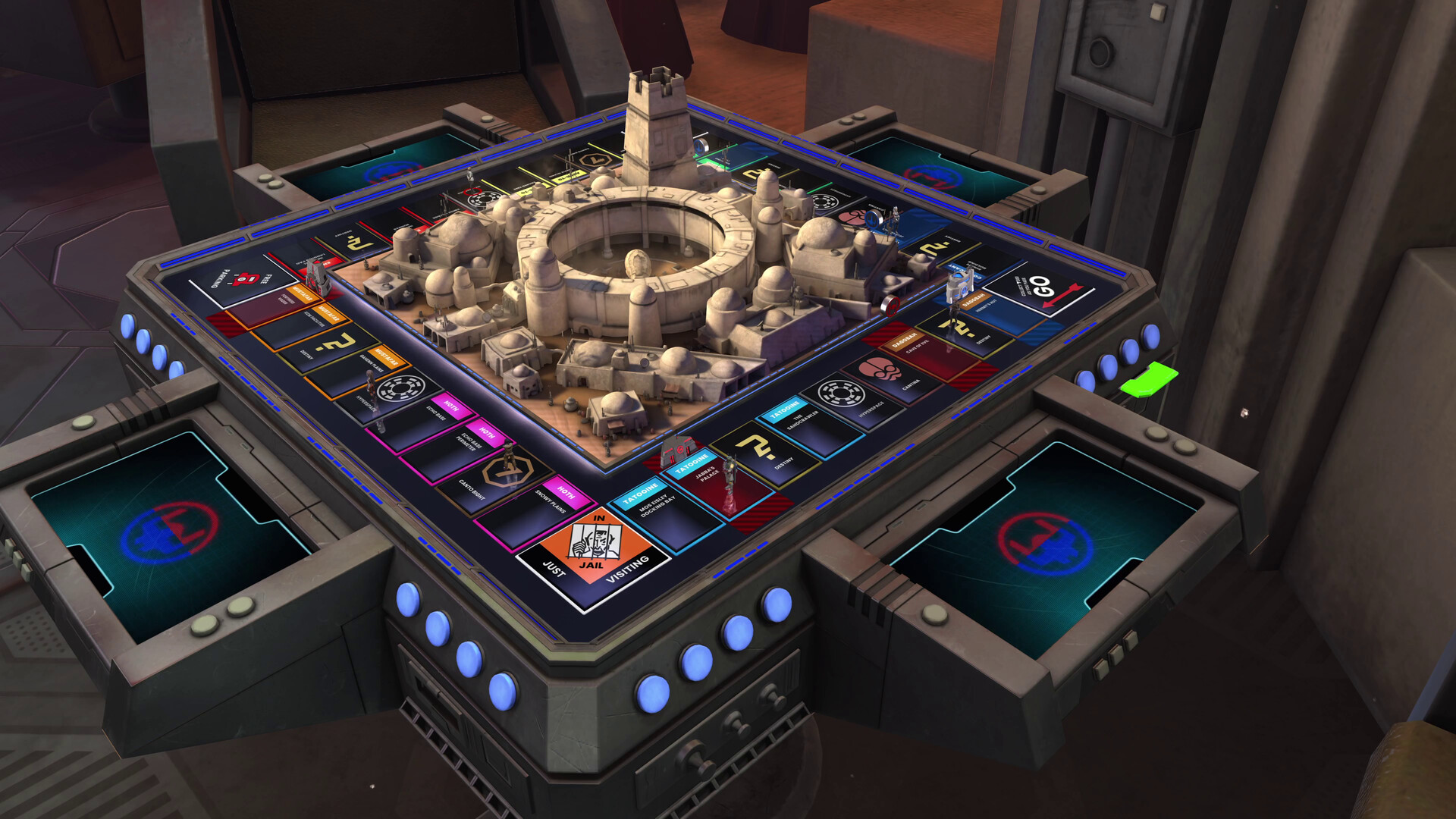
At its foundation, this is the Monopoly you already know in your bones. You roll two dice, move around a square board, buy the properties you land on, build them up, and charge opponents when they come to visit. Passing GO still pays out. Bankruptcy still ends your run. If you have played any version of Monopoly in the last ninety years, you can sit down and play this one in about thirty seconds, and that frictionless on-ramp is one of the smartest things about it.
The reinvention happens in the layers stacked on top. The board is themed around 22 iconic locations pulled from across multiple Star Wars eras, so instead of Marvin Gardens and Park Place you are wrangling control of instantly recognizable planets and outposts. Properties are bought with credits, deeds are galactic real estate, and the whole thing is wrapped in a presentation that treats the license with obvious affection. But the headline change — the reason the subtitle is Heroes vs. Villains — is that this is a team game. You are not a lone top hat grinding everyone else into dust. You are the Rebellion or the Empire, and you win or lose together.
How Heroes vs. Villains Actually Plays
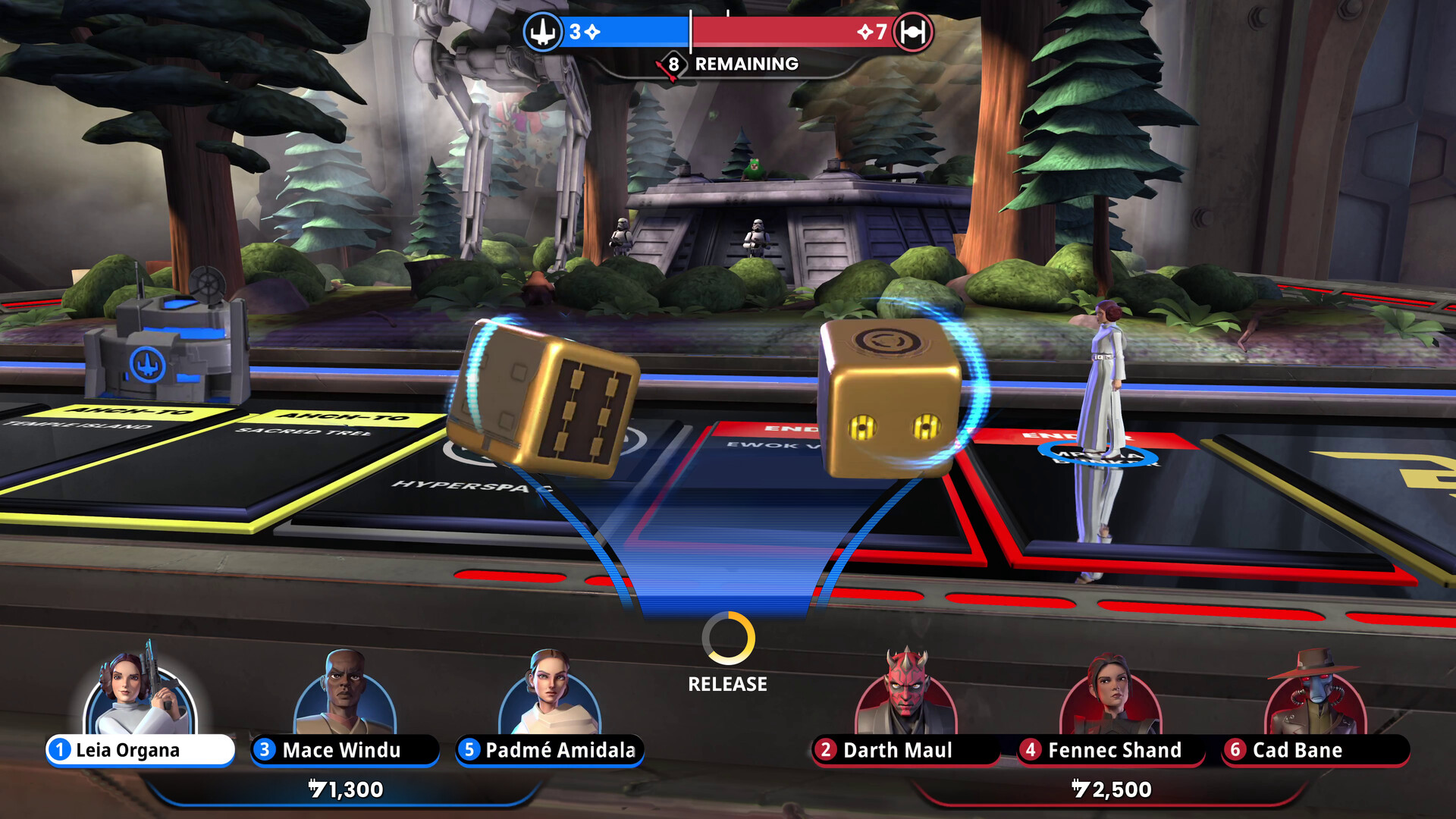
Here is the core loop that separates this from a cardboard box on your shelf. Each player controls a Star Wars character with a unique ability, and those abilities are the levers you pull to break Monopoly’s usual math. There are 28 characters in total — 14 heroes and 14 villains — and their powers touch every part of the game: acquiring locations faster, winning credits, manipulating movement, or turning encounters with opponents into something more aggressive.
Some concrete examples make the design click. Luke Skywalker can call in Wedge Antilles for backup, while his villain mirror, Darth Vader, calls in a Stormtrooper to the same effect. Yoda can upgrade his locations twice in a single turn, letting a team snowball rent income at frightening speed — and Emperor Palpatine does exactly the same for the dark side. Leia Organa siphons 100 credits every time she passes an opponent; Cad Bane pulls the identical trick for the villains. Rey can drag a random opponent into combat where the winner walks away with credits, a mechanic mirrored by General Grievous. On top of that, Dynamic GO Events fire off unpredictable, board-altering effects that can swing momentum in a single lap, so a match rarely settles into the death-march equilibrium that classic Monopoly is infamous for.
What works is how these abilities push you toward an actual strategy rather than just praying to the dice gods. Do you build a team around raw location acquisition, around combat victories, around movement control, or around stacking credits? Because you are coordinating with a partner (or two), the interesting decisions are about synergy: pairing a character who generates income with one who accelerates upgrades, or combining movement manipulation with a combat specialist to bully opponents off key squares. When a match is firing on all cylinders, it feels less like Monopoly and more like a light, chaotic team strategy game wearing Monopoly’s clothes.
A Turn, Blow by Blow
To understand why the additions matter, it helps to walk through a single turn. You roll, you move, and immediately the familiar Monopoly calculus kicks in — is this location worth buying, can I afford the upgrade, do I dare land on the opposing team’s stronghold next lap? But before or after that roll, your character’s ability enters the equation. Maybe you spend your turn as Yoda double-upgrading a location you already control, turning a modest holding into a genuine credit trap. Maybe you are Rey and you decide the timing is right to yank a leading opponent into combat, gambling a chunk of credits on the outcome. Maybe a Dynamic GO Event has just reshuffled the board and your carefully laid plan needs an on-the-fly rewrite.
Those micro-decisions, layered onto the base roll-and-move, are what keep turns feeling alive. And because you are on a team, your choices are rarely just about you: a good play often means setting up your partner’s next move rather than maximizing your own board. The best sequences are the ones where teammates chain abilities across two turns to spring something an opponent could not have blocked alone. That is a genuinely different rhythm from the every-player-for-themselves grind of traditional Monopoly, and it is the single biggest reason the reinvention lands as often as it does.
The Roster: 14 Heroes, 14 Villains, One Clever Balance Trick
The roster design hides a genuinely smart idea. Rather than trying to balance 28 wildly different powers against each other — a nightmare that would inevitably produce a “best” character everyone gravitates to — Behaviour paired each hero with a villain counterpart who shares the exact same ability. In practice, this means the hero/villain divide is largely thematic flavor rather than a mechanical advantage. Choosing the Empire over the Rebellion is a costume and a vibe, not a tier-list decision.
That is a double-edged lightsaber, and it is worth being honest about. On one hand, it neatly sidesteps the balance complaints that plague asymmetric party games, and it means your group can argue about who gets to be Vader without anyone gaining a real edge. On the other, it slightly deflates the fantasy: if Luke and Vader do mechanically identical things, the “heroes versus villains” framing is more skin than substance. I would have loved a few signature powers that felt distinct to each side, even at the cost of some balance headaches. Still, for a game clearly built to be played with family and friends of wildly different skill levels, prioritizing fairness over spectacle is a defensible call.
Modes: 2v2, 3v3, Couch and Online
The team framing is delivered through two main formats: 2v2 and 3v3. You can play them in local couch co-op or online, and this is squarely where the game is at its best. Gather a few people in a room, split into factions, and the ability-driven turns and GO Events generate exactly the kind of loud, table-talk chaos that a good party game lives on. Coordinating with a teammate — “hold your upgrade, I’ll drag them into combat first” — adds a cooperative texture that regular Monopoly simply does not have, and it is a legitimately clever way to keep eliminated-feeling players engaged, because your fate is tied to a partner rather than resting solely on your own dwindling pile of credits.
Online play extends that to friends who are not in the room, with cross-platform reach across PlayStation, Xbox, Switch, PC and GeForce NOW. When you can fill a lobby with people you know, it is a great remote game-night option. The caveat — and it is a real one — is that a team-based digital board game lives or dies by its player population. Matchmaking with strangers is only as good as the number of strangers online at any given moment, and that is a genuine question mark for a title like this months down the line. A four-player Monopoly variant is not much fun if you are waiting in a queue for a fourth.
The Case for a Digital Monopoly
It is worth pausing on why a digital Monopoly is a good idea in the first place, because this game quietly makes that case. So much of the friction in tabletop Monopoly comes from administration: counting out multicolored bills, making change, adjudicating rent, remembering whose turn it is, and refereeing the inevitable rules arguments about Free Parking and auction house rules. The digital version handles all of that instantly and impartially. Transactions are automatic, the rules are enforced without debate, and nobody can “accidentally” skim from the bank. That alone removes a surprising amount of the tedium and tension that sours physical game nights.
On top of that housekeeping, the digital format is what makes the abilities and Dynamic GO Events possible at all. Tracking 28 unique powers and random board-altering events by hand would be a bookkeeping nightmare; letting the software manage it frees players to just make decisions. In that sense, Heroes vs. Villains is not merely a Monopoly board on a screen — it is a design that could only really exist digitally, and it uses the medium to do things cardboard cannot. That is more than can be said for a lot of licensed board-game ports.
Onboarding and Interface
Accessibility is clearly a north star here, and mostly it is achieved. The tutorial gets you into a match quickly, the UI does a decent job of surfacing what each ability does and when you can use it, and the moment-to-moment presentation makes it obvious whose turn it is and what just happened. For a game explicitly designed to be played by mixed groups — kids and grandparents, seasoned players and total newcomers — that clarity is essential, and it is one of the areas where the extra production budget over a bargain-bin adaptation shows.
It is not flawless. With a full 3v3 lobby and abilities and events firing, the screen can get busy, and a cleaner log of exactly what an opponent’s power has just done would help. Mnemonic icons help, but a first-timer will still spend a match or two learning what everything means. These are minor complaints against an interface that, on the whole, does the hard job of making a busier-than-Monopoly game feel approachable.
Presentation: This Is the Star Wars Part
Whatever reservations I have about the underlying game, the presentation is a joy. This is a lovingly assembled Star Wars package. The board and menus are slick and colorful, character models and animations have real personality, and the audio leans hard on the franchise’s unmistakable orchestral language and sound design to make every showdown feel like an event. Landing on a rival’s upgraded location and watching an ability cinematic play out has a theatricality that a physical board could never match, and it is the sort of fan service that reliably pulls a smile even when the underlying dice roll went against you.
The 22 locations are clearly chosen to span the saga and tickle recognition, and the hero/villain rosters read like a greatest-hits parade. For the Star Wars faithful, the game’s surface is the easiest part to love. It looks and sounds the part, and it never feels like a cynical cash-in on the aesthetic front — the care is visible in the details.

Where It Shines
The best version of this game is a specific, lovely thing: three or four people who like each other, on a couch, on a weeknight, half-arguing and half-scheming across factions. The barrier to entry is basically zero, the abilities give even non-gamers something clever to reach for, the team structure keeps everyone invested to the end, and the GO Events keep matches from ossifying into the hopeless late-game grind that killed so many childhood Monopoly nights. It is accessible, it photographs beautifully, and it is a smart way to get a mixed-experience group all playing the same game on equal terms.
It also, quietly, solves a couple of Monopoly’s oldest problems. The pace is brisker than the tabletop original, the digital bookkeeping removes the tedium of counting money and administering rent, and the team format means that being unlucky does not automatically mean sitting on your hands for an hour while everyone else finishes. Those are meaningful quality-of-life wins.
Where the Empire Stumbles
And yet. For all the clever scaffolding, this is still Monopoly, which means it is still a game where the dice, not the player, frequently decide the outcome. Abilities add agency and the GO Events add spice, but a bad run of rolls can still bury a well-played team, and a hot streak can paper over sloppy decisions. If you find Monopoly’s fundamental luck-versus-skill ratio frustrating, no amount of Force powers will convert you here. The strategy is real but shallow, and the ceiling on outplaying an opponent is lower than the ability system initially suggests.
The solo experience is the weakest link. This is a game engineered from the ground up for playing with people, and playing against AI is a pale imitation — fine for learning the ropes, thin as a main course. If you are buying this to play by yourself, temper your expectations sharply. Matches can also still overstay their welcome; a 3v3 that goes the distance can run long, and the momentum swings, while more dynamic than classic Monopoly, sometimes feel arbitrary rather than earned.
Then there is value. As a premium-priced digital release, it is competing not only with a cheap cardboard Monopoly box but with a crowded field of excellent digital party and board games. Whether the asking price is justified depends almost entirely on how many people you have to play it with, and how much the Star Wars coat of paint means to you.

Replayability and Longevity
How long this holds your group’s attention depends on the roster and the mix-and-match potential of abilities. With 28 characters whose powers span acquisition, combat, movement and credits, there is real incentive to experiment with team compositions, and discovering a combo that clicks is satisfying. Swapping factions, trying a combat-heavy trio against an economy-focused one, and learning to counter specific abilities gives the game a longer tail than a single Monopoly board has any right to.
That said, the shared hero/villain ability design caps the variety somewhat — because each power exists on both sides, there are effectively 14 distinct abilities rather than 28, and a dedicated group will map the meaningful combinations before too long. The game would also benefit from more board variety and deeper customization options: house rules, match-length settings and alternate boards would go a long way toward extending replay value. What is here is a solid, repeatable party game; whether it becomes a game-night staple or a fun few-weekends novelty will vary group to group.
How It Stacks Up
Context matters when you are deciding where your money goes. Compared to Hasbro and Ubisoft’s more straightforward digital Monopoly releases, Heroes vs. Villains is clearly the more ambitious and more entertaining product — the abilities and team play give it an identity those plainer ports lack. Compared to the broader universe of digital party and board games, though, it sits in a fiercely competitive field, and it does not obviously out-class the best of them on depth or value. It is closer in spirit to a lightweight, board-game-flavored party title than to a strategy game, and it should be judged on those terms.
The honest framing is this: if the Star Wars license is a major draw for you and you have people to play with, it is one of the more enjoyable digital Monopoly experiences available, and the presentation is a cut above. If you are license-agnostic and hunting purely for the deepest or best-value multiplayer board game, you have other options worth weighing first.
Who Should Roll the Dice
Buy it if you have a regular game-night crew or a Star Wars-loving family and you want a low-friction, great-looking way to get everyone around the same board. In that context, the abilities and team play genuinely elevate Monopoly into something more social and more strategic than the original, and the presentation seals the deal. Approach with caution if you are primarily a solo player, if Monopoly’s luck-heavy nature already grates on you, or if you are hoping for a deep competitive game with real skill expression — this is a party game first, and it never pretends otherwise.
Verdict
Monopoly: Star Wars Heroes vs. Villains is the rare licensed board-game adaptation that actually tries to improve the formula rather than just re-theme it. The hero abilities, the balanced hero/villain pairings, the Dynamic GO Events and the 2v2/3v3 team structure add a genuine layer of strategy and social chaos on top of a foundation everyone already understands, and the Star Wars presentation is a treat from start to finish. But it cannot outrun its own DNA: the dice still rule the galaxy, the solo mode is an afterthought, matches can drag, and a premium price makes it a tougher sell than the box on your shelf. As a couch co-op crowd-pleaser it is easy to recommend; as a purchase for one, it is easy to skip. The Force is with it — just not quite strongly enough.