There is a particular kind of fatigue that sets in after a few hundred hours with the modern roguelike deckbuilder. Ever since Slay the Spire drew the blueprint, the genre has been a parade of variations on the same theme: draw a hand, spend your energy, end your turn, climb the map, fight the boss. The very best entries — Balatro, Inscryption, Monster Train — earn their place by finding one truly new idea and building a whole game around it. Moonsigil Atlas, the debut from Snake Tower Games and published by Twin Sails Interactive, has exactly that idea, and it is a good one: what if the thing you spent to play your cards wasn’t energy at all, but space?
That single swap — from a clock to a canvas — ripples outward into one of the most genuinely fresh deckbuilders since Balatro. After two years in development and a long stretch of public demos, Moonsigil Atlas arrived on Steam on May 28, 2026 for PC and Linux at $19.99. Here is why the idea works, and where the game still has growing to do.
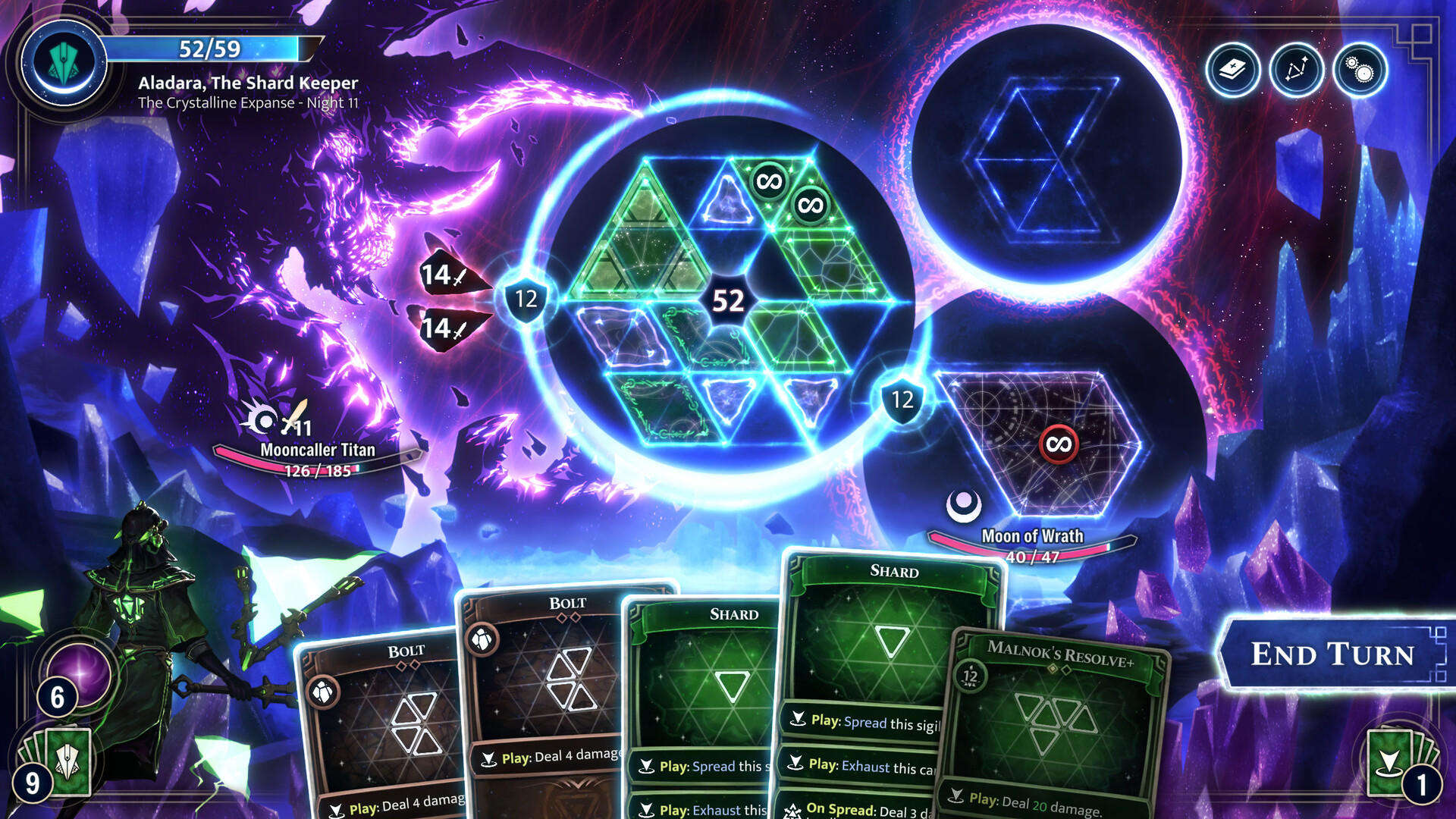
Before we get into the weeds, the elevator pitch: you are one of three mages charting an atlas of the heavens, drawing constellations on a celestial board to fend off cosmic titans that want the moon dead. Cards aren’t cast by paying mana — they are placed, each one occupying a physical footprint on a grid. You play as many cards as you can fit. Run out of room and the turn is over, no matter how much you still want to do. It is a deckbuilder that thinks like a puzzle box, and once it clicks, the genre’s old energy economy starts to feel quaint.
From a two-year build to a confident debut
It helps to understand where Moonsigil Atlas comes from. This is the debut release from Snake Tower Games, a small team that spent roughly two years building the game in public, iterating through a series of demos that steadily sharpened the spatial hook. Those earlier builds — including the Steam Next Fest demo that first put the tile-placement twist in front of a wider audience — showed the idea was special even when the surrounding content was still thin. Twin Sails Interactive, a publisher with a growing reputation for backing clever strategy and board-game-adjacent titles, picked it up for launch, and that pairing shows in the final product’s polish.
That long, demo-driven gestation matters because it explains both the game’s confidence and its limits. The core loop has clearly been play-tested into something tight and intentional; nothing about the spatial economy feels accidental. But it also explains why the launch package leans lean rather than sprawling — the team poured its time into nailing one big idea rather than padding out a roster. Whether that was the right call is, in a sense, the central question of this review.
The pitch: a deckbuilder with no energy
Let’s state the core idea plainly, because everything else grows from it. In Moonsigil Atlas you have a board — a starfield grid — and a hand of cards. Each card has a shape and a size, like a tetromino with attitude. To play a card you must place it onto the board, and you can only place it if there is room. There is no energy bar ticking down, no “you may play one more card” gate. The limiter is purely spatial. Your turn ends when you decide it does or when you simply can’t cram another shape onto the grid.
This sounds like a small tweak. It is not. Energy systems are fundamentally about sequencing in time: which three things do I do this turn, and in what order. Space systems are about arrangement in two dimensions: how do I tessellate my options so that the most valuable ones all coexist on the same board at the same moment. Suddenly a card’s worth isn’t just its effect; it’s the effect divided by the area it eats. A devastating bomb that swallows half the grid might be worse than three modest cards that interlock neatly around it. You start thinking like a Tetris player who happens to be casting spells.
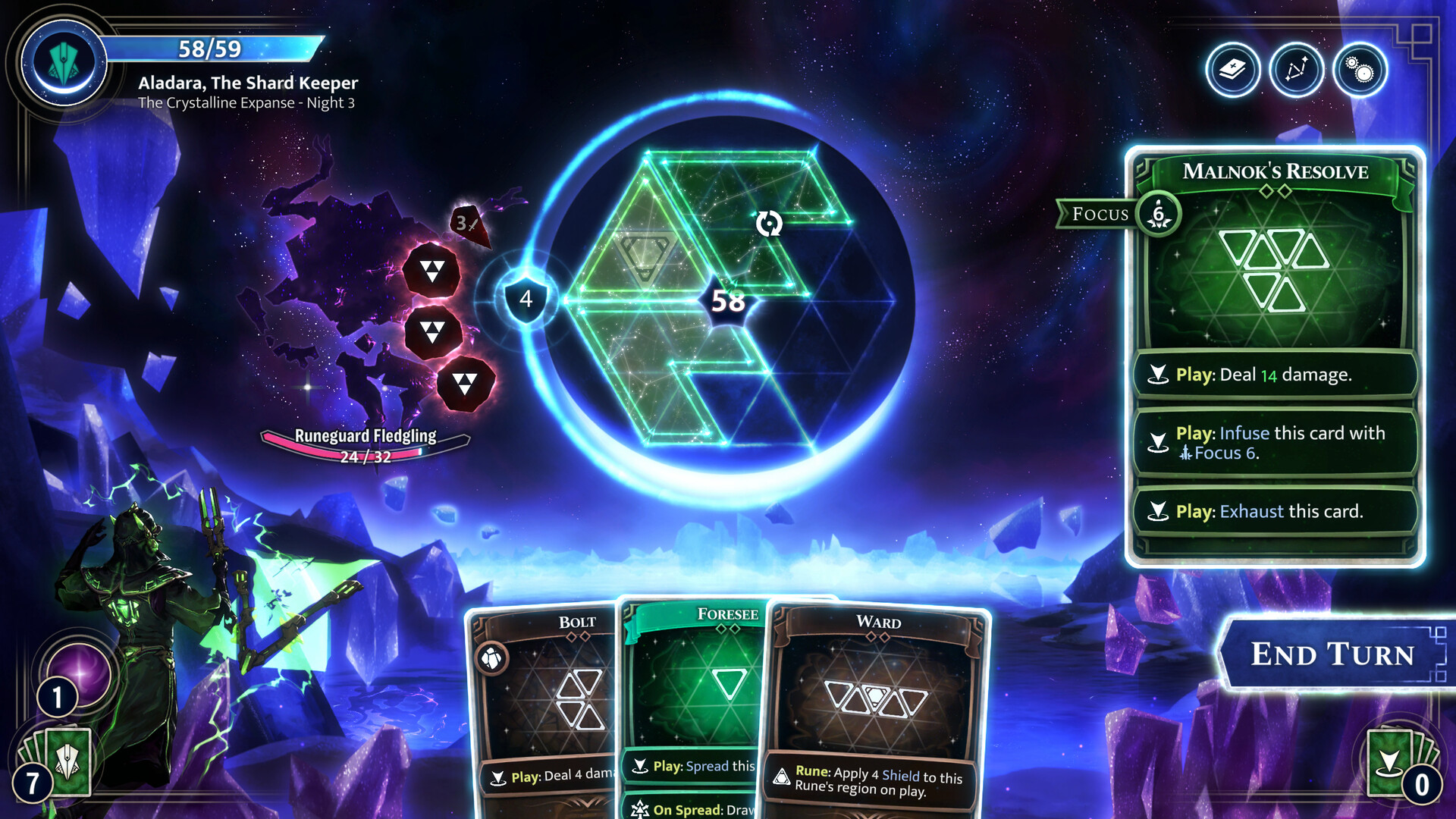
The obvious comparison is Carcassonne, and it is apt — there is real tile-placement DNA here, the satisfying snap of a piece finding its slot. But Moonsigil Atlas layers combat math on top of that spatial logic, so the placement isn’t just tidy, it’s lethal. Cards talk to one another based on where they sit: proximity matters, overlap matters, the runes you’ve etched onto a card matter, and keywords and lasting effects ripple across neighbors. Some cards even grow stronger when laid over ground you’ve already used, rewarding you for planning several turns of real estate in advance. The board becomes a living circuit you are constantly rewiring.
Playing cards in space, not time
What makes the spatial economy sing is how legible it is in motion. You pick up a card, and the game shows you its silhouette hovering over the grid, valid placements glowing, blocked ones greyed out. The fantasy of the “perfect turn” — that Slay the Spire dream of chaining your whole hand into one unbroken combo — is here reframed as a packing problem. Can I fit the engine piece, the payoff piece, and the two enablers it needs, all touching, all inside the space I have? When you solve it, the dopamine is enormous, because you didn’t just draw well; you arranged well.
Crucially, the board isn’t static. Enemies push back on your space directly, and that is where the design reveals its teeth. Rather than simply chipping at your health, foes deny you territory: they corrupt tiles, wall off regions, and shrink the usable area until your beautiful interlocking machine no longer fits. A turn that would have been trivial on an open board becomes an agonizing triage when half the grid is on fire. You are not only building an engine; you are defending the floor space that engine needs to run.
The result is a combat rhythm that feels distinct from anything else in the genre. In a typical deckbuilder you optimize a sequence and hope the draw cooperates. Here you are negotiating with the geography of the encounter turn by turn, and the geography is actively hostile. It rewards a flexible, improvisational mind over a memorized line. Two runs with an almost identical deck can play completely differently depending on how the board gets carved up, which does a lot of heavy lifting against the repetition that plagues lesser roguelikes.
Anatomy of a turn
To make the spatial economy concrete, picture a representative turn. You open with a board that’s mostly clear and a hand of cards, each a different footprint. Your instinct from other deckbuilders is to lead with your biggest hitter, but here that instinct can betray you: drop the largest shape first and you may strand a corner of the grid too small to hold the enabler that would have doubled its value. So you pause and you plan the packing — which piece anchors where, which neighbors it needs to touch, how the leftover space tessellates.
You lay an engine card centrally, then nestle a smaller support piece so its edge overlaps the engine, triggering an adjacency bonus. A rune you etched two fights ago turns that support into a repeatable effect, so now every placement nearby pings extra value. You slot a third card into the gap you deliberately left, and suddenly the board is humming — each new tile feeding the cluster you’ve been assembling. The next card doesn’t fit anywhere useful, so you hold it. That restraint, the decision not to play a card because the geometry isn’t right, is a texture the energy-based deckbuilder rarely offers.
Then the enemy acts, corrupting two tiles at the heart of your layout, and next turn the machine you built no longer fits the same way. You adapt — reshape a card to squeeze around the corruption, or commit to a burst before the board shrinks further. This is the core loop: not “what’s my optimal sequence” but “how do I solve this turn’s puzzle with the pieces and the space I’ve got.” It is deckbuilding as spatial improvisation, and it stays fresh far longer than a memorized line ever could.
Shaping the deck: 250 cards and a soldering iron
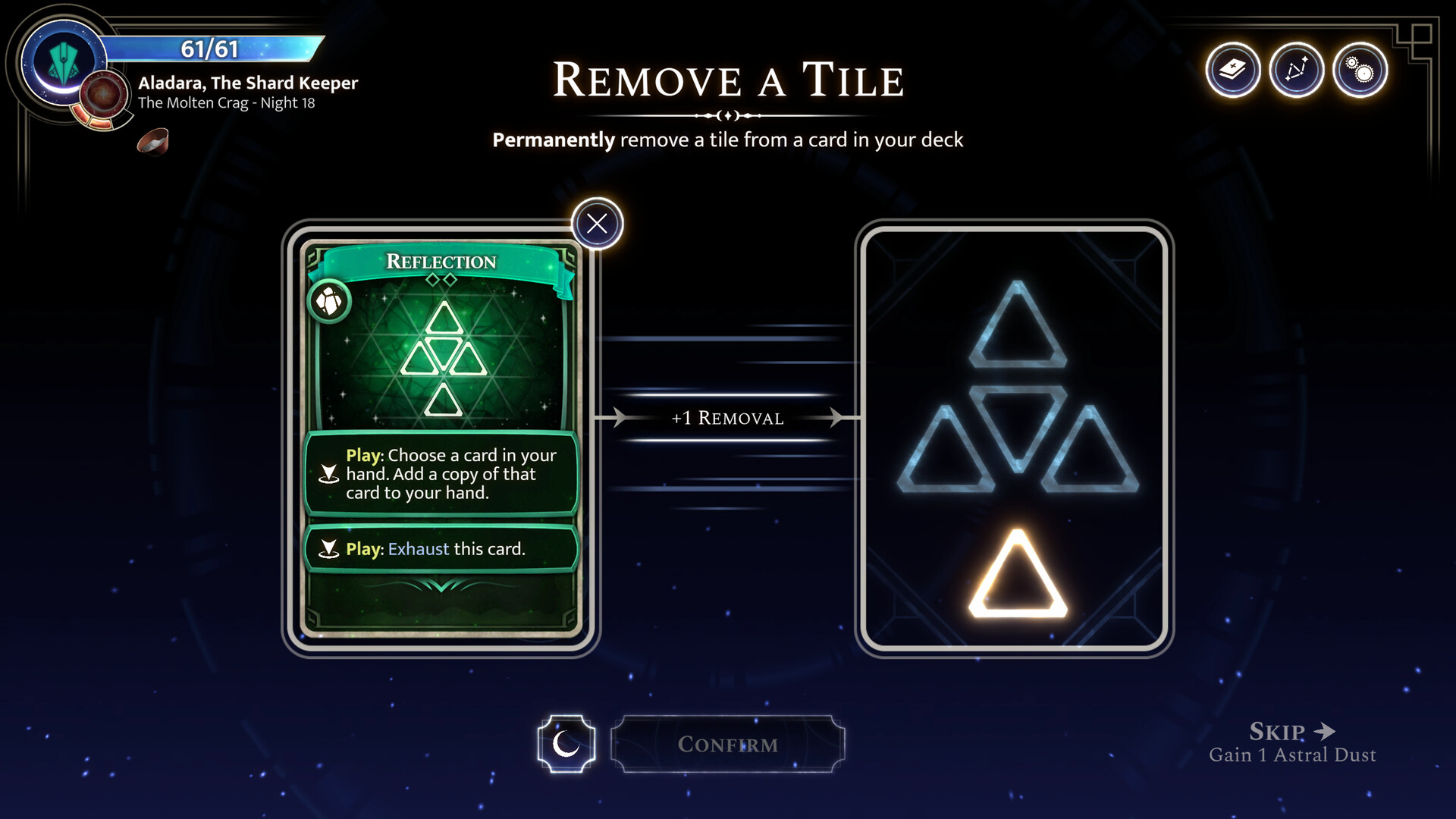
If spatial play is the hook, the deck modification is the depth. Moonsigil Atlas ships with over 250 cards, but the more interesting number is the one you can’t count: the permutations created by the game letting you physically alter your cards. You can change a card’s shape — trimming a footprint so it slots into tighter spaces, or reshaping it to overlap a key neighbor. You can etch runes directly onto cards to bolt on new effects. You can modify existing cards rather than only acquiring new ones, which means your starting tools evolve alongside your finds.
This turns deckbuilding into something closer to deck engineering. The question stops being “which cards do I add” and becomes “how do I reshape what I have so it tessellates into a machine.” A card that was awkward and oversized early can be filed down into the perfect connective tissue by mid-run. A bland attack becomes a combo lynchpin once you stamp the right rune on it. The build variety that emerges is genuinely staggering, and it is the main reason the game survives the “just one more run” test so well.
It also feeds directly into the genre’s most beloved sensation: the run where you break the game over your knee. Moonsigil Atlas openly invites this, and the systems deliver. When you finally assemble a self-perpetuating loop — a cluster of overlapping cards that feed each other across the board until the numbers go silly — it scratches the exact itch Balatro made fashionable. The difference is that getting there is a spatial achievement, not just a sequencing one, so it feels earned in a slightly different muscle.
There is a balance cost to this generosity, which I’ll return to in the criticisms. But as a sandbox for tinkerers, the card system is a triumph. It is the kind of design that makes you open the notes app and start sketching builds when you’re supposed to be doing something else.
Runes, overlap, and the grammar of synergy
It’s worth dwelling on how cards talk to each other, because that grammar is what gives the spatial layer its depth. Synergy here is positional. A keyword might fire based on what sits adjacent; an effect might scale with how many cards cluster in a region; a card might pay out more when laid over a tile you’ve already activated. Runes are the wildcard — little modular stamps you affix to cards to graft on triggers, turning an inert filler piece into the glue that binds a whole layout together.
The upshot is that your deck isn’t a list, it’s a set of interlocking parts you’re constantly machining to fit. You don’t just want good cards; you want cards whose shapes and runes let them coexist on the same board at the same time. Two individually strong cards that can never be placed adjacently are worth less than two modest ones engineered to overlap into a loop. That is a genuinely different optimization target from anything the genre’s big names ask of you, and it’s the source of the game’s deepest ‘aha’ moments.
Three mages, three philosophies
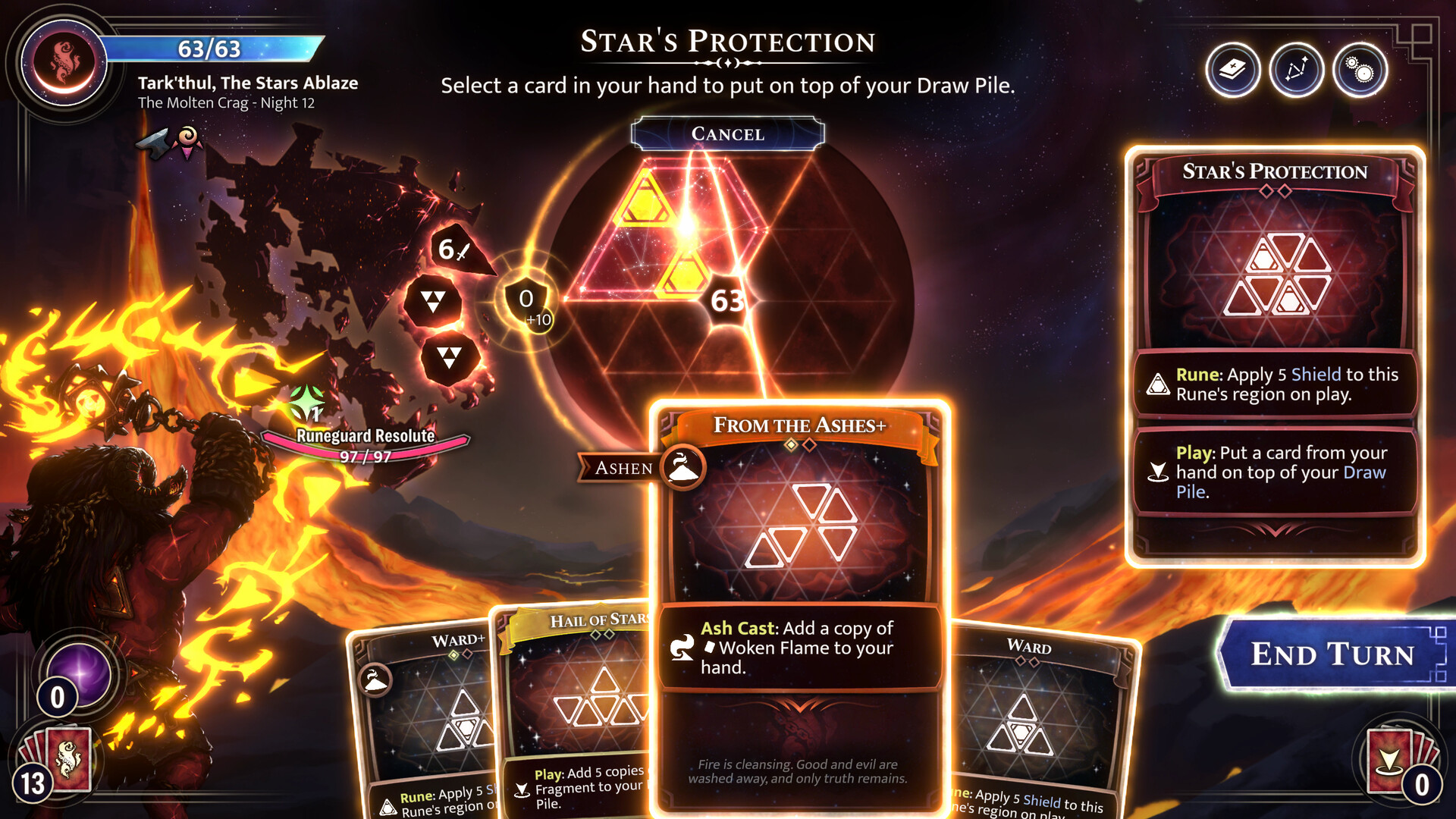
You explore all of this through three playable mages — Feldryn, Aladara, and Tark’thal — and to the developer’s great credit, they are not reskins. Each plays to a fundamentally different relationship with the board. One is built around controlling board width, stretching and dominating the available space so that no card ever wants for room. Another rewards compact, dense engine builds, where the whole game is about packing maximum interaction into minimum area. A third leans into burst turns and repeatable rune effects, front-loading explosive output rather than slow accumulation.
Because the resource you’re managing is space itself, these identities aren’t cosmetic — they change the literal geometry of how you play. A wide-control mage encourages sprawling, luxurious layouts; a compact-engine mage turns every run into a study in efficiency and overlap; a burst mage has you spending the board like a currency you fully intend to be broke by turn’s end. Learning one well does not teach you another, which is the highest compliment you can pay a roster of this kind.
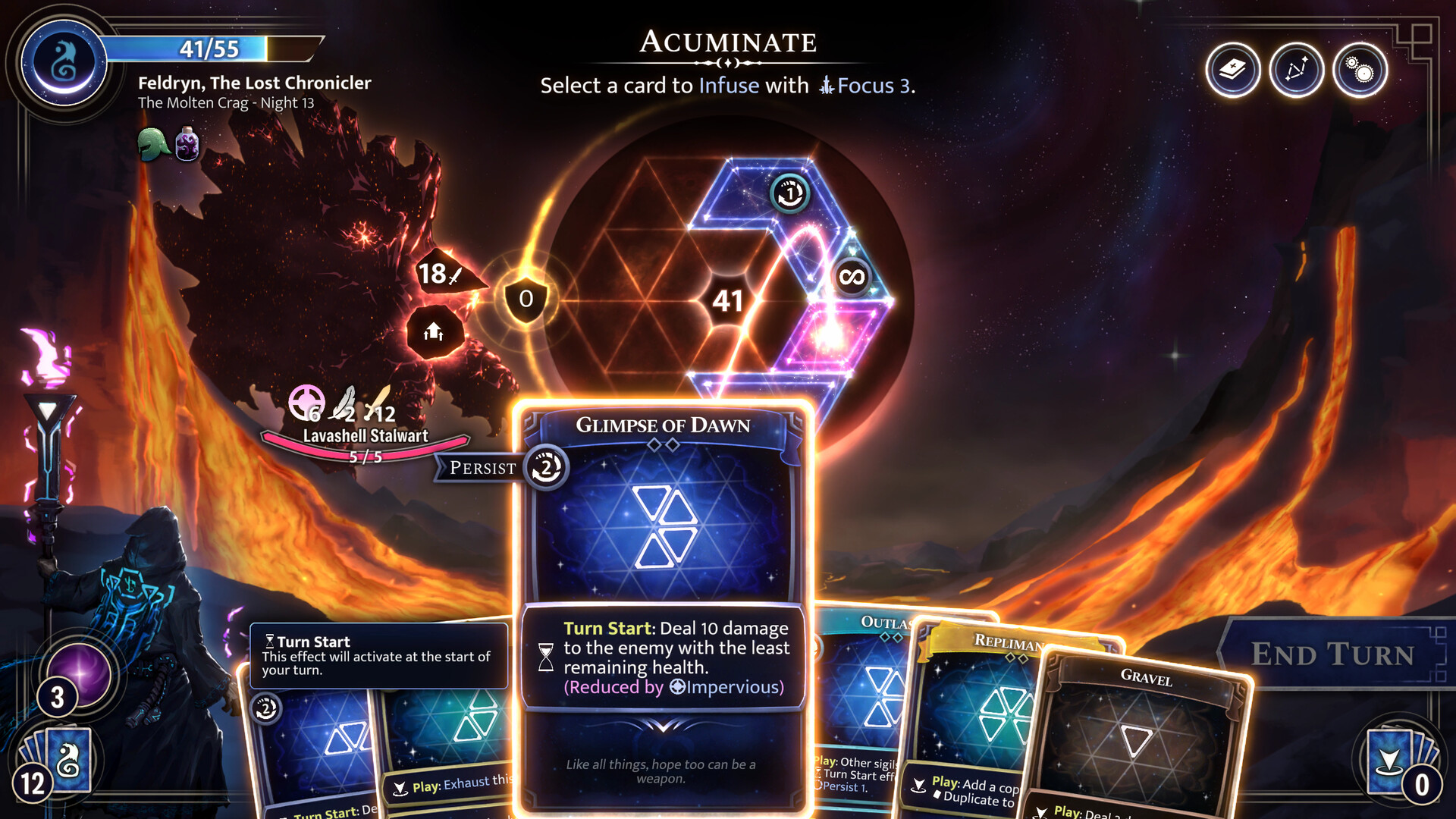
Each mage also has its own card pool that unlocks through play, so mastery is gated behind familiarity. The upside is a real sense of progression and discovery as your toolkit blooms; the downside is that the roster is simply small. Three characters is enough to demonstrate that the design scales across wildly different playstyles, but it leaves you wanting a fourth and fifth almost as soon as you’ve internalized the first three. The architecture clearly supports more. It just isn’t here yet.
The three-mage structure also shapes the game’s learning curve in a smart way. Because each character demands a different mental model of the board, switching mains is almost like learning a new mode, which extends the runway considerably even with a small roster. A player who has “solved” the compact-engine mage will find their hard-won instincts actively unhelpful on the wide-control one, and that productive friction is exactly what keeps a roguelike from going stale. It also means the difficulty of mastery stays high even where the difficulty of completion sometimes isn’t.
Titans and the astral realm
Structurally, a run sends you climbing through a randomly generated astral realm toward a confrontation with one of three titans — and these are not your standard escalating damage-sponges. The titans attack the board itself. They create hostile zones, warp the grid, and impose special conditions that force you to adapt your whole approach mid-fight.
This is where the spatial conceit pays its biggest narrative and mechanical dividends. A boss that simply hits hard tests your deck. A boss that eats your floor tests your composure. The best titan fights in Moonsigil Atlas are tense little puzzles of adaptation, where you’re recalculating the geometry of survival every turn and feeling genuinely clever when you wriggle out of a collapsing board with a lethal swing. They are the high points of the game, and they make the climb feel like it’s building toward something rather than just looping.
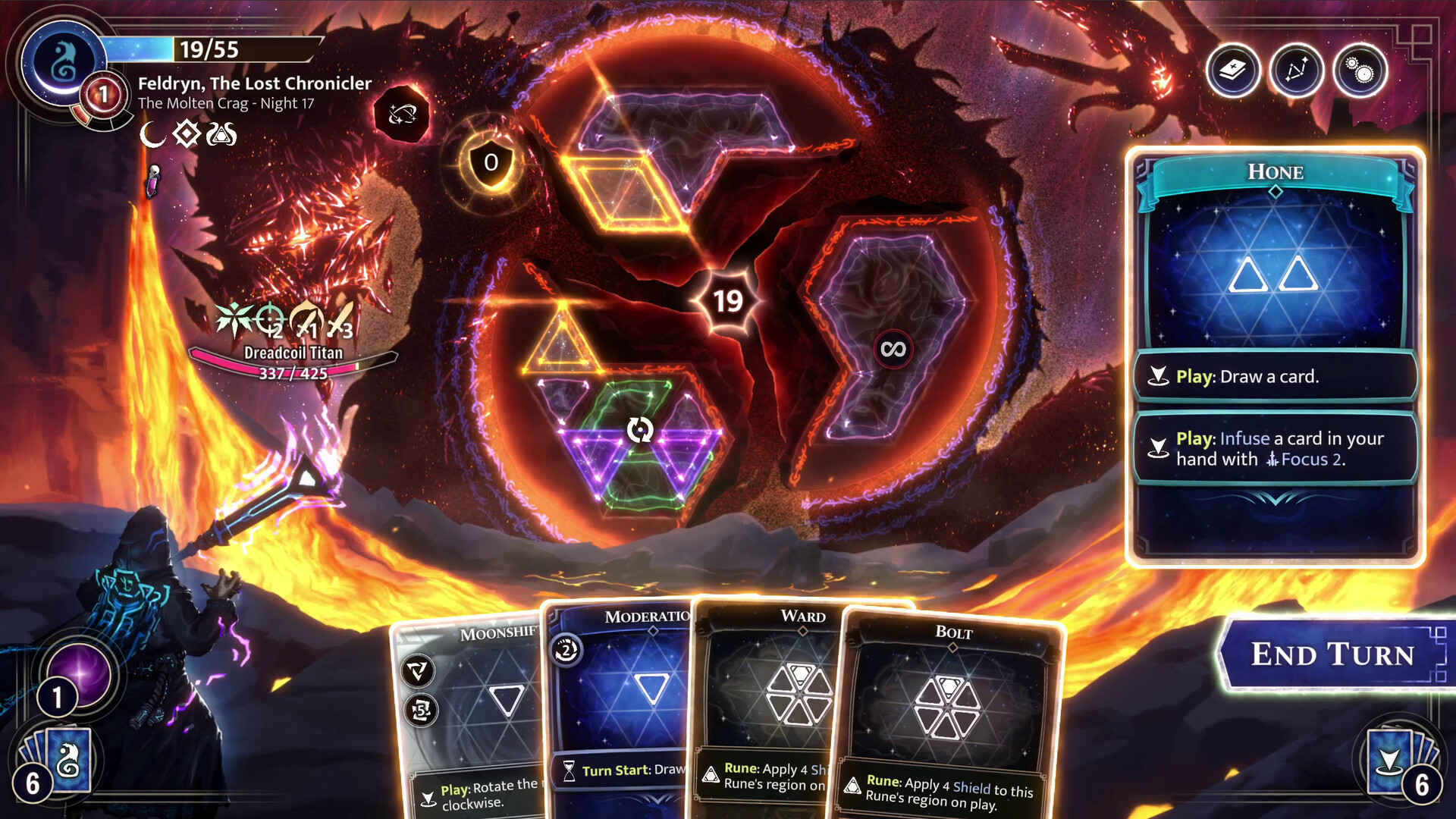
That said, the road to the titans can feel familiar after enough runs. The encounter variety between bosses doesn’t always keep pace with the brilliance of the bosses themselves, and the moment-to-moment map structure — choose a node, fight or shop, repeat — is the genre’s most well-worn skeleton, lightly dressed. The titans elevate the destination; the journey is sturdier than it is surprising.
When the real moon changes your run
The game’s most charming flourish is also its most literal nod to its title. Moonsigil Atlas reads the real-world lunar phase and lets the actual moon overhead nudge your run. The state of the sky on the day you sit down to play subtly colors the conditions you encounter, a small piece of ambient magic that ties this celestial card game to the genuine celestial clock outside your window. It is the kind of detail that has no business mattering and yet makes the world feel a degree more alive.
Mechanically it is a light touch rather than a run-defining system, and you can enjoy the game without ever consciously tracking it. But thematically it is a lovely bit of craft. In a genre where flavor is too often wallpaper, Moonsigil Atlas reaching out to bind itself to the real sky is exactly the kind of small ambition I want to reward.
The difficulty curve and the long game
Roguelikes live or die on their long game — the dozens of hours after the credits, when the loop has to sustain itself on mastery and variety rather than novelty. Moonsigil Atlas mostly delivers here, and the engine is the card system. With 250-plus cards, shape editing, and runes, the space of viable builds is vast. The spatial puzzle also resists rote solutions: because the board gets reshaped by enemies every fight, you can’t simply replay a memorized opening, which is the death of replayability in weaker entries.
Where the long game wobbles is difficulty consistency. The same generosity that makes build experimentation joyful means a skilled player can, on a good run, assemble a loop that flattens the back half of the climb. The first time you break the game it’s euphoric; the tenth time, you start to wish the titans pushed back a little harder against dominant strategies. The fights that consume your board are the best counter to this — they punish over-reliance on a single fragile layout — but the regular encounters between bosses don’t always keep the pressure on.
None of this is unusual for the genre, and it’s the kind of thing post-launch tuning and new content tend to address. But it’s worth setting expectations: Moonsigil Atlas is at its most thrilling while you’re still learning each mage and discovering the board’s tricks. Once you’ve internalized a character, the challenge can soften even as the satisfaction of clean execution remains. How much that matters depends entirely on whether you play roguelikes for the cliff or for the comfortable cruise afterward.
Pacing and the ‘one more run’ problem
A single run lands in that comfortable roguelike pocket — long enough to develop a build, short enough to fit in a sitting — which is ideal for the Steam Deck sessions the game seems designed around. The pacing within a run is well judged: early fights are loose enough to let you lay foundations, the mid-game tightens as enemies start contesting your space in earnest, and the titan finale forces you to prove your engine under pressure. That arc, repeated with a different mage or a different seed, is the rhythm you’ll settle into.
The “one more run” pull is strong, and it comes overwhelmingly from the build sandbox rather than from chasing the next unlock. That’s the healthiest reason a roguelike can hook you, and it speaks to how generative the core systems are. When a game has you theorycrafting away from the screen, it has done the most important part of its job.
Presentation: a classy night sky
Visually, Moonsigil Atlas is understated and elegant rather than flashy, and it suits the material. The board reads like an illuminated star chart, cards and runes glowing against deep cosmic blues and silvers, constellations forming as your layouts take shape. There’s a tactility to placing a piece — the snap, the shimmer, the way completed synergies light up their neighbors — that makes the core interaction feel good a thousand times over. Critically, it is also clear: in a game about geometry, you can always parse what fits where and why, which is no small feat of interface design.
The audio matches. A moody, atmospheric score sits low and patient under the puzzle, swelling at the right moments without ever stepping on your concentration, and the sound effects give each placement and trigger a satisfying weight. It is the kind of presentation that doesn’t demand attention but rewards it — exactly what a long-haul roguelike needs, since you’ll be staring at this board for a very long time. The bite-sized run structure and tap-friendly board also make it close to ideal handheld fare.
I want to single out the interface specifically, because a game built on geometry succeeds or fails on whether you can read the geometry at a glance. Moonsigil Atlas nails it. Valid placements light up, footprints preview cleanly as you hover, and triggered synergies visibly pulse across the cards they touch, so cause and effect are never a mystery. In a genre where information overload is a constant risk, the clarity on display is its own quiet achievement, and it’s a big part of why the game stays approachable despite the depth lurking underneath.

Where it stumbles
For all its invention, Moonsigil Atlas is a debut, and it wears a few debut growing pains. The most immediate is content breadth. Three mages and three titans is a confident, well-curated core, but it is a core, and dedicated genre players will see most of what the game has to structurally offer faster than they’d like. The 250-plus cards keep build experimentation fresh long after the run skeleton has gone familiar, but there’s a ceiling on novelty that a fourth character or a second realm would meaningfully raise.
The progression model is the other sticking point, and it’s a matter of taste. Mastery unlocks cards over time rather than handing you the full pool up front or layering in passive meta-bonuses. For players who love the long unlock drip, that’s a feature. For players who’d rather theorycraft with the complete toolbox from hour one, it can feel like the game is withholding its best ideas behind a grind. I land somewhere in the middle: the drip suits the early runs, but I’d have traded some of it for a faster route to the full sandbox.
A handful of smaller frictions round out the picture. The sheer flexibility of the card-editing tools can be daunting at first — the game trusts you to find your own build with relatively light hand-holding, and newer deckbuilder players may feel briefly adrift before the systems click. And while the board reshaping keeps fights varied, the connective tissue between them — the shops, the events, the node-by-node map — is competent rather than memorable, and could use more of the inventiveness the combat shows off.
There’s also a gentle tension between the “break the game” ethos and lasting challenge. When the combo ceiling is this high and the tools to reach it this malleable, a confident builder can trivialize encounters once they crack a dominant spatial loop. That euphoria is part of the appeal — it’s the whole Balatro promise — but it does mean the difficulty can wobble, soaring on a fresh run and deflating once you’ve found your engine. And while the cosmic-mages-versus-titans setting is atmospheric, it’s thin as a story; the world is a mood, not a narrative, and players hungry for a hook beyond the systems won’t find much to chew on.
How it stacks up against the genre
Set beside its peers, Moonsigil Atlas occupies a niche all its own. Slay the Spire remains the genre’s grammar — the energy-and-intent model everyone else either adopts or reacts against — and Moonsigil Atlas is one of the boldest reactions, swapping the entire resource premise rather than tweaking it. Against Balatro, it shares the gleeful pursuit of game-breaking combos, but where Balatro is about escalating multipliers, Moonsigil is about escalating arrangements; the joy is geometric rather than numerical.
The clearest mechanical cousin is actually the board-game world it borrows from. The tile-placement satisfaction of Carcassonne is right there in every snap of a card into a gap, and there’s a whiff of Inscryption’s board-as-battlefield thinking in how enemies manipulate your play space. What Moonsigil Atlas does that none of them quite manage is fuse the spatial puzzle and the deckbuilding combo-engine into a single act — placing a card is simultaneously your resource decision, your synergy decision, and your positioning decision.
That fusion is the whole argument for the game. If you bounce off it, it’ll likely be because you wanted the comfort of the familiar energy loop and found the constant spatial reckoning exhausting rather than exhilarating. But if it lands, it makes a lot of other deckbuilders feel like they’re only using half the table.
Value, comparisons, and who it’s for
At $19.99, Moonsigil Atlas is priced exactly where it should be, and arguably a touch under given how much build experimentation is on offer. If your shelf already holds Slay the Spire, Monster Train, and Balatro, this slots in beside them as the “spatial one” — the deckbuilder you reach for when you want the genre’s satisfactions filtered through a packing puzzle rather than a sequencing one. Newcomers are well served too; the spatial limiter is, if anything, more intuitive to grasp than abstract energy, and the glowing-placement interface teaches itself.
The one audience I’d caution is the player who comes to deckbuilders purely for cathartic power fantasy with minimal friction. Moonsigil Atlas asks you to think every single turn — there is no autopilot, no turn where you simply dump your hand and move on, because the packing problem is always there. For most genre fans that constant engagement is the entire draw. For someone who wants to switch their brain off and watch big numbers happen, the spatial demands may occasionally feel like homework. It’s worth knowing which player you are before you buy.
The shape of the thing is simple enough to state plainly: the central idea is special — the tile-placement hook is what elevates an already-solid deckbuilder — and the package around it is good-not-yet-great.
A few notes for newcomers
If you’re coming in fresh, a little orientation goes a long way. Resist the deckbuilder reflex to dump your biggest card first; in Moonsigil Atlas, sequencing your placements to preserve useful space is usually more important than raw power. Treat the empty board as a resource to be spent deliberately, and pay attention to which cards reward overlap or adjacency, because those are the seeds of the loops that win runs. When you pick up a rune or a reshaping option, think about it as a way to make your existing cards fit together better, not just hit harder.
Above all, lean into experimentation. The game is at its best when you’re trying to engineer a combination it surely didn’t intend, and the relatively forgiving early difficulty gives you room to fail and iterate. Each of the three mages will teach you a different lesson about space, so if one playstyle isn’t clicking, switching characters can feel like a fresh start rather than a lateral move. Give it the handful of runs it takes for the spatial logic to become second nature; that’s the moment the whole design opens up.
The verdict
Moonsigil Atlas is the rare deckbuilder that earns its place not by polishing the formula but by rethinking its fundamental currency. Spending board space instead of energy turns every turn into a spatial puzzle that the genre’s veterans haven’t solved a hundred times already, and the deep card-reshaping, rune-etching toolkit gives that puzzle near-endless permutations. Three genuinely distinct mages and a trio of board-warping titans prove the idea scales, and the whole thing is wrapped in an elegant star-chart presentation that’s a pleasure to sit with for the long haul.
What lingers is how complete the central idea feels even when the package around it isn’t. Plenty of games have a clever hook that frays under scrutiny; Moonsigil Atlas has one that only deepens the more you press on it. Spending space instead of time isn’t a gimmick bolted onto a familiar chassis — it reshapes deckbuilding, synergy, boss design, and even how you read your own hand, all at once. That kind of coherent, load-bearing idea is rare, and it’s worth celebrating even with the caveats attached.
It is held back, for now, by a slim roster, an unlock-gated progression curve that won’t suit every theorycrafter, and a run structure whose journey isn’t quite as inventive as its destinations. None of that dulls the central achievement. This is one of the freshest things to happen to the roguelike deckbuilder since Balatro, and it is the easiest recommendation I can make to anyone who thought the genre had run out of new ideas. Snake Tower Games has built a foundation worth returning to — and worth watching as it grows.
Moonsigil Atlas is available now on Steam for PC and Linux at $19.99, with a launch discount running early on. For a debut from a small studio, it’s a remarkably assured statement of intent — and if Snake Tower Games keeps building on this foundation with more mages, more realms, and a little more friction at the top end, the sequel or the post-launch roadmap could turn a very good deckbuilder into an essential one. As it stands, it’s already one of 2026’s most pleasant surprises.