The central conceit of Tides of Tomorrow is easiest to explain with a single scene. You are picking your way through the waterlogged ruins of what was once a hospital, searching for medical supplies to treat a companion whose arm is slowly hardening into translucent plastic. You find a locked cabinet. The combination has been scratched into the wall — but not by a developer. By another player, someone who passed through this exact corridor days or hours before you, and chose to leave a clue behind rather than hoard the supplies. Or perhaps they left a false combination. You have no way of knowing until you try.
That uncertainty — that low-level hum of not quite trusting the footprints left in front of you — is the emotional core of DigixArt’s ambitious second major title. When the game leans into it, Tides of Tomorrow achieves something no other narrative adventure has managed. It makes you feel the presence of other human beings in a single-player story, not as co-op partners or competitive opponents, but as ghosts whose choices have reshaped the world you inhabit. It is a remarkable trick. It is also a trick that the rest of the game does not always know how to support.
From Road 96 to Open Water
DigixArt earned a cult following with Road 96, a procedurally arranged narrative adventure about hitchhiking across a fictional authoritarian nation. That game was scrappy and uneven — its best moments sparkled with genuine emotional intelligence, while its worst felt like interactive student films. Tides of Tomorrow is a dramatically more confident work. The studio has clearly grown, both technically and creatively, and the leap in ambition is evident from the opening moments.
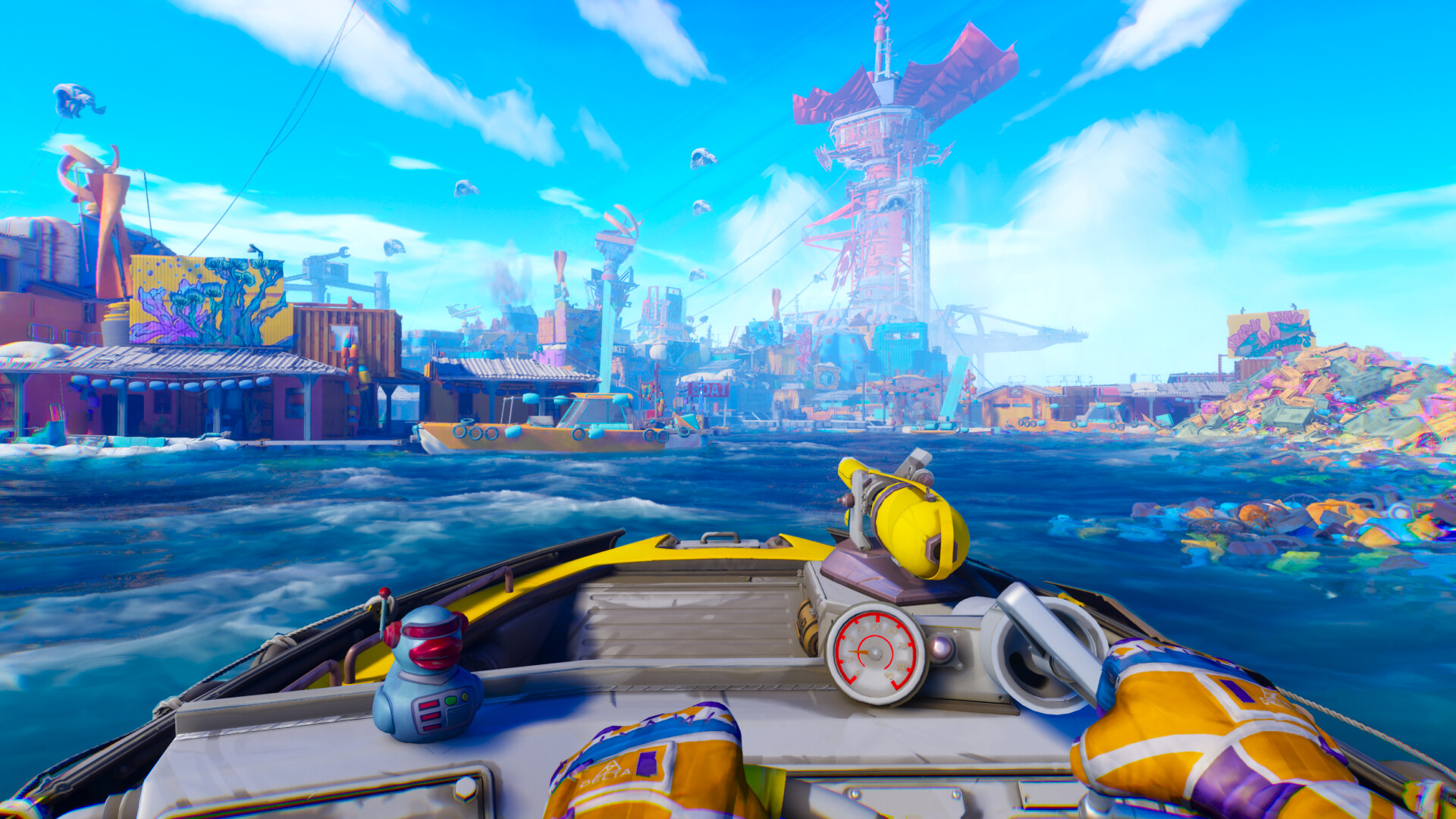
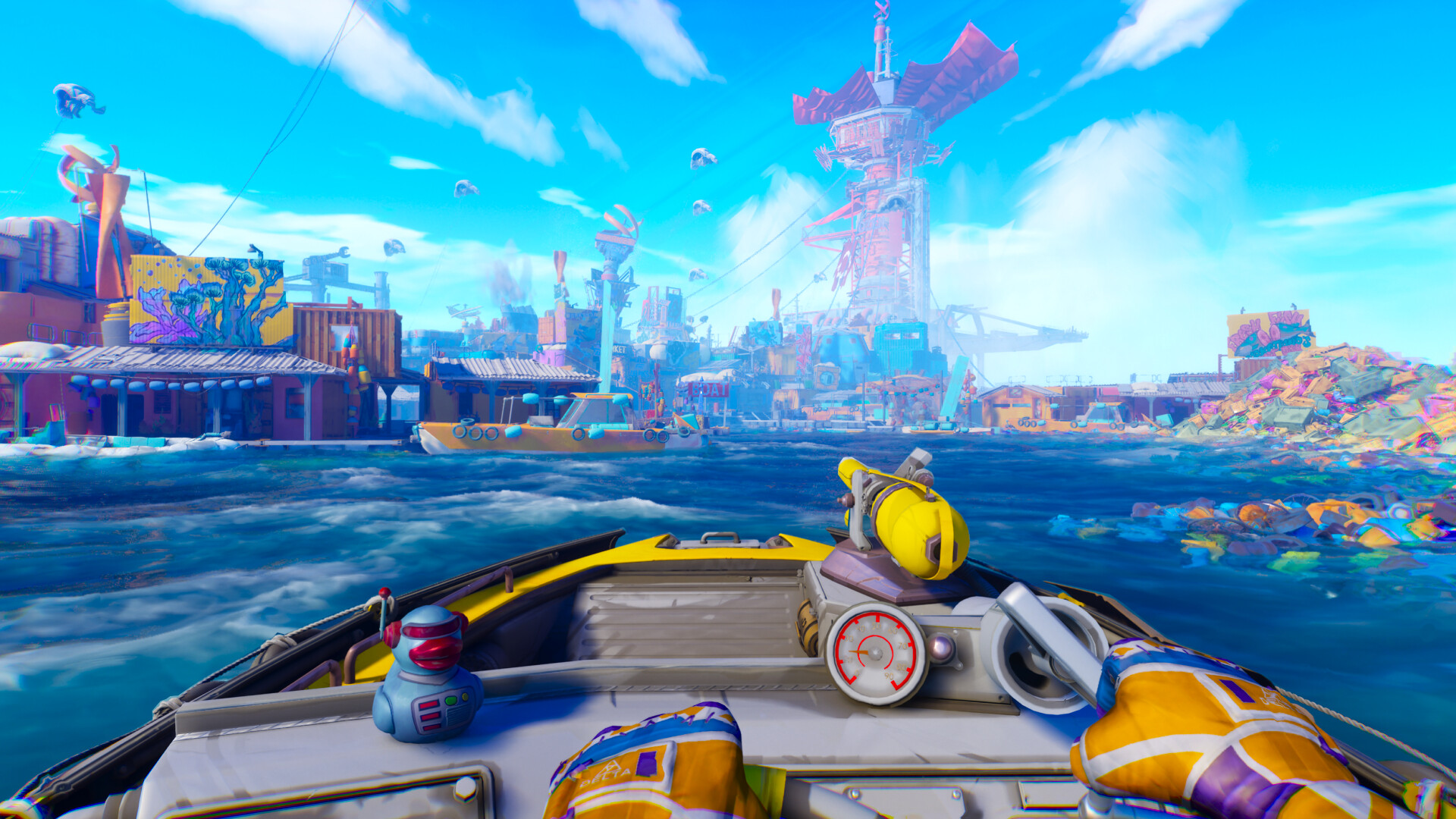
Where Road 96 shuffled randomized vignettes along a single highway, Tides of Tomorrow drops players into a fully realized open world — or, more accurately, an open ocean. The planet Elynd has been devastated by a cataclysmic flood known as the Great Submersion. Continents are gone. Cities exist only as half-drowned skeletal towers poking through the waterline. Humanity clings to survival on floating settlements, repurposed oil rigs, and lashed-together flotillas of salvaged debris. It is a post-apocalypse rendered not in the usual browns and grays, but in vivid teals, corals, and sun-bleached whites. The art direction is one of the game’s most immediate and lasting strengths.
The shift from road to sea is more than cosmetic. Road 96’s structure was inherently episodic — a series of encounters along a linear path, reshuffled between playthroughs. Tides of Tomorrow maintains DigixArt’s fascination with procedural variation but embeds it within a continuous, interconnected world. The result is a game that feels both more cohesive and more expansive than its predecessor, one that trusts the player to chart their own course through its narrative rather than simply presenting randomized stops along the way. It is a meaningful structural evolution, and it allows the game’s strongest ideas — particularly the Story-Link system — to breathe in ways that Road 96’s format would not have permitted.
You play as a Tidewalker — an amnesiac survivor pulled from the sea by a small crew of scavengers aboard a vessel called the Driftwood. Your body bears the early marks of Plastemia, the central threat: a mysterious disease that gradually transforms living tissue into rigid, translucent plastic. It is a wonderfully unsettling concept, body horror rendered with an almost pastel delicacy. Fingers stiffen. Skin takes on a faint sheen. The transformation is slow enough to create genuine dread but fast enough that every hour spent searching for the rumored cure — a rare compound called Ozen — feels urgent.
The Plastemia concept does triple duty as a gameplay mechanic, a narrative device, and a thematic metaphor. On the mechanical level, your disease progression acts as a soft timer — spend too long exploring side content without advancing toward a cure, and your condition worsens, limiting your physical capabilities and eventually locking you out of certain dialogue options as your jaw stiffens. Narratively, Plastemia is the engine that drives every faction’s ideology: the Marauders hoard the cure, the Reclaimers try to synthesize it, and the Mystics argue that the disease is itself the answer. And thematically, the slow transformation into something rigid and lifeless serves as a potent metaphor for the loss of humanity — both individual and collective — in a world where survival has become the only value that matters.
The Online Story-Link: A Genuine Innovation
The Online Story-Link system is the centerpiece of Tides of Tomorrow, and for good reason: it is genuinely unlike anything else in the genre. Every time you begin a new chapter, you select the name of a player who has already completed that section. You then play through the chapter in a version of the world shaped by that player’s choices. Doors they opened remain open. NPCs they killed are dead. Resources they consumed are gone. Scattered throughout the environment are echoes — spectral imprints of the previous player’s actions that you can observe, learn from, or deliberately contradict.
The system creates a layered, communal narrative that feels less like traditional multiplayer and more like reading a book in which someone has underlined passages and scrawled notes in the margins. Sometimes those notes are helpful. Sometimes they are misleading. Sometimes they reveal that the previous player made a choice you find morally repugnant, and you are left to navigate a world scarred by their decisions. It forces you to reckon not just with fictional consequences but with the real human impulses that produced them.
In practice, the Story-Link manifests in dozens of small ways. A bridge that one player chose to destroy might force you to find an alternate route, discovering a hidden settlement you would never have encountered otherwise. A faction leader assassinated in a previous run might be replaced by a far less sympathetic successor in yours. Supplies left in caches by generous players can be a lifeline; traps set by malicious ones can be deadly. The game tracks all of this silently, never calling attention to the seams between your narrative and the inherited one.
The echoes themselves are haunting. They appear as translucent blue figures, frozen in the moment of a key decision — reaching for a lever, pointing a weapon, extending a hand. You can choose to follow their path or diverge from it, and the game subtly acknowledges your alignment or rebellion through shifts in dialogue and environmental storytelling. In the best moments, encountering an echo feels like finding a message in a bottle: a fleeting connection with a stranger who navigated the same storm.
The comparison to Death Stranding is inevitable and largely apt. Hideo Kojima’s 2019 game pioneered the concept of asynchronous community interaction within a single-player framework, using ladders, bridges, and supply drops left by other players to create a sense of shared endeavor. Tides of Tomorrow takes that concept and applies it to narrative rather than traversal. Where Death Stranding’s social strand was about physical infrastructure, Tides of Tomorrow’s is about moral infrastructure — the choices, consequences, and ethical compromises that accumulate as players move through a shared story. It is a more intimate and arguably more ambitious application of the idea, and when it works, it creates emotional resonance that Death Stranding’s bridges never quite achieved.
There are limitations. The system requires an internet connection. DigixArt has confirmed that AI-generated profiles will fill gaps when the player pool is thin, but these synthetic echoes lack the unpredictability that makes the human ones compelling. The system also introduces narrative inconsistency — when the world state shifts dramatically based on a previous player’s choices, it can occasionally create jarring tonal whiplash as your personal story struggles to accommodate the inherited context.
There is also a philosophical tension at the heart of the system that the game never fully resolves. The Story-Link asks you to invest emotionally in a narrative whose most important variables were determined by someone else. In a traditional choice-driven game, the weight of a decision comes from knowing that you made it. In Tides of Tomorrow, you are often navigating the aftermath of choices you had no part in, and while the game frames this as a feature rather than a bug — a commentary on how we all inherit the consequences of others’ decisions — it can sometimes feel like the rug has been pulled out from under your agency. Players who prioritize authorship over exploration may find this frustrating rather than liberating.
But these are growing pains, not fatal flaws. The Online Story-Link is the kind of idea that makes you excited about the future of interactive storytelling. It is a proof of concept that will almost certainly be adopted, refined, and expanded upon by other developers. DigixArt deserves real credit for shipping it first, and for making it work as well as it does.
Navigating Elynd: Factions, Choices, and Consequences
The narrative unfolds across roughly ten to fifteen hours, depending on your pace. The Driftwood serves as your mobile hub — a creaking, lovingly detailed vessel that you gradually upgrade with salvaged materials. From the bridge, you chart courses across Elynd’s vast ocean, choosing which settlements to visit and which distress signals to investigate. The game presents a satisfying illusion of freedom, though the main narrative beats are largely fixed in sequence. It is the spaces between those beats — the side stories, the environmental discoveries, the faction encounters — that offer the most meaningful variation.
Three major factions dominate Elynd’s political landscape, and each represents a coherent but flawed response to civilizational collapse. The Marauders, led by the ruthless warlord Obin, control the largest stockpile of Ozen and enforce their dominance through violence. They are conventional antagonists on the surface, but Obin himself is more nuanced than the archetype suggests — a man who genuinely believes that rationing salvation through force is the only way to prevent total societal collapse. His logic is brutal but internally consistent, and the game wisely avoids making him a cartoon villain. There are moments when his arguments are uncomfortably persuasive.
The Reclaimers are engineers and idealists who believe that Elynd’s flooded cities can be rebuilt and who seek to develop a synthetic Ozen substitute. They represent hope through technology — the conviction that human ingenuity can solve any problem given sufficient time and resources. But their optimism has a cost: they are so focused on the future they are trying to build that they often neglect the people suffering in the present. Several Reclaimer side quests involve uncomfortable ethical trade-offs where short-term human welfare is sacrificed for long-term scientific progress.
And the Mystics are perhaps the most philosophically interesting faction — a spiritual movement that views Plastemia not as a disease but as a transformation, a painful but necessary evolution toward a new form of existence. They argue that humanity’s attachment to its current biological form is a kind of vanity, and that true survival means embracing change rather than fighting it. It is a perspective that the game treats with surprising respect, never reducing the Mystics to simple death-cult antagonists. Their rituals are strange and sometimes disturbing, but the underlying philosophy raises genuine questions about what it means to survive versus what it means to live.

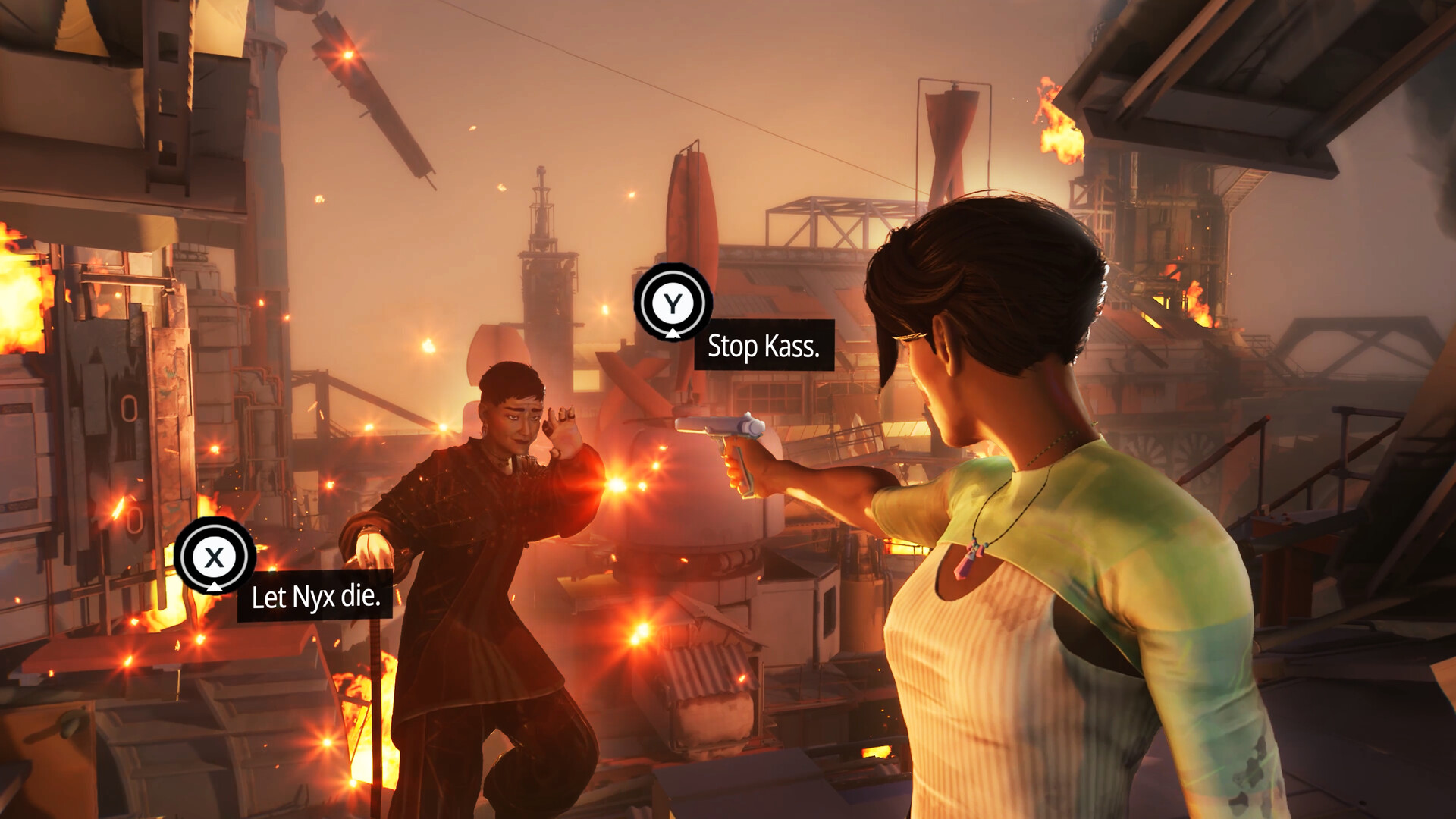
Your relationship with each faction is tracked through a nuanced reputation system, and the game rarely presents choices as simple binary morality checks. Helping the Reclaimers secure a water purification system might require stealing components from a Mystic commune, while siding with Obin against a pirate fleet might save lives in the short term but consolidate authoritarian power in the long term. The game is at its best when it forces you to weigh competing goods against each other, and it does this frequently and well.
The seven distinct endings are determined by a combination of faction alignment, character archetype — Survivalist, Cooperative, or Troublemaker, defined by behavioral patterns rather than explicit selection — and a series of pivotal late-game decisions. Not all endings are created equal; some feel rushed or insufficiently distinguished. But the strongest among them deliver genuinely emotional payoffs that recontextualize the choices you made along the way. One ending in particular, which we will not spoil, ranks among the most affecting conclusions in any narrative game.
The Writing Problem
If the Online Story-Link is Tides of Tomorrow’s greatest strength, its writing is its most persistent weakness. Not the worldbuilding — Elynd is richly imagined with fascinating lore, and the Plastemia concept is exploited to excellent thematic effect. The problem lies in the character-level writing: the dialogue, the personal stories, the moment-to-moment interactions that should give the larger narrative its emotional texture.
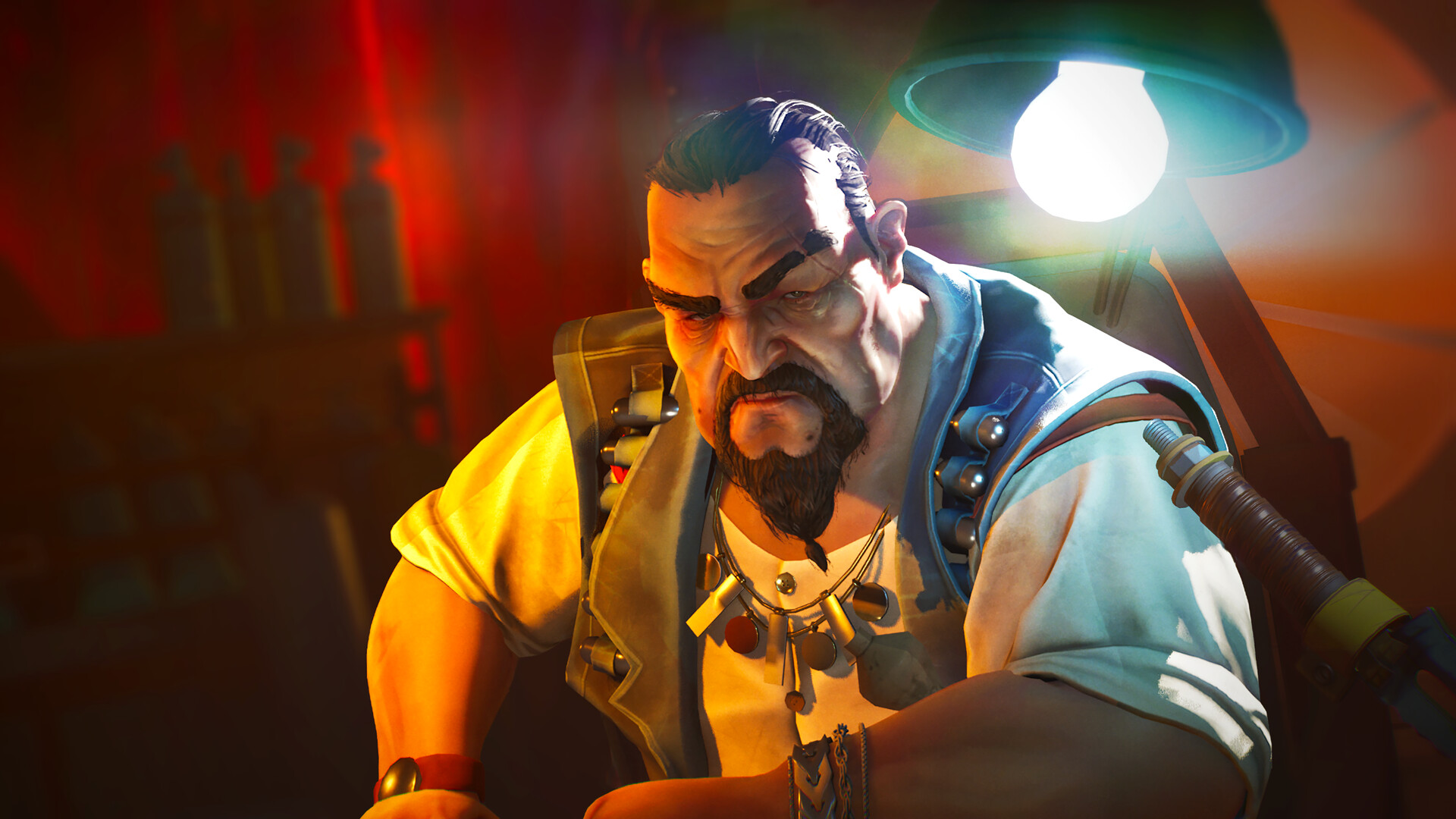
Your crew aboard the Driftwood includes a half-dozen characters who serve as companions, quest-givers, and moral sounding boards. In concept, each is interesting — a former Marauder deserter named Kael who carries visible guilt over the things he did in Obin’s service; a Mystic healer called Senna who is quietly questioning her faith as she watches her own fingers harden; a teenage scavenger named Pip with a photographic memory who treats the apocalypse like an adventure because she was too young to remember anything else. In execution, they too often speak in the functional, slightly wooden register that plagues many mid-budget narrative games. Dialogue conveys information efficiently but rarely surprises. Characters state their feelings rather than revealing them. Key emotional moments land with less impact than they should because the writing tells you what to feel rather than creating the conditions for you to feel it.
There are exceptions. The relationship between the player character and Lysara, the Driftwood’s grizzled captain, builds with genuine warmth and complexity. Lysara is written with a restraint that the other characters lack — she reveals herself through actions and silences rather than exposition dumps, and her personal arc, which involves coming to terms with a decision she made during the early days of the Great Submersion, is the most emotionally complete storyline in the game. Several side characters encountered in settlements also shine — particularly a mute painter in the Reclaimer capital whose work tells the story of the world’s decline more powerfully than any dialogue, and a dying Marauder scout in a remote outpost who asks you to deliver a message that may or may not be a trap.

It is worth noting that the writing in Road 96 had similar issues, and that Tides of Tomorrow represents a significant improvement. The gap between concept and execution is narrower than it was. DigixArt is clearly getting better. But in a game that asks you to care deeply about the consequences of your choices, every moment of flat dialogue is a moment where that investment is tested.
Gameplay: Sailing, Scavenging, and Surviving
At its core, Tides of Tomorrow is a first-person exploration game with light survival elements. The primary loop involves sailing the Driftwood between points of interest, docking at settlements or ruins, and exploring on foot to gather resources, complete quests, and advance the narrative. The sailing is pleasantly meditative — the ocean is vast and often beautiful, with dynamic weather systems that range from gentle fog to terrifying electrical storms. There is a genuine sense of seafaring adventure in charting a course toward a distant speck on the horizon and watching it slowly resolve into a settlement, a wreck, or something else entirely.
The Driftwood itself is a character in its own right. You begin the game with a barely functional hull and gradually transform it into a capable vessel through a salvage-and-upgrade system that feels satisfying without becoming overwhelming. New sails improve speed. Reinforced plating reduces storm damage. A crow’s nest extends your detection range for distant points of interest. The upgrades are functional rather than cosmetic, and they create a tangible sense of progression that complements the narrative arc nicely. By the end of the game, the Driftwood feels like home in a way that few game vehicles manage to achieve.
On foot, the game adopts a more traditional first-person adventure structure. You move through environments, interact with objects and NPCs, solve environmental puzzles, and occasionally engage in action-oriented sequences. The puzzles are generally well-designed, if not particularly challenging — most involve routing power through damaged electrical systems or finding ways to access sealed areas. They serve their purpose as pacing mechanisms between narrative beats without overstaying their welcome.
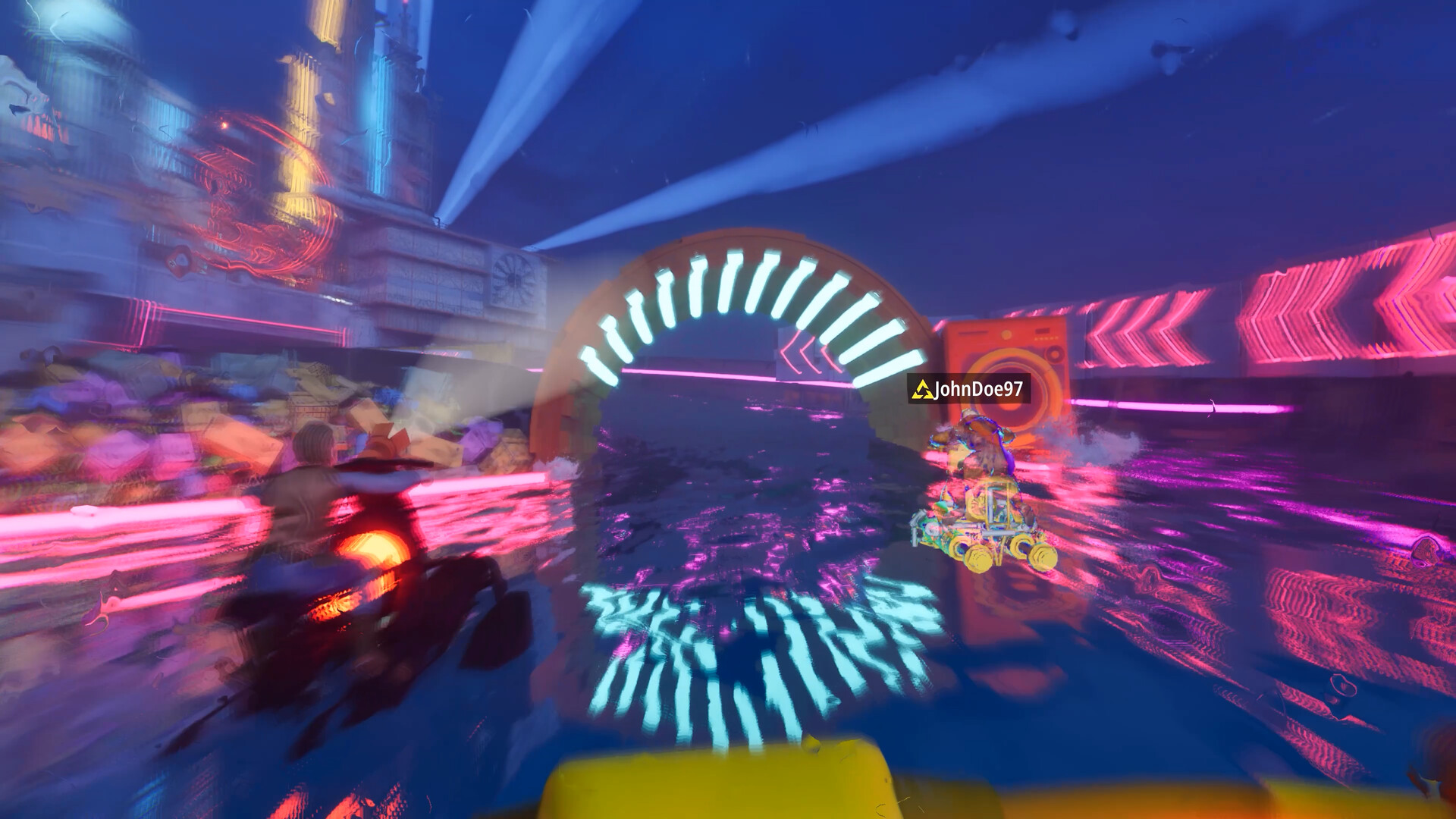
The more problematic gameplay elements are the secondary systems that appear at irregular intervals. Boat combat — which pits the Driftwood against Marauder patrol vessels — is functional but shallow, amounting to little more than pointing your bow at the enemy and timing cannon volleys. A handful of stealth sequences, in which you must infiltrate guarded facilities, are hampered by rudimentary AI that alternates between oblivious and omniscient with little middle ground. And a late-game racing sequence, in which you pilot a high-speed hydrofoil through a debris field, is technically competent but feels disconnected from the rest of the experience, as if it wandered in from a different game entirely.

None of these secondary systems are broken. They work. But they rarely rise above serviceable, and they represent development time that might have been better spent deepening the game’s strongest elements — exploration, dialogue, and the Story-Link system. The resource management layer, which requires balancing food, fuel, and Ozen supplies for your crew, adds light strategic texture to the sailing segments but never becomes demanding enough to create meaningful tension. You will occasionally need to make a tough call about whether to detour to a supply cache or push forward to the next story objective, but the game is generous enough with resources that genuine scarcity is rare.
The best gameplay moments come when exploration, narrative, and the Story-Link system converge. Discovering a hidden underwater cave that a previous player’s echo led you to, finding a cache of supplies they left behind along with a cryptic warning scratched into the wall, and then deciding whether to heed that warning or press deeper — these sequences are genuinely thrilling, and they represent the game at the peak of its creative powers. When all of Tides of Tomorrow’s systems are firing in concert, there is genuinely nothing else like it.
A World That Shimmers: Visual and Audio Design
If there is one area where Tides of Tomorrow punches unambiguously above its weight, it is visual design. The art direction is spectacular. DigixArt has chosen a stylized approach that sits somewhere between photorealism and illustration — characters have slightly exaggerated proportions and expressive features, while environments blend detailed texture work with bold, almost painterly color choices. The result is a game that looks like a watercolor painting brought to life, and it suits the material perfectly.
Elynd’s environments are strikingly varied for a world that is ninety percent water. Floating settlements range from ramshackle raft-towns held together with rope and optimism to gleaming Reclaimer arcologies powered by experimental wave energy. The Marauder stronghold is a masterpiece of environmental storytelling — a former oil tanker converted into a floating fortress, its deck crowded with cages, forges, and crude market stalls, every surface telling the story of a community built on exploitation. The Mystic sanctuaries, by contrast, are eerily serene — structures of driftwood and glass that seem to float on the water’s surface, filled with sculptures of partially transformed figures frozen in attitudes of prayer.
Underwater sequences — brief but memorable — reveal the ghostly outlines of submerged cities, their skyscrapers now encrusted with coral and inhabited by bioluminescent sea life. The Plastemia effects are particularly well-realized: watching a character’s skin gradually take on the horrible sheen of hardening plastic, with tiny air bubbles trapped beneath the surface, is deeply unsettling in a way that a more realistic art style might not have achieved. The stylization gives DigixArt permission to push the body horror into more expressive territory — plastic veins visible beneath translucent skin, fingers fused together into smooth paddles, eyes that slowly lose their focus as the surrounding tissue stiffens — without crossing into gratuitousness.
The soundtrack, composed by a team that includes several contributors from the Road 96 sessions, is a moody blend of ambient electronica and acoustic instrumentation. Ocean segments are scored with gentle, lapping synthesizer pads that evoke the rhythm of waves, while settlement interiors feature more grounded arrangements — acoustic guitar in the Reclaimer capital, percussive chanting in Mystic communities, industrial clatter in Marauder strongholds. The music adapts dynamically to the Story-Link state, subtly shifting in tone when you enter an area that has been significantly altered by a previous player. It is a small touch, but an effective one that reinforces the sense that every space in the game has been shaped by the people who passed through it before you.
Voice acting ranges from solid to excellent. The player character is unvoiced — a deliberate choice that allows the Story-Link echoes to feel more personal — but the supporting cast is fully performed. Lysara benefits from a commanding vocal performance that does much of the heavy lifting that the writing sometimes cannot. Minor characters are more inconsistent, with some settlement NPCs delivering their lines with a flatness that undercuts the atmosphere.
Technical Performance: Rough Seas on PC
On PlayStation 5, the DualSense implementation is thoughtful if not revolutionary — adaptive triggers provide mild resistance when sailing against the wind, and the haptic feedback creates a convincing impression of waves striking the hull during storms.
The PC version is less polished, with intermittent frame drops in settlement areas, particularly when the game is simultaneously rendering multiple Story-Link echoes and complex weather effects. Texture streaming occasionally struggles, producing momentary blur on environmental surfaces after fast-travel, and a shader compilation stutter on the first visit to each new area is noticeable enough to briefly disrupt immersion.
DigixArt has already released one post-launch patch addressing PC performance, and a second is planned. Given the studio’s track record with Road 96 — which saw significant performance improvements in the months after launch — we are cautiously optimistic that the technical rough edges will be smoothed over time. But at launch, the PS5 version is the more consistently polished experience.
Replayability: Seven Endings and a Reason to Return
The combination of seven endings, three character archetypes, and the ever-shifting Story-Link system gives Tides of Tomorrow more replay value than the typical narrative adventure. A second playthrough is substantially different from the first — not just because you can make different choices, but because you are linking to different players, encountering different echoes, and navigating different world states. The game actively encourages replay by gating certain story revelations behind specific faction alignments, meaning that a single playthrough will only ever reveal a portion of Elynd’s full narrative picture.
Core story beats and some key set-pieces repeat between runs regardless of your choices, and there are moments in the middle act where the structure becomes visible enough to break the illusion of organic variation. But the final two chapters diverge dramatically based on accumulated decisions. For a game of this scope and budget, that is an impressive achievement.
The question of whether seven endings represent genuine narrative variety or cosmetic permutation is one that players will answer differently depending on their tolerance for structural repetition. The emotional impact of the endings is sufficient to justify the replay. The Mystic ending in particular — which asks you to confront the full implications of embracing Plastemia as evolution rather than disease — reframes the entire game in ways that are impossible to appreciate on a first playthrough. But some of the middle-tier conclusions feel more like variations on a theme than truly distinct outcomes, and players who are satisfied with a single run will not miss anything essential to the core experience.
Context and Comparison: Where Tides of Tomorrow Fits
Tides of Tomorrow arrives at an interesting moment for narrative adventure games. The genre has been undergoing a quiet renaissance, with titles like Life is Strange: Double Exposure, Until Dawn’s PS5 remake, and Detroit: Become Human’s continued cultural presence demonstrating that there is a substantial audience for choice-driven storytelling. But the genre has also been largely iterative — refining existing formulas rather than introducing new ones. Tides of Tomorrow is one of the rare entries that genuinely expands the genre’s toolkit.
The Online Story-Link system exists in a lineage that includes Death Stranding’s social strand, Dark Souls’ message and bloodstain systems, and the async community features of games like Journey. But where those titles used asynchronous connection to enhance gameplay or atmosphere, Tides of Tomorrow uses it to enhance narrative. It is a meaningful distinction, and it positions the game as a potentially influential touchstone for the genre’s future development.
At thirty dollars, Tides of Tomorrow offers a comparable value proposition to most narrative adventures. The initial ten-to-fifteen-hour playthrough is satisfying as a standalone experience, and the replay incentives are genuine without being obligatory. It is not the longest game in its category, but it is one of the densest — there is very little padding, and nearly every hour contributes something meaningful to the experience.
Who Is This Game For?
Tides of Tomorrow occupies an interesting niche. It is too experimental for players who want a straightforward narrative adventure and too narrative-heavy for players who prioritize mechanical depth. Its ideal audience is the player who is drawn to bold ideas and willing to forgive the rough edges that inevitably accompany them — the player who would rather experience an imperfect innovation than a polished formula.
If you loved the communal storytelling of Death Stranding but wished it were applied to a more intimate, character-driven narrative, Tides of Tomorrow is worth your time. If you are drawn to the choice-driven structure of games like Life is Strange or The Walking Dead but crave something that pushes the genre in a new direction, this is your game. And if you simply want to explore a beautiful, haunting, deeply original science fiction world, Elynd will reward your curiosity.
If, on the other hand, you need tight mechanical loops to sustain your engagement, or if flat dialogue is a dealbreaker regardless of the surrounding ambition, or if you prefer your narrative games to be entirely self-contained without online requirements, Tides of Tomorrow may frustrate you more than it delights.
Final Verdict
Tides of Tomorrow is a game that reaches for something genuinely new and largely succeeds in grasping it. The Online Story-Link system is not a gimmick — it is a meaningful evolution of how narrative games can create emotional resonance, and its best moments are among the most memorable in the genre. The world of Elynd is gorgeous, the Plastemia premise is inspired, and the faction system offers real moral complexity. DigixArt has delivered a significant step forward from Road 96 and established themselves as a studio worth watching closely.
But the game is not without meaningful flaws. The character writing does not consistently match the ambition of the systems surrounding it. The secondary gameplay mechanics are functional but uninspired. The PC version needs additional optimization work. And the Story-Link system, for all its innovation, can occasionally create tonal inconsistencies that pull you out of the narrative rather than deeper into it.
What we are left with is a game that is greater than the sum of its parts — a game whose best ideas are so compelling that they carry you through its weaker stretches, and whose emotional peaks are high enough to make the valleys feel like a worthwhile trade. It is not a masterpiece. It is something arguably more interesting: a deeply ambitious, imperfect, and wholly original work that expands the vocabulary of its genre. In an industry that often rewards the safe bet, Tides of Tomorrow is a reminder that the most exciting games are the ones willing to risk failure in pursuit of something new.
That is worth celebrating, rough edges and all.