
Five and a half years is a long time to spend in Early Access. It is long enough for the genre you helped define to grow up around you, standardise a dozen conveniences you never adopted, and start asking awkward questions about what you have been doing all this time. On September 9, 2026, Valheim finally answered by shipping 1.0 — the Deep North, a final boss, an ending, and a 50% price increase.
The short version: Valheim is still one of the two or three best survival games ever made, and the Deep North is the best-looking, most confident thing Iron Gate has ever built. It is also a game that spent half a decade in public development and came out the other side with no way to craft from a nearby chest. Both of those sentences are true at the same time, and the gap between them is the whole story of this launch.
What 1.0 actually contains
This is not a version-number victory lap. The 1.0 patch notes are genuinely enormous: a tenth and final biome, 40-plus new weapons across three material tiers (Nord, Frostfire and Thunderblood), four armour sets, two capes, two trinkets, 10-plus creatures, 80-plus buildable pieces, 30-plus crafting materials, 20-plus food items, two new dungeon types, new music, new events, and achievements — which Valheim somehow shipped five years without.
There are also new verbs. You shovel snow before you can build on it. You test the ice on frozen seas and ponds before you walk across it, because it gives way. You get a grappling hook, which does more to fix Valheim's relationship with vertical terrain than any patch before it. The Jotun have begun an invasion you have to go out and stop, arriving as a world event called "The Jotun have found you." Sail to the outer edges of the map and you can find alternate versions of earlier biomes. Collect idols scattered across the world, bring them to a hidden forge, and you can push gear past its previous ceiling.
And there is an ending. An actual one, with a final boss — Kall Fimbulbringer — and a conclusion to the errand Odin sent you on. That is rare enough in this genre to be worth stating plainly. You can keep playing your world afterwards.
At 1.0 the price went from $20 to $30, a 50% rise, applied to new purchases across Steam, Xbox and PlayStation; anyone who already owned it keeps their copy at no extra cost. The ocean biome gets no overhaul in 1.0. There is new content scattered across the older world, but nothing aimed at the water. How long updates continue after this, the studio says, is too soon to say.
The Deep North is the best thing in the game, and partly a rerun
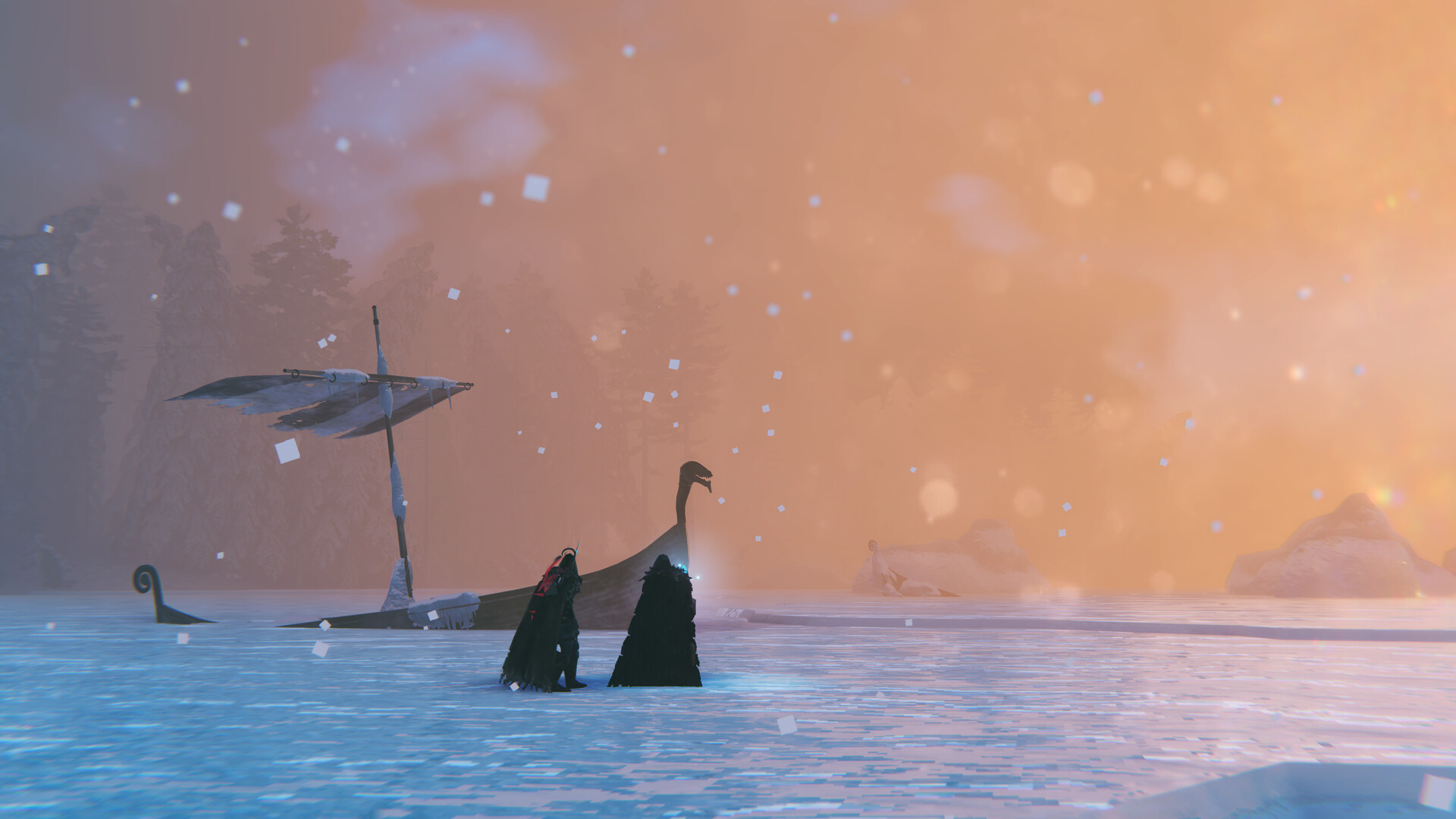
Arriving in the Deep North is the single best sequence Valheim has. Your ship grinds through ice floes past the wrecks of a dozen other Viking vessels that did not make it, and then you step off onto ice you can hear cracking and wade into snow up to your waist. The low-poly art style, which has always punched above its weight because Iron Gate spends its budget on lighting and fog rather than texture resolution, has never had a better subject. Aurora over black conifers, a whiteout blizzard that genuinely hides what is coming, sun through ice at dusk in colours you would not expect from this engine.
The underground is where it escalates. The new dungeon types — Winding Tunnels and Mörkhalla — include structures on a scale Valheim has not attempted before, the kind of chained-titan architecture that makes you stop and pan the camera. There is a new crafting bench that works differently from the ones you have used for five years, which after this long is a real surprise.

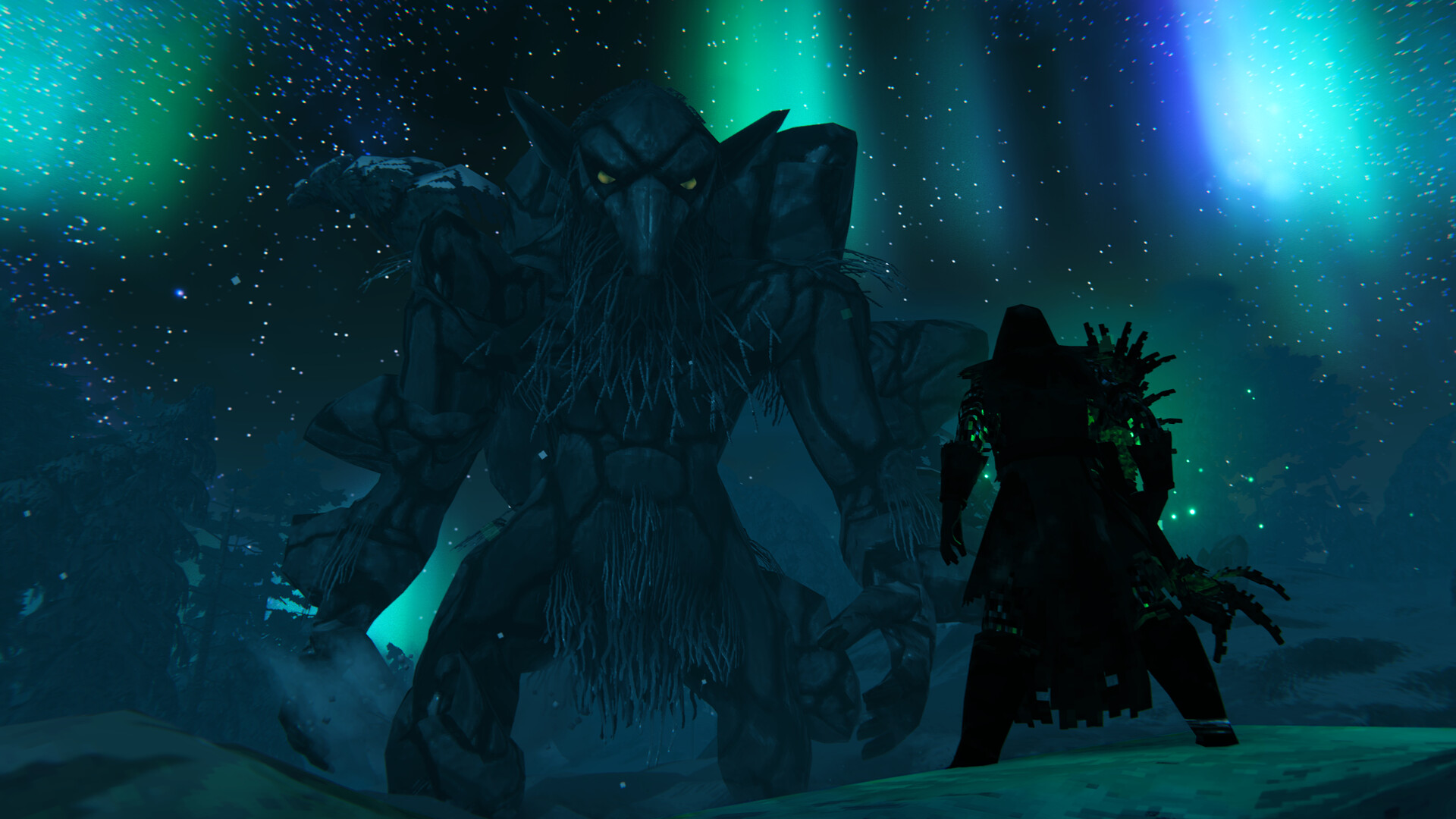
The overland enemy roster is the highlight. The Gammeltrolls are enormous, and fighting one is the closest Valheim has come to the thing its marketing has always implied: a small determined warrior felling a titan under the northern lights. The Jotun are the ancient enemies of the Norse gods, and swinging at one lands with a weight that generic skeletons and blobs never had.
Which brings us to the honest part. A meaningful slice of the Deep North is recycled. There are more greydwarfs — the same squat nuisances you have been mindlessly clearing since the Black Forest. There are more narrow underground tunnel networks. And there is yet another iteration of the blob-type enemy that has always felt like a placeholder for something better, now in Frost, Hexahedric, Shapeless and Tiny varieties. The opening stretch of the Deep North feels like a reskin, and then the ground opens up.
The route to the final boss is the best-designed thing in the update — a genuinely demanding sequence that reads as Odin making sure you have actually mastered this world before you are allowed to finish it. The boss fight at the end of it is the weakest link. It is fine. The journey to reach it is not fine, it is excellent, and it is the real payoff.
The loop that still has no real competition
Strip away the new content and what makes Valheim work is the same thing that made it a phenomenon in February 2021: it solved the pacing problem that the survival genre usually just shrugs at.
The world is a procedurally generated disc split into biomes, and it gets more dangerous the further you get from the centre. Each biome holds one boss. Killing that boss drops an item or a power that makes the next biome survivable. Nothing is locked — you can sail into the Plains at hour three and be deleted by a fuling with a club, and that is allowed — but the world has a reading order, and it communicates that order through pain rather than a quest log.

There are no quests. There is no NPC filling your ears with exposition. The motivation to cross a mountain range is that you want to know what is on the other side of it, and the reward for going is usually a recipe you did not know existed. Recipes unlock through discovery, not levels, which ties the crafting system directly to exploration in a way that most of the genre's better-funded games have never managed.
The food system remains, five years on, one of the best mechanics in any survival game. Your stomach is a three-slot inventory. Eat a mushroom, a blueberry and some cooked meat and those three items fuel your health and stamina until they digest. Better recipes mean dramatically bigger bars, which means food is as important as armour — arguably more so. Your kitchen is the strongest crafting station you own.
1.0 adds animated dream sequences that unlock as you kill bosses, plus a new intro cinematic. They are genuinely lovely, hand-animated in a style that has nothing to do with the in-engine look. They are also entirely optional flourish. The game did not need them; it is nicer for having them.
Building is still an engineering problem
Valheim's building system is the reason people have 2,000-hour play counts. It is not a snap-together kit. Beams need support, unsupported spans sag and then collapse, and the game shows you structural integrity as a colour gradient so you can see your longhouse deciding whether to stay up. Building a great hall here means solving a physics problem, and the failure state is your roof landing on your bed.
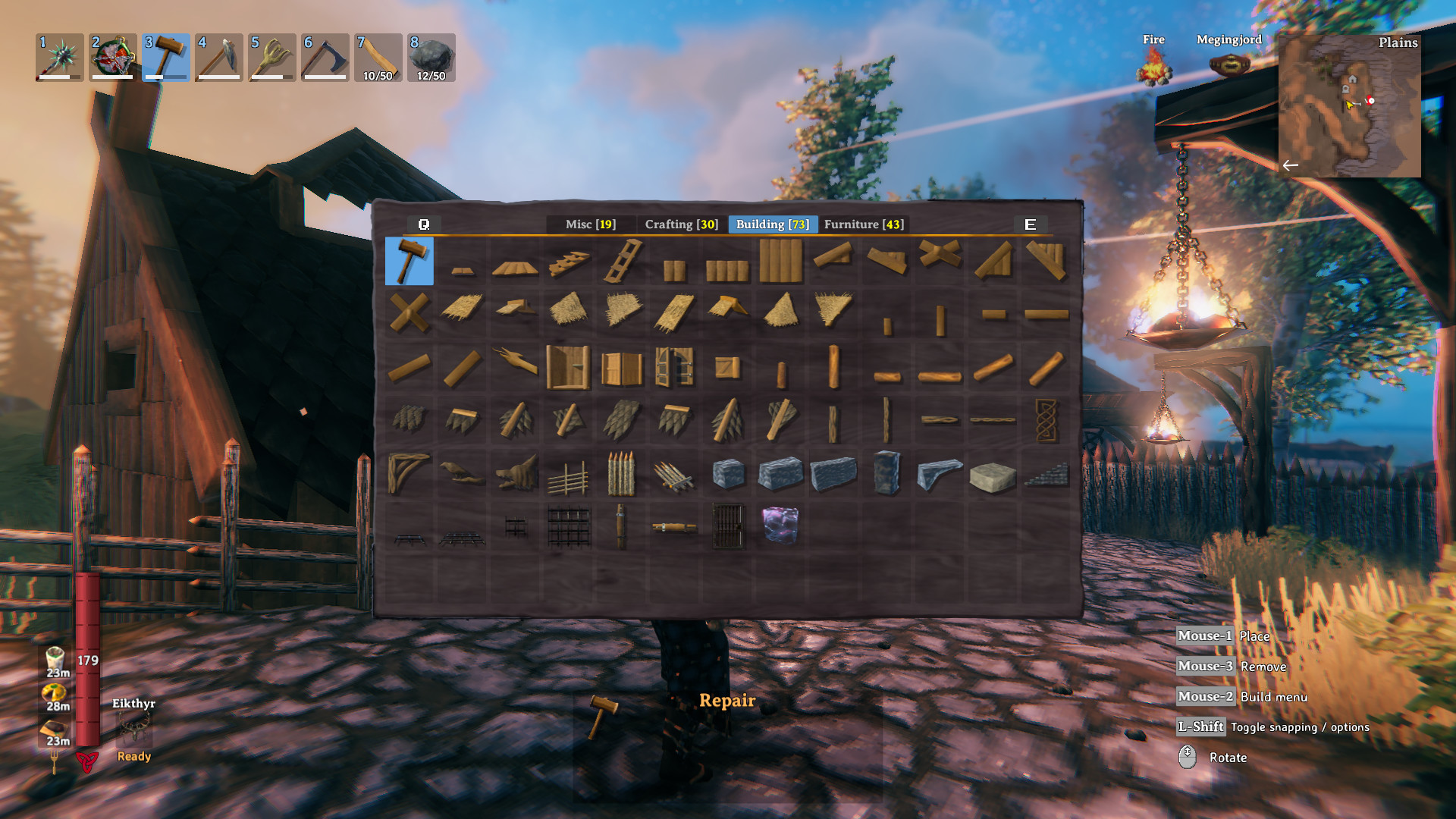
1.0 pours more into it: 80-plus new pieces, including four drawbridge variants, timber and scalewood wall sets, 67-degree roof and beam angles that close long-standing gaps in the geometry, ice blocks, and material stacks for every ore in the game. Snapping and stability behaviour have both been improved. There is a wardrobe, an antler throne, sealskin rugs. If you are the kind of player who builds, this is the most generous update the game has had.
If you are not, the cost is unchanged: everything in that menu is made of resources you gather by hand, and translating a vision into a structure is measured in hours of chopping and hauling. That is a fair trade for the people it is aimed at and a wall for everyone else.
Combat rewards patience and punishes button-mashing
The melee combat is deliberately committal. Start a swing at the wrong moment and you cannot cancel out of it — you will eat the counter-hit. Block too often and your guard breaks. The intended answer is dodging or parrying, and a clean parry opens the enemy up for a full combo before you step back to recover stamina and start the exchange again. Parries also work on projectiles, which is as satisfying as it sounds.

Magic and archery both exist and both feel undertuned next to melee. Bows in particular are weak enough that the game seems to be steering you toward an axe, which is thematically defensible and mechanically a shame. The four new staves in 1.0 — Echo Spike, Spirit Caller, Northern Vengeance and Lightning Strike — help the magic side more than the previous rebalances did, but the gap is still there.
Three new gear tiers, and a reason to keep upgrading
The 40-plus new weapons are not padding, because they are structured as three complete tiers rather than a scattering of one-offs. Nord, Frostfire and Thunderblood each cover the full spread — sword, greatsword, atgeir, mace, sledge, axe, greataxe, spear, dagger, knucklechains, bow and crossbow — which means whatever weapon class you have specialised in across the last nine biomes has somewhere to go in the tenth. That is a small design decision with a large effect: Valheim's skill system rewards sticking with one weapon type, and previous biomes have not always respected that.
The materials behind them are the more interesting part. Bloodgold, Frostcore, Liquid Frost, Frostfire Essence, Thunderblood Essence, Petrified Tissue, Nornathread. Two new production stations — the Frigid Kiln and the Frost Foundry — plus extensions for the Black Forge, cauldron and Galdr table. It is a full economy rather than a coat of paint, and it is deep enough that a returning player will spend real time working out what feeds what.
Then there is the idol system, which is the cleverest addition in the update. Sixteen Protection and Battle Idols are scattered across the world; find them, carry them to the hidden Forge of Potential, and you can push items past the upgrade ceiling they previously hit. It gives the Deep North's exploration a reason to exist beyond "see the new thing," and it retroactively makes the older biomes worth combing again, which is the closest 1.0 comes to refreshing content it did not rebuild.
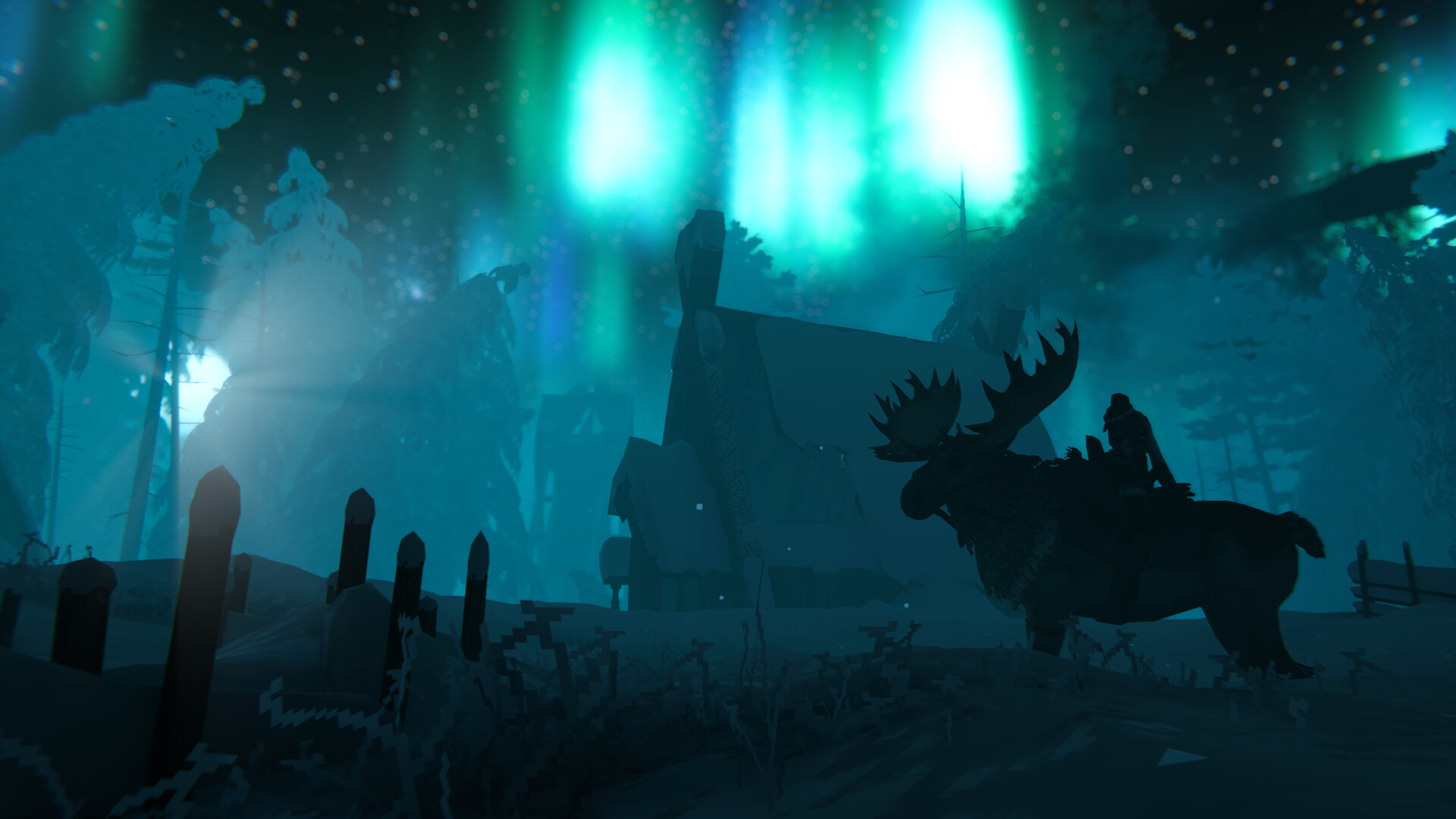
Taming got a new marquee animal too. The Moose is tameable and rideable, and it is the Deep North's answer to crossing deep snow. Taming one takes a long time and they have an unhelpful habit of bolting onto thin ice and drowning themselves, which is either a bug or the funniest feature in the update depending on how many you have lost. Seals and their calves are also here, and yes, you can kill them for blubber.
Boss fights are the highlight and the difficulty spike. Eikthyr, the first, is a tutorial in blocking that lulls you into thinking you understand the game. Everything after that is happy to kill you repeatedly. Solo, the later encounters are a genuinely punishing time sink; there is a reason the server cap is ten players.
The sea is still magnificent and still empty
The first time you finish a real longship — not the starter raft — and put out to sea with the score swelling behind you is one of gaming's better moments of scale. Sailing in Valheim looks and sounds superb, and the restriction that makes it matter is that portals will not carry ore. If you want silver from a mountain peak, you sail there, mine it, cart it down a near-vertical slope while things attack you, load it into the hold, and sail home through a storm. It is an absurd amount of work and it produces the game's best co-op stories.
But the ocean itself is content-thin, and 1.0 explicitly does not address it. You get serpents and weather. That is the biome.
Where five years of Early Access shows
This is the part that will decide whether you bounce off. Valheim arrives at 1.0 missing quality-of-life features that the genre it inspired now treats as table stakes.
You still cannot craft or build using materials from nearby chests. Everything has to be in your personal inventory. In a game about hauling resources, with a base full of storage, that adds an extra round of sorting and hauling to every construction job.
Armour still has no dedicated equipment slots. The helmet, chest, legs and cape you are wearing occupy inventory space you could be using for ore. 1.0's answer is a partial one: Haldor the trader now sells Deeper Pockets and Wider Pockets, which add rows to your inventory. More space is welcome. It is not the same as fixing the reason you needed it.
There is also no quick-sort, no pull-from-mass-storage, and no way to adjust the camera angle. Interaction requires more cursor precision than it should. Asset pop-in is visible even with the new draw-distance setting turned up. And Hugin, the raven who explains mechanics, talks constantly.

The older biomes have not been re-examined either. The Swamp still means long stretches in cramped underground corridors hitting an iron deposit with a pickaxe, an activity with no discernible upside. The Mistlands, added during Early Access, still combines the Swamp's unpleasantness with fog so thick that the item designed to see through it barely helps. If you disliked those biomes in 2023, 1.0 gives you no reason to revisit that opinion.
Solo is possible, co-op is the point
You can play Valheim alone. Expect it to be slow. Resource costs and boss health are tuned with a group in mind, and the world modifiers — which do let you dial gathering rates, combat difficulty and death penalties — smooth the curve without changing the fundamental shape of it.
With two to four people it transforms. The hauling becomes logistics, the boss fights become choreography, and the base becomes a place several people are quietly improving in different directions. Ten is the cap and probably too many. Four is the number.
1.0 also finally makes it easy to get a group together: Valheim is now on PS5 and Nintendo Switch 2 for the first time, alongside PC, Mac, Linux, Xbox One and Xbox Series X|S, with full crossplay across all of them. The friend on a handheld and the friend on a 4070 can share the same mead hall. On PC the game is Steam Deck Verified, and 1.0 brought a Unity engine upgrade, a new draw-distance setting, and a cloth-simulation system for capes.
Three housekeeping notes for returning players. First, saves are safe: existing worlds and characters carry over, and characters are stored separately from worlds, so you can drop a fully-geared veteran into a fresh 1.0 world. But new biome generation only works in terrain you have not already uncovered, so on a heavily explored map you may have to sail a long way to find the Deep North — which is why Iron Gate itself recommends a new world for the intended experience.
Second, achievements start recording from the moment 1.0 is installed. Old characters and worlds are eligible going forward, but five years of past accomplishments do not backfill, so a veteran opening 1.0 sees an empty list. Third: Iron Gate shipped a cheat detector alongside the achievements, and it flags the world save rather than just the character — permanently. Using console commands such as spawn locks that character and world out of achievements for good, and the flag applies retroactively to characters that used commands before 1.0. If you ever spawned yourself a stack of iron in 2022, that world is not getting achievements. Worth knowing before you decide which save to load.
Mods are the other consideration, and an awkward one. Mods can add crafting from containers, equipment slots and inventory sorting, addressing the gaps discussed above. Valheim still has no official mod support, and Iron Gate has been upfront that it cannot guarantee existing mods work immediately after 1.0; with a Unity engine upgrade in the mix, mod authors need time to catch up, as they have after every major update. If you are on PC and the QoL complaints in this review sound like dealbreakers, the modding scene will have answers for most of them — just not necessarily in launch week. If you are on console, it never will, and you are playing the game exactly as shipped.
The verdict
Valheim at 1.0 is a landmark survival game that chose to finish itself rather than modernise itself, and it is worth understanding which of those you were hoping for.
If you have never played it, this is the best possible moment. Ten biomes, a real ending, a build system with more depth than anything else in the genre, a food system other developers have been copying for five years, and a world whose art direction still produces images that games costing fifty times as much do not. Even at $30 it is one of the great value propositions in PC gaming, and it runs on almost anything.
If you are a veteran who stopped after the Ashlands and came back hoping 1.0 would fix the friction, temper that. The Deep North is genuinely superb and the last stretch to the final boss is the best content Iron Gate has ever shipped. The inventory is still fighting you, the chests still will not talk to your workbench, and the ocean is what it always was.
It earns its 1.0. It just does not earn the argument that five and a half years was the right amount of time to take.