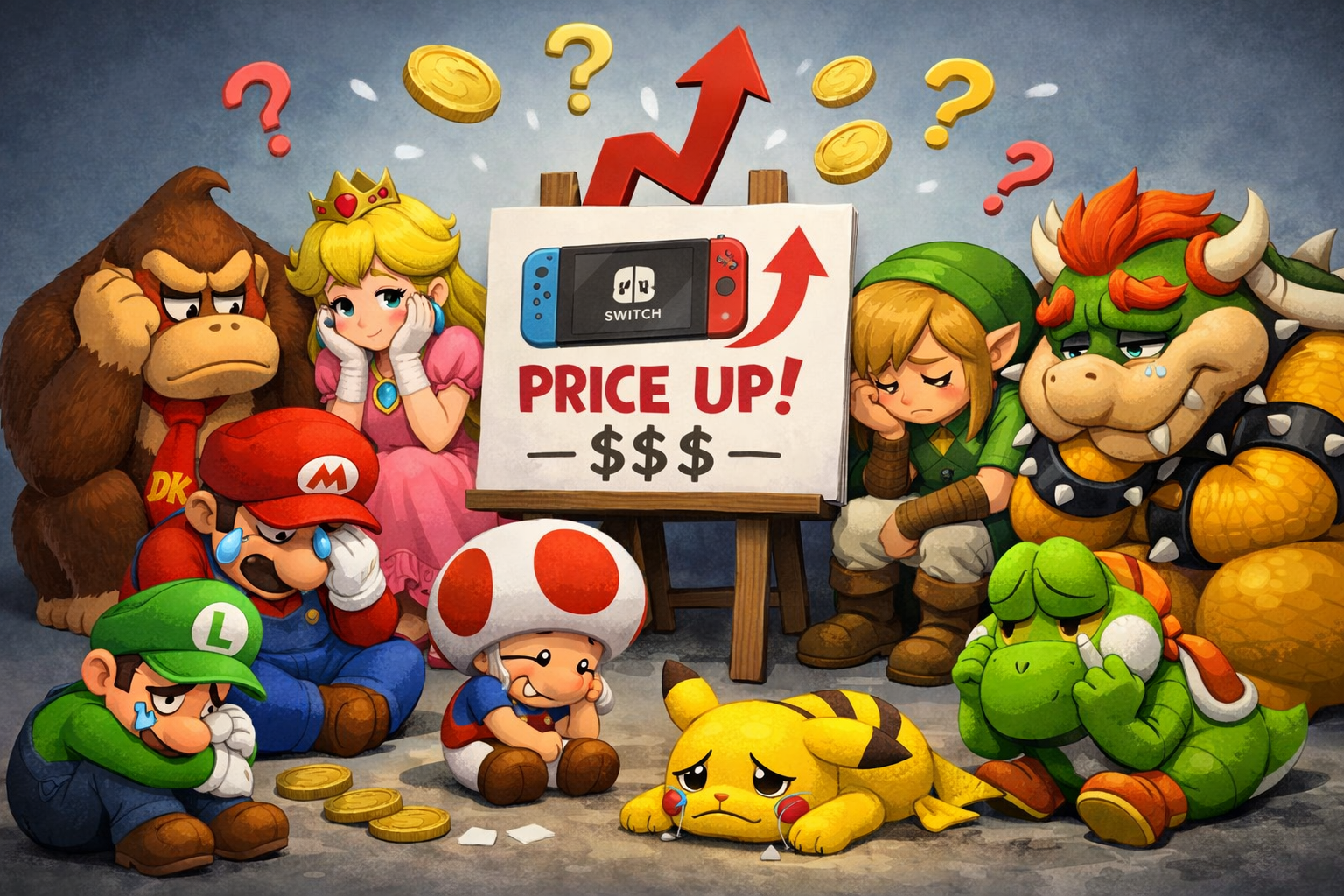
Nintendo broke its silence on May 8, 2026 with a sentence nobody wanted to read: the Switch 2 is getting a $50 price increase. Effective September 1, 2026 in the United States, Canada, and Europe. Effective May 25, 2026 in Japan, where the increase is significantly steeper. And the original Nintendo Switch — yes, the eight-year-old hardware most fans assumed was already on a glide path to retirement — is getting an even larger hike in Japan to boot.
The company's official notice cited changes in market conditions and the global business outlook as the reasoning. Nintendo did not name tariffs. Nintendo did not name semiconductor pricing. Nintendo did not blame the yen. But everyone in the games industry already has, and the timing — barely two and a half months after Nintendo confirmed the Switch 2 hit seven million units sold globally — has set off the loudest discourse Nintendo's pricing strategy has seen since the original Switch held its $299 MSRP for nearly its entire lifetime.
The New Prices, Region by Region
Nintendo published the changes as a single global press release, with separate effective dates per region.
Switch 2 (Western Markets — Effective September 1, 2026)
- United States: $449.99 → $499.99 (+$50, +11.1%)
- Canada: $629.99 → $679.99 (+$50, +7.9%)
- Europe: €469.99 → €499.99 (+€30, +6.4%)
- United Kingdom: To be announced
Switch 2 and Original Switch (Japan — Effective May 25, 2026)
- Switch 2 (Japanese-language): ¥49,980 → ¥59,980 (+¥10,000, +20%)
- Switch 2 (Multi-language): No change — sold only via My Nintendo Store
- Switch OLED: ¥37,980 → ¥47,980 (+¥10,000, +26%)
- Switch: ¥32,978 → ¥43,980 (+¥11,002, +33%)
- Switch Lite: ¥21,978 → ¥29,980 (+¥8,002, +36%)
That last column is the eye-popping one. The original Switch and Switch Lite are getting larger percentage hikes than the Switch 2 — a strong signal that Nintendo is no longer trying to keep the older hardware as an entry-level option. If you wanted a Switch Lite as a gift for a kid in Japan, the price just leapt 36 percent overnight.
Nintendo Switch Online Is Going Up Too — In Japan
The price changes also touch the subscription side, but only in Japan for now, effective July 1, 2026:
- Individual plans: Up 24–31% depending on duration
- Family Plan and Expansion Pack: Up 18–29%
- South Korea: Adjustments incoming, specifics not yet announced
Nintendo has not announced any change to NSO pricing in the US, Canada, Europe, or UK as of this writing. That could change. The fact that Japan is being hit first across the entire pricing structure (hardware, online, soonest effective date) tracks with what analysts have been warning about for months: the yen has weakened against the dollar by roughly 18% since Switch 2 launched, and Nintendo's domestic margin has been eroding faster than its international one.
What Nintendo Said (and What They Didn't)
The official statement is short. Translated from the Japanese release:
In light of changes in market conditions, and after considering the global business outlook, we have decided to revise the prices of Nintendo Switch 2 and Nintendo Switch systems, as well as Nintendo Switch Online membership fees in Japan. We sincerely apologize for the impact these price revisions may have on our customers and other stakeholders, and we deeply appreciate your understanding.
What's not in the statement: any specific reference to US tariffs on consumer electronics, any mention of the yen, any mention of NAND or DRAM pricing, any mention of TSMC node costs, and any mention of Switch 2's actual sales performance (which Nintendo has been bragging about in every other public document for the past two months). The omissions are conspicuous. Nintendo's last earnings call repeatedly emphasized that the company had absorbed cost pressures during launch, and the implication was that those absorptions had a shelf life.
The Tariff Question Nobody Will Ignore
The Switch 2 launched at $449.99 in the US — a price that already reflected an internal decision to bake in some cost contingency. Nintendo is now revising that price upward effective September 1, the same week most analysts have been forecasting fresh consumer-electronics tariff rounds to come into effect. The company will not say one thing has anything to do with the other. Industry reporters absolutely will. Expect the next two weeks of gaming press coverage to be dominated by spreadsheets comparing Switch 2's new MSRP to PlayStation 5 Slim, Xbox Series X, and the recently leaked Project Helix specs.
If You Are About to Buy a Switch 2
You have until August 31, 2026 in the US, Canada, and Europe to lock in the old price. Nintendo has not announced any pre-order protections or honor-the-old-price commitments at major retailers, but historically Best Buy, Target, GameStop, and Amazon have honored existing pre-orders at the original price even after MSRP increases. If you are sitting on a wishlist and a tax refund, this is the news that turns the decision.
For Japanese buyers, the deadline is much tighter — May 24, 2026 — and the savings are larger across original Switch hardware than on the Switch 2 itself. If you have been holding off on a Switch Lite for a kid, that ¥8,000 increase is the difference between a casual purchase and a budget event.
What This Means for the Rest of 2026
The Switch 2 momentum coming out of the holidays was historic. Mario Kart World outsold expectations. Donkey Kong Bananza shipped seven figures. The console line at every Nintendo Store on launch night was the kind of social spectacle Nintendo had not had in eight years. A $50 hike does not end that momentum — but it changes the math for the second wave of buyers, the ones who were waiting for a price drop, a bundle, or a holiday deal.
It also re-opens the conversation about what a healthy MSRP for a console actually looks like in 2026. The PS5 Slim is $499. Xbox Series X is $499. Steam Deck OLED is $549. The Switch 2 is now in that same price band, with a smaller battery, weaker GPU silicon, and a single-screen handheld form factor. Whether the value proposition still holds depends entirely on Nintendo first-party output — and the next eighteen months of that catalogue had better be very, very good.
September 1 is a long way out. Two-and-a-half months in Japan. The Switch 2 era's golden window of cheap relative to the alternatives is closing on a calendar.