Updated 18 September 2026. This comparison first ran in May. Since then Microsoft has put its next-generation plans on the record at GDC, the Xbox silicon has a name, a PS6 handheld has entered the picture — and the price story has turned upside down. The $750 PS6 figure reported here originally no longer holds.
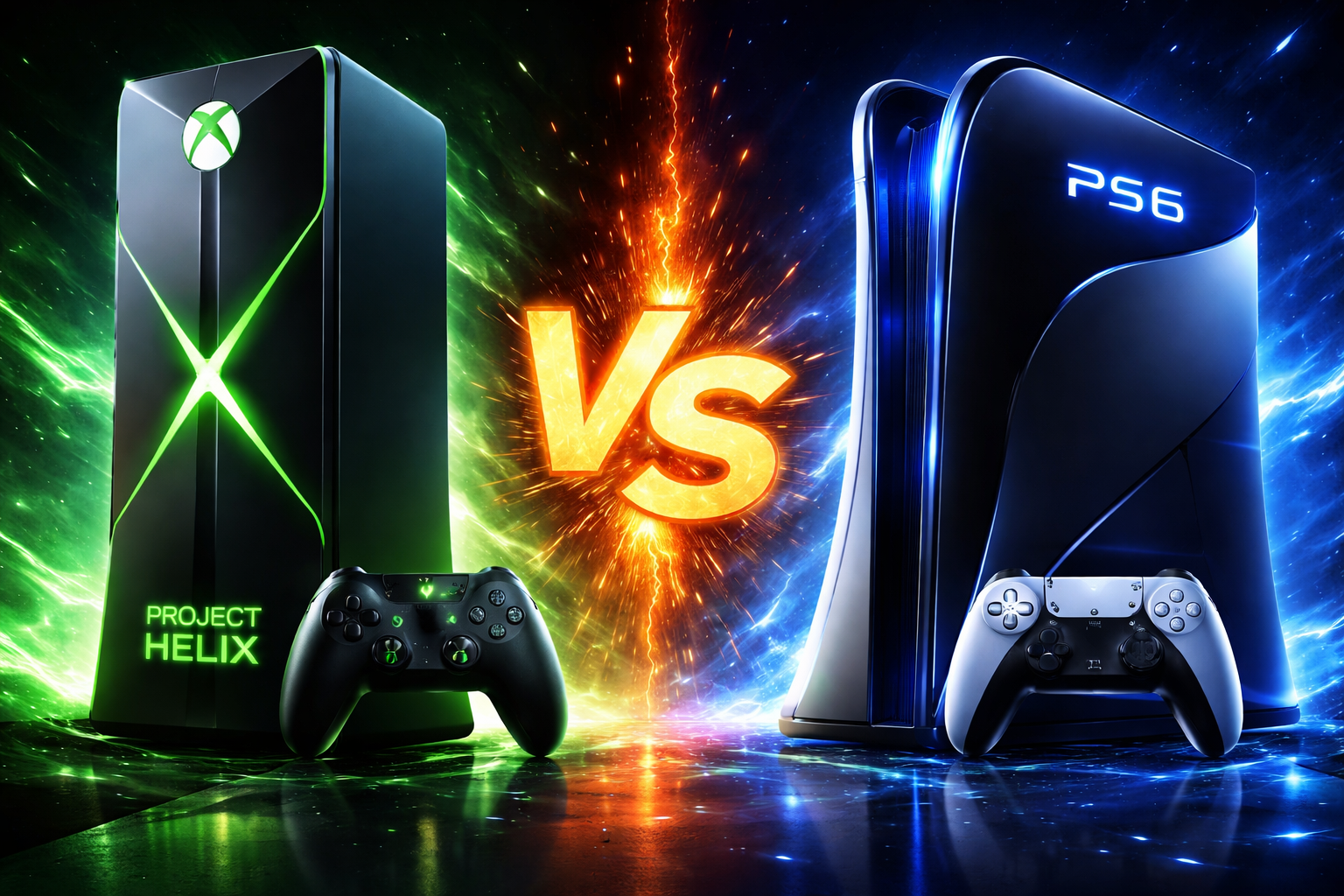
The next console war is shaping up to be the strangest one yet. On one side: Microsoft's Project Helix, an Xbox that doubles as a gaming PC running the full PC games library, Steam store included. On the other: Sony's PlayStation 6, a more conventional successor that promises roughly triple the raw power of the PS5. Neither has been formally unveiled. Neither has a price or a date.
What has changed since spring is that the comfortable framing — expensive hybrid Xbox against affordable PlayStation — has stopped being true. Both machines are now described by the same leakers in the same price bracket, for the same reason: memory. Everything below is leaks and rumour unless marked as an on-record statement, and the specifications will shift again before either console ships.
What changed since May
Five things moved, and each one dents part of the original comparison.
- The PS6 got expensive. The bill-of-materials estimate tracked by AMD insider Kepler L2 climbed from roughly $760 in March to “dangerously near $1,000” by late June. That is the cost to build one, before Sony's margin, which makes the $750 retail figure this article originally carried very hard to defend.
- The Xbox silicon has a name. Leaks now identify the chip as a custom AMD SoC codenamed Magnus, with a hybrid CPU of up to 11 cores. Earlier reporting described Helix as effectively a PC with no custom APU. That was wrong.
- Microsoft went on the record at GDC 2026. Jason Ronald, Xbox's VP of Next Generation, confirmed alpha dev kits for early 2027, an “order of magnitude leap” in ray tracing and backward compatibility across four console generations. AMD's Jack Huynh confirmed the 3nm process.
- Helix is a family, not a box. The GDC framing describes a first-party flagship alongside cheaper variants and OEM machines from partners such as Asus and MSI.
- Sony has a handheld in the same silicon family. A companion chip codenamed Canis now appears alongside Orion in the same leaked material.
What we know about Project Helix
The Magnus SoC is built on TSMC's 3nm node, the one detail AMD has stated publicly through SVP Jack Huynh at GDC 2026. The CPU is a hybrid arrangement of up to three high-performance Zen 6 cores and up to eight efficiency-focused Zen 6c cores, eleven in total, with the performance cores estimated in the 5–6 GHz range. The GPU carries 68 RDNA 5 compute units at an estimated 2.5 GHz or better, on a die of roughly 408 mm², targeting native 4K at 120 FPS.
Memory is the wild card. Leaked documents point to 48GB of GDDR7 across a 192-bit bus, but Microsoft may settle at 36GB depending on what GDDR7 costs in 2027. There is also a substantial dedicated NPU — 110 TOPS at 6W, or 46 TOPS at 1.2W in low-power mode — well beyond anything in a current console.
The headline feature is still software. Helix is a true PC platform: the Windows 11 game library, with Steam, the Epic Games Store, GOG and the Microsoft Store coexisting on one device, fronted by a controller-friendly Xbox Mode. There is no disc drive. If that ships as described, Helix is not really competing with the PS6 at all. It is competing with prebuilt gaming PCs.
On price, Kepler L2's “over $1K” estimate is the number everyone quotes, but it predates the memory and storage increases that have already pushed up current Xbox hardware. Xbox CEO Asha Sharma confirmed in late April that the shortages would affect both the pricing and the availability of the next console.
What we know about PS6
Sony's approach is more conservative, and that is not a criticism. The PS6 uses a semi-custom AMD chip codenamed Orion, pairing eight Zen 6 CPU cores with an RDNA 5 GPU of 52–54 compute units running at up to 3.6 GHz — a meaningful upward revision from the 2.6–3.0 GHz reported in spring. That lands at roughly 34–40 TFLOPs of raster compute, about triple the PS5, with a 6–12x leap in ray tracing. Memory is GDDR7 on a 160-bit bus at around 640 GB/s, a 43% bandwidth increase over the PS5. The process node is unsettled: newer leaks say TSMC 2nm, earlier ones said 3nm.
Under its Project Amethyst collaboration with AMD, Sony gets the same RDNA 5 building blocks Microsoft does — Radiance Cores for ray and path tracing, Neural Arrays for upscaling and denoising, and Universal Compression. This is the quietly important part of the generation. The two consoles are drawing on one AMD feature set, so the differences between them will come from configuration and software rather than from fundamentally different graphics technology.
Storage is a rumoured 1TB SSD with no disc drive, which fits Sony's confirmed plan to stop producing physical discs for new games in January 2028. Backward compatibility covers PS4 and PS5.
The launch math is where this article has aged worst. In May the most credible figure was a $750 launch price. It is now much harder to defend: Kepler L2 put the bill of materials alone “dangerously near $1,000” on 27 June. A realistic retail band today is $699 to $1,000 or beyond, with the PS5 Pro's $699 tag as the obvious psychological reference point.
Timing has slipped as well. Bloomberg reported in February that Sony was considering pushing the debut to 2028 or even 2029 on memory costs. Piers Harding-Rolls of Ampere Analysis calls late 2028 the most likely outcome. Sony's own chief executive said on 17 August that the launch date has yet to be decided, which is not a denial.
The PS6 handheld nobody was discussing in May
Orion now has a sibling. Project Canis is a handheld chip on TSMC 3nm at roughly 135 mm², combining four Zen 6c cores with two low-power Zen 6 cores for the OS, and 16 RDNA 5 compute units clocked around 1.20 GHz portable and 1.65 GHz docked. Memory is LPDDR5X on a 192-bit controller, with developers reportedly arguing that 24–36GB is the minimum for next-generation features.
In practice that is about half a PS5 in rasterisation but 1.3–2.6x its ray tracing, with the same PS4 and PS5 backward compatibility. The catch is the one hurting every other device here: one leaker warned in late August that the handheld cannot hit $600, because AI datacentre demand is competing for exactly the memory it needs. A PlayStation handheld that has to launch north of $600 is a very different product from the one most people picture.
The hardware comparison
Here is the side by side as it stands in September 2026. Treat every cell as provisional.
For scale, this is what both machines are being measured against.
The questions people actually ask
Which will be more powerful, Project Helix or PS6?
On paper, Helix. It has 68 compute units to the PS6's 52–54, more memory, and a large dedicated NPU the PS6 does not appear to have. But the gap is narrower than those numbers suggest, because Sony clocks its smaller GPU much harder — up to 3.6 GHz against roughly 2.5 GHz — and pairs it with tighter API integration and a single fixed target to optimise against. Expect the two to land within about 20% of each other in real rasterised games, with Helix ahead. In ray tracing they should be close, because both are built on the same RDNA 5 Radiance Core hardware.
PS6 vs Project Helix: how do the TFLOPs compare?
The PS6 is the one with a number attached: 34–40 TFLOPs of raster compute, roughly triple the PS5's 10.28. Helix has not been described in TFLOPs by any credible leak. The figure quoted for it is a multiplier — 5–6x the Xbox Series X. Series X is 12.2 TFLOPs, so the naive arithmetic gives 61–73 TFLOPs, but that comparison is close to meaningless across two GPU architectures and four years. RDNA 5 does substantially more work per teraflop than the RDNA 2 in Series X. Treat any direct TFLOP comparison between these two machines with suspicion, this one included.
Which will have better graphics?
Probably neither, in the way the question is usually meant. Both run RDNA 5 with the same Radiance Cores, the same Neural Arrays and the same Universal Compression. The visual difference will come down to what developers do with a fixed Sony target against a scalable Microsoft one, and historically a single fixed target gets squeezed harder. The larger visual gap this generation will be between first-party studios, not between the silicon.
Which will be cheaper?
In May this was the easy question. It is not any more. Helix is expected above $1,000, and the PS6's parts alone are approaching $1,000. Sony almost certainly still has the cheaper machine, and it has historically been willing to accept thinner hardware margins, but the gulf that made the original comparison interesting has narrowed to something far less dramatic.
When do they actually launch?
Neither has a date. Helix dev kits reach studios in early 2027, which puts the earliest plausible consumer launch at late 2027 and makes 2028 more likely. The PS6 is a 2028 machine in most credible accounts, with 2029 not ruled out. Anyone quoting a firm date for either is quoting a guess.
What this actually means
The original version of this article concluded that Microsoft was making a calculated bet that a console-priced gaming PC justified a premium over a cheaper, more focused machine. That framing needed a cheap PlayStation to work against. It no longer has one.
What is left is more interesting. Two consoles, one AMD feature set, both squeezed by the same memory market, arriving into a world where Sony has already ended disc production for new games and Microsoft has already raised current-generation prices. The differentiator is no longer price, and it is not really raw performance either. It is what the box is for. Helix wants to be the only computer under your television. The PS6 wants to be the best PlayStation.
The most underrated story is still what Helix means for the PC market rather than for Sony. A $1,000 box that runs Steam, plays Xbox exclusives and matches a far more expensive prebuilt is a sharper threat to boutique PC builders than it is to PlayStation. Sony's customer, the person who wants to play without thinking about driver updates, was never the one Helix was designed to take.
What to watch next
Helix alpha dev kits land with studios in early 2027, and dev kits leak. That is the next point at which the specification above stops being rumour and starts being something developers can measure. Before then, watch the GDDR7 spot market. It is the single variable that decides whether Helix ships with 48GB or 36GB, and whether the PS6 lands nearer $699 or $999.
Sony has still not confirmed the PS6 exists. Historically that silence means a tightly choreographed reveal is being held back, most likely in 2027 ahead of a 2028 launch. Until then the honest summary is unchanged from May in one respect only: both machines will have shipped before anyone can say which approach was right.