There is a version of this review that writes itself. Dead or Alive 6: Last Round is the most complete, best-looking, most newcomer-friendly form a notoriously misunderstood fighting game has ever taken, arriving on current-gen hardware just in time to throw a 30th-anniversary party for one of the genre's most distinctive 3D brawlers. Team Ninja's triangle of strikes, throws and holds is still one of the most satisfying close-quarters rhythms in fighting games, the stages still try to kill you, and the roster is finally whole. On paper, this is a victory lap.
And yet there is a gap between a genuinely excellent fighting engine and a package that feels short-changed, and it is why Last Round is a far more complicated thing to recommend than a quick glance at the combat would suggest. Over the following sections I want to do justice to both halves: why the fighting is as good as it has ever been, and why the package around it is so hard to love.
Three decades of a misunderstood series
To understand why Last Round lands the way it does, it helps to remember where Dead or Alive comes from. Born in the arcades in 1996 and brought to consoles on the original Sega Saturn and then the Dreamcast, the series spent its early life fighting two battles at once: one against Tekken and Virtua Fighter for credibility as a serious 3D fighter, and one against its own reputation as the genre's most shameless purveyor of fan service. For thirty years it has carried both identities uneasily - a fast, counter-driven combat system with real competitive bones, dressed in marketing that has often worked against it being taken seriously.
That tension matters here because Last Round is explicitly an anniversary release, a moment meant to celebrate the franchise's endurance. When a series uses a milestone to look back, it invites the question of what, exactly, it is asking you to celebrate: the craft of the fighting system, or the storefront that has so often surrounded it. Last Round never fully answers that, and the ambivalence runs through the whole package.
The triangle still snaps into place
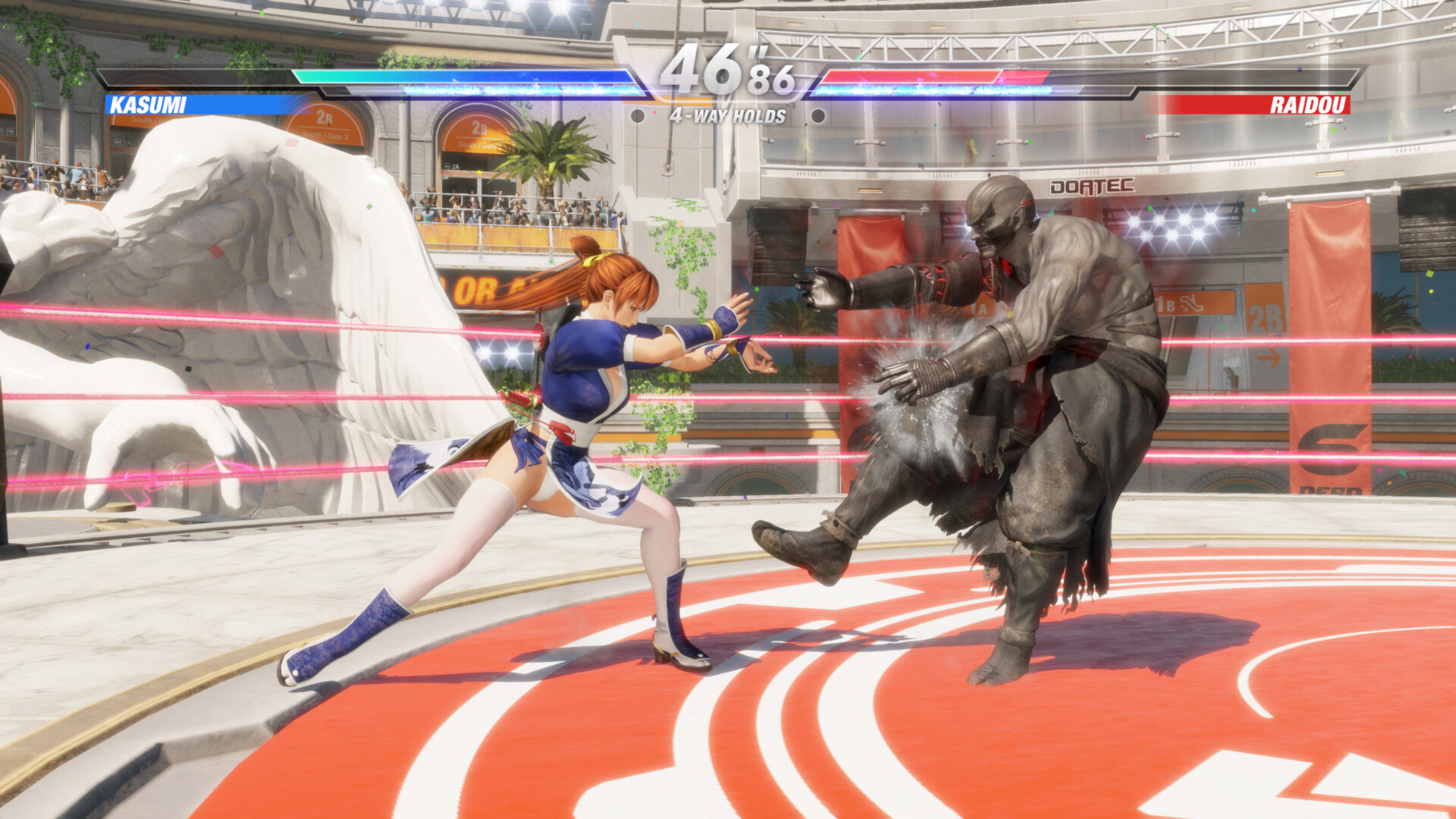
Strip away everything else and Dead or Alive's core remains a small miracle of design legibility. Strikes beat throws, throws beat holds, holds beat strikes. That rock-paper-scissors triangle sits underneath every exchange, and once it clicks you stop thinking in terms of memorized combos and start thinking in terms of reads. Do I commit to pressure and risk a hold? Do I bait the reversal and punish with a throw? The mind games are immediate and constant, and they are the reason a DOA match at any skill level feels like a conversation rather than a recital.
Around that foundation, DOA6's additions are still here and still smart. The Break Gauge gives every character a meter to spend, fuelling the cinematic Break Blow - a heavy, slow-motion super - and the Break Hold, a universal reversal that lets a cornered player buy breathing room. Fatal Rush, the auto-combo string mapped to a single button, is the genre's most graceful on-ramp: it gives a total beginner a flashy, functional offense on day one while remaining a real, if limited, tool in expert hands. Few fighters thread the accessibility needle this elegantly, handing newcomers a foothold without hollowing out the depth that keeps veterans around.
What keeps it from feeling like a casual toy is the stun system. Land the wrong move and you are launched into a juggle; guess wrong on defense and you eat a critical stun that snowballs into real damage. The tension between offense and the ever-present threat of a hold means matches swing hard and fast, and the comeback potential baked into the Break mechanics keeps even lopsided rounds alive until the final blow. It is fast, readable and dramatic - exactly what it has always been.
The longer you sit with it, the more the depth reveals itself. Movement is built on quick, committal sidesteps and crouch transitions rather than free-flowing skating, so positioning is a deliberate act. The hold system is the real skill ceiling: directional holds must be timed to the height and class of an incoming attack, which turns defense into an active read rather than a passive block. Expert play becomes a knife's-edge of conditioning - feinting strings to coax out a hold, then blowing it up with a throw, all in the space of a heartbeat. That risk-reward loop is what separates a button-mashed win from a match where both players are genuinely trying to outthink each other, and it is as sharp here as it has ever been.
Stages that hit back
If the combat is the heart, the stages are the showmanship. Dead or Alive has always treated its arenas as a third combatant, and Last Round keeps the series' love of verticality and spectacle intact. Multi-tiered levels let you blast an opponent through a railing to a lower floor, environmental Danger Zones detonate when a body hits them, and the larger "Mass Destruction" set pieces turn a single well-placed launcher into a chain-reaction of collapsing scenery and bonus damage.
It is pure theater, and it matters mechanically too: stage awareness becomes part of your spacing, because knowing where the explosive wall or the long drop is can flip a neutral exchange into a round-ending sequence. Some competitive players will always prefer to lab on a flat, hazard-free stage, and that option exists - but for the way DOA wants to be played, the chaos is the point. On current-gen hardware these stages have never looked better, with denser crowds and sharper reflections.
A roster that finally feels whole
This is where Last Round earns its "definitive" label most honestly. The package ships with 29 fighters out of the box: the full 24-strong DOA6 base roster plus five characters - Nyotengu, Phase 4, Momiji, Rachel and Tamaki - that were previously sold as paid DLC, now folded in for free. For anyone who bounced off the original game's piecemeal roster, getting the complete cast in one purchase is a meaningful, tangible upgrade.
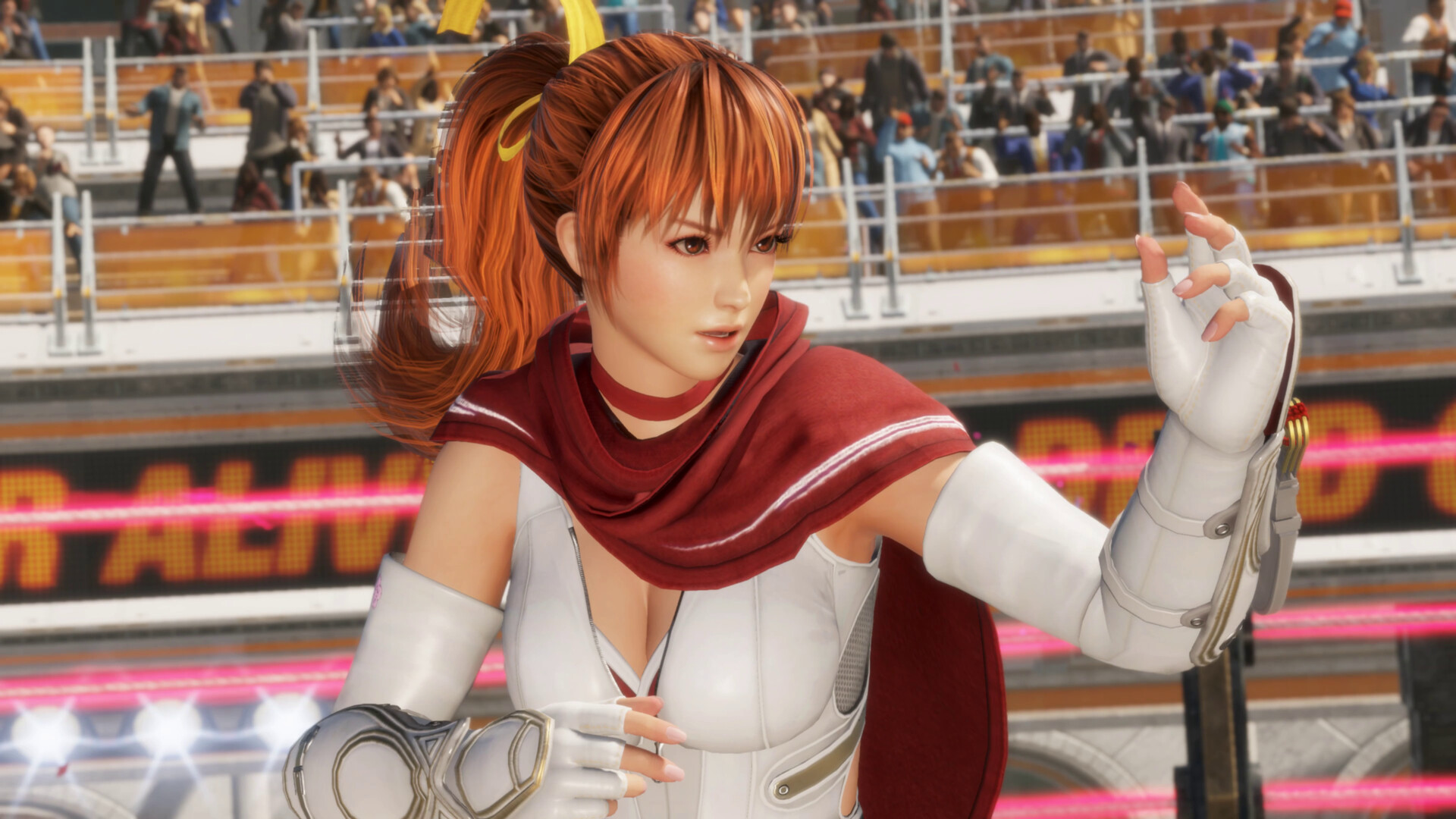
More importantly, that cast is genuinely diverse in playstyle. You have grappler-leaning bruisers like Bass and Bayman, the lightning rushdown of Hayabusa and Hayate, technical counter-heavy fighters, and a whole spread of distinct ninjutsu, wrestling, kung-fu and military-CQC archetypes. Even the guest fighters who have wandered in over the years - most famously SNK's Mai Shiranui - feel mechanically considered rather than bolted on. There is a main here for almost anyone, and the visual identity of each fighter is so strong that learning a new character feels like an event.
Balance and the competitive picture
For a game often dismissed as style over substance, DOA6 has quietly held up as a competitive platform, and Last Round inherits years of that tuning. The cast is broadly viable - there is no single character so dominant that the others are unplayable, and even the flashier archetypes have exploitable gaps. The hold mechanic is the great equalizer: because any player can attempt a reversal at any time, blowout situations are rarer than in many fighters, and a confident defender can drag a match back from the brink.
That same mechanic is also the series' biggest trade-off. Universal holds can reward guessing and dampen the value of pure execution, and there is a real debate to be had about how much the triangle leans on reads versus skill. But in practice, high-level DOA is a tense, watchable spectacle, and Last Round's training suite - frame data, hit-box display, recording dummies and DOA Quest's structured drills - gives an aspiring competitor everything they need to climb. The scene is small, but the tools to support it are not.
From a free front door to a sprawling story
Koei Tecmo clearly wants Last Round to be the easiest DOA to try in the series' history, and the structure reflects that. A free Core Fighters tier launches alongside the paid standard edition, letting anyone download the game at no cost, run the tutorials, hit training mode and play a rotating selection of characters before spending a cent. As a way to lower the barrier to a genre that can feel intimidating, it is hard to fault, and it is the same model that built audiences for the previous two entries.
The mode list around it is broad if uneven. DOA Quest returns as a grid of bite-sized challenge missions that double as a stealth tutorial, teaching mechanics through objectives while dripping out rewards - it remains the best way to actually learn the game. Training and combo challenges are robust. The Story mode, on the other hand, is the same overstuffed, time-hopping tangle it always was: dozens of short vignettes strung across a timeline that makes very little sense, delivered with a straight face it does not quite earn. You play it for the fights and the fan service, not the plot.
Online is the part that most needs to prove itself, and the picture is mixed. Lobbies, ranked and casual matchmaking are all present, and when a connection is clean the netcode holds up well enough for the series' fast pace. But the matchmaking can be slow outside peak hours, and longtime players will remember that DOA6's online took a long time to reach a good place after the original launch. Last Round inherits that improved baseline rather than reinventing it, which is fine - but "fine" is not the leap a 2026 re-release might have promised.
Gorgeous, and quietly generous in places
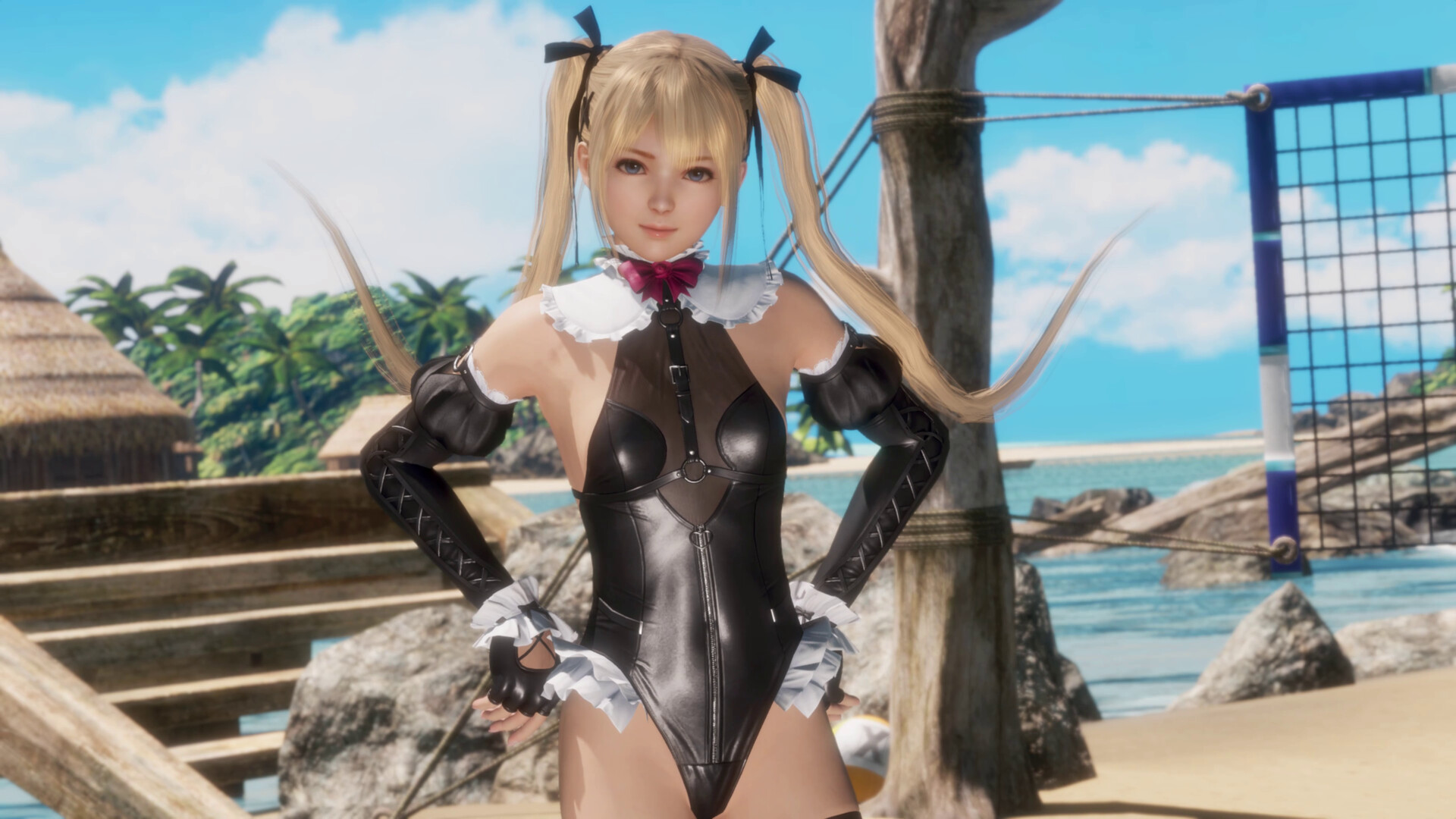
Visually, this is still a showcase. Team Ninja's Soft Engine renders skin, fabric and hair with a tactility few fighters match, and the new photo mode is a genuine highlight - a deep, fiddly toolset for posing the series' famously detailed models against its multi-tiered stages. It is the kind of feature that sounds frivolous until you lose an hour to it. The UI is clean, and the whole thing carries itself with the polish of a game that has had years to settle.
The audio deserves a mention too. The soundtrack leans into propulsive, slightly cheesy rock and electronic tracks that suit the on-screen spectacle, the impact sound design gives every counter-hit a satisfying crunch, and both Japanese and English voice options are present for the cast. It is not a score you will hum away from the game, but in the moment it does exactly what fighting-game music should: keep your pulse up. Customization, meanwhile, is vast - costumes, hairstyles, accessories and color variants run deep, which is a double-edged sword we will come back to.
Credit where it is due: bundling five paid characters in for free and offering a no-cost entry tier are real concessions to value, and they should be acknowledged. When Last Round is being generous, it is properly generous.

Where the package cracks
So where does it go wrong? Because for all its polish, Last Round is, fundamentally, a seven-year-old game sold again - and the way it is sold reopens every old wound the franchise has. The headline problem is value. At $39.99 for the standard edition, a definitive edition should feel like more than a current-gen port of DOA6 with the DLC roster switched on. There is no major new mode, no reworked story, no substantial mechanical evolution. The genuinely new content - the original character Minato and a fresh King of Fighters collaboration - is arriving later as paid add-ons, which lands badly when the base package already feels thin on new ideas.
And then there is the monetization, the third rail of every Dead or Alive conversation. The series' reputation for selling costumes by the hundreds - bundle after bundle, season pass after season pass - precedes it, and it is hard not to see the same storefront looming over a free tier here. A "free to download" front door rings hollow when the road behind it is paved with paid cosmetics, and the problem is less about the fighting and more about the sense that the package is engineered as a monetization platform first and a celebration second.
It is worth being precise about what is wrong here, because it is not simply "this game has DLC." Plenty of live-service fighters sell cosmetics, and that alone is not the issue. The problem is the combination: a re-release of old content, at a non-trivial price, from a series with a long history of nickel-and-diming its most dedicated fans, marketed as an anniversary celebration. Each of those on its own might be forgivable. Together, they read as a cash-in dressed up as a tribute.
Part of it is also simply about expectation. A 30th-anniversary release dangled the possibility of something new; what shipped is a very good re-release wearing an anniversary banner. That the series' actual next chapter - the early-development mainline entry Koei Tecmo has teased - exists makes Last Round feel even more like a placeholder, a way to keep the lights on rather than the event the marketing implied. None of that makes the combat worse. It does make the asking price harder to swallow.
Who it's for
If you have never played Dead or Alive 6, this is unambiguously the version to get - and thanks to Core Fighters, you can find out whether you like it for free before paying anything. The fighting is excellent, the spectacle is unmatched, and the complete roster removes the original's biggest sticking point. For lapsed fans who skipped DOA6 in 2019, the all-in-one package is a tidy way back in.
If you already own and play DOA6, the calculus is much harder. You are paying again for a prettier coat of paint, five characters you may already own, and the promise of paid extras to come. The double-dip is hard to justify. Wait for a sale, or wait to see how the post-launch content and storefront actually shake out before committing.
The verdict
Underneath the business model is one of the best-feeling fighting games you can buy, and Last Round presents it more completely and more beautifully than ever. But a re-release is judged as much on its deal as on its design, and this one asks a lot while offering little that is genuinely new, leaning on the same monetization habits the series has always had. The fighting earns a hearty recommendation; the package earns a hard, honest "it depends." Try the free tier, fall for the triangle, and then decide with your eyes open - because the game is brilliant, and the sell is not.