There's a particular trick that very few games have ever pulled off: convincing you that the best moments of your own teenage life were probably more interesting than they actually were. Mixtape, the second game from Melbourne-based studio Beethoven & Dinosaur, pulls it off in its first ten minutes — and then doubles down for another five hours. By the time the credits roll on Rockford, Slater, and Cassandra's last night of high school in 1990s Northern California, you've been dragged through skate parks, suburban backyards, fireworks-lit beaches, and police chases set to needle-drops from DEVO, The Cure, Joy Division, and a quietly stacked roster of college-rock B-sides. None of it feels like filler. Some of it feels like the best storytelling Annapurna has put its name on since What Remains of Edith Finch.
This is also the part where we have to admit that Mixtape is barely a game in the way most people use that word. There's no skill tree. There's no progression system. There are no enemies, no failure states, no upgrades, no skill checks, and almost no decisions that change anything substantive about the story. What there is, instead, is a tightly choreographed sequence of vignettes — twenty-five of them, give or take — each one set to a curated track from the kind of mid-period college-rock playlist that defined the entire decade Beethoven & Dinosaur is reaching for.
It is, in every meaningful sense, an album. Not a soundtrack, not a music game, not a narrative-with-songs. An album. With cover art, a tracklist, a deliberate sense of pacing, a closing number, and a clear intent that the order matters. And like the best albums, it hits you harder when you stop trying to evaluate every song individually and just let the thing play through. That's also why we've landed at 88 rather than higher. The album is fantastic. A handful of the tracks are not.
Three friends, one night, one cassette
It's the last night of high school in summer 1996. Rockford, the kind of dreamer kid who builds tape compilations because he doesn't know how to express anything else; Slater, his best friend and the reluctant adult of the group; and Cassandra, who has been quietly drifting toward a future the others haven't fully reckoned with — three friends, one perfectly curated playlist, and a single night in a small town in Northern California to do everything they've been talking about for four years and never actually done.
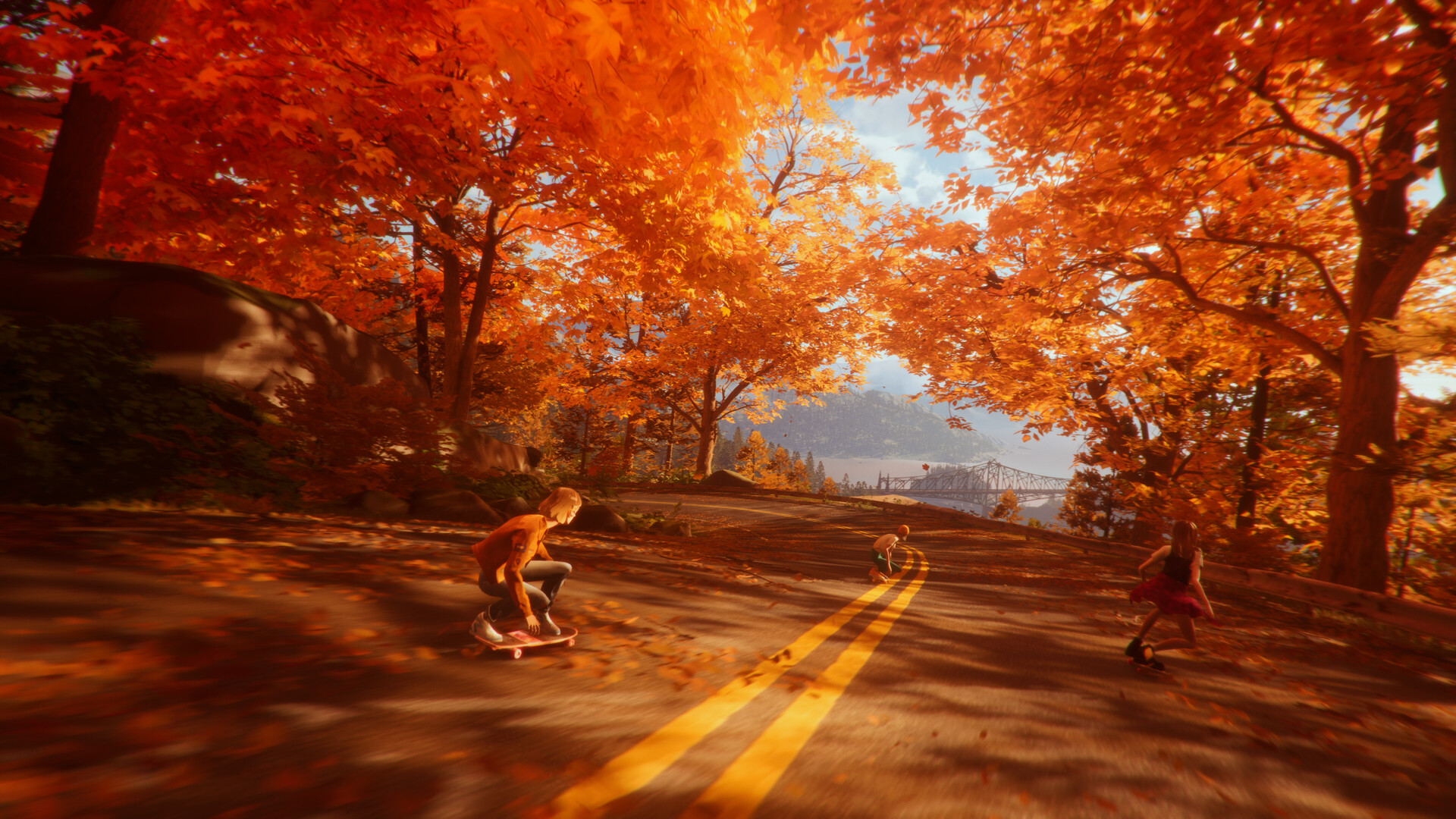
That's the entire setup. Beethoven & Dinosaur doesn't try to dress it up. There's no cosmic mystery, no genre swerve, no twist where the friend group secretly contains a vampire. The conceit is that Rockford has burned a mixtape for the night — a literal cassette, thumbnailed onscreen between scenes, with each track listed on a hand-written label — and as each song plays, the trio is pulled into a slightly heightened, slightly dreamlike reenactment of one of the formative memories that song has fused itself to. Skating down a hill at sunset. The first time they snuck into a movie. The summer they got chased by the police out of a half-finished construction site. The night Cassandra finally admitted she was leaving.
The framing is loose, and that's a feature. Each vignette is a song; each song is a memory; the memories are not necessarily literal. Sometimes a memory stylizes to the point where the geography of the scene stops making sense and the camera starts floating freely through impossible space. The cumulative effect is closer to a music documentary than a traditional video game. You're playing an album about three people who don't quite know what they want to remember, and the structure leans into that ambiguity rather than trying to resolve it.
The character work, surprisingly, holds up to the framing's ambition. Rockford is the kind of mixtape-burning teenager who is both impossibly earnest and absolutely unbearable in the way only a sixteen-year-old can be, and the script gives him the room to be both without ever winking at the audience. Slater is funny in the deflecting, sarcastic way that real best friends are funny — sharp enough to land jokes, gentle enough to not draw blood — and Cassandra carries the genuine emotional weight of the trio. Her decisions are the ones actually about to ripple outward, and the writing trusts you to feel that without ever drawing a sign that points at it.
The script never makes their conflicts melodramatic. Nobody screams at anybody. There is no scene where someone runs out of a party in tears. The tension is the kind that exists between people who have known each other so long they don't quite know how to talk about the thing they're all thinking about, and so they keep playing tape after tape and pretending it'll come up later. It's a remarkably mature read on a teenage friend group, and it's the part of Mixtape that's likely to stick around in conversations about the game years after the discourse around its gameplay has settled. The trio feels real in a way most coming-of-age fiction across film, books, and games has stopped achieving. They aren't archetypes. They're three specific kids on one specific night.
The soundtrack is the game
The soundtrack is the part of Mixtape we want to be very careful about, because it's the part the game lives or dies on, and Beethoven & Dinosaur clearly knows that. The licensed tracklist runs deep — DEVO, Roxy Music, Lush, The Smashing Pumpkins, Iggy Pop, Siouxsie and the Banshees, Joy Division, The Cure, and at least a dozen more — and the curation isn't just an "iconic 90s playlist" pull. The picks lean specifically toward the moodier, more melancholic end of the era. There's no Nirvana. There's no Pearl Jam. There's no Smashing Pumpkins single you've already heard a thousand times — the Pumpkins track here is a cut from Adore, not Mellon Collie.
That selection bias matters. Mixtape isn't a celebration of the loudest, most populist part of the 90s; it's a celebration of the small, weird, slightly-off-center parts. The college-rock parts. The parts that ended up on actual mixtapes a 16-year-old made in 1996 because they were trying to convince a different 16-year-old that they had taste. The licensing budget here must have been astronomical, but every dollar shows up onscreen. Annapurna has a long track record of letting its narrative games punch above their weight on music — Outer Wilds, Stray, Edith Finch — but Mixtape is the first project under the publisher's banner where the music is the structural skeleton of the entire game. Cut the songs and there is, almost literally, no game left.
The technical side is just as careful. Each track in Mixtape has been re-mastered for in-game use, with custom edits that fade the song under dialogue and back up under setpieces. Every single transition between vignettes is timed to the bar — when one memory ends and the next begins, the music doesn't crossfade, it cuts on a downbeat, often mid-syllable. It's the kind of thing you only notice if you're watching for it, and it's the kind of thing that elevates the entire experience above what most narrative games attempt. Most games treat their soundtrack as wallpaper. Mixtape treats its soundtrack as scaffolding.
Where it stumbles is when a song is asked to carry a vignette that doesn't fully earn it. There's a sequence about two-thirds of the way through that uses a Joy Division track for what is, in the end, a ten-minute fishing minigame. The song deserves better. The minigame, blessedly, doesn't outstay its welcome — almost no minigame in Mixtape does — but the mismatch is jarring enough to break the spell that the rest of the album works so hard to maintain. There are maybe three or four moments like this across the full run-time. Not enough to break the album. Enough to keep it from being a perfect ten.
The original score, written specifically for the game by Beethoven & Dinosaur's in-house team, is the other unsung hero. It's used sparingly — most of the runtime is licensed music — but the few moments where the original score steps forward are some of the most quietly devastating in the game. There's a scene late in the second act, set on a beach as the trio watches fireworks, that drops the licensed tracks entirely and lets the original score breathe. That scene alone justifies the entire purchase price for a certain kind of player.
The vignette structure: what you actually do
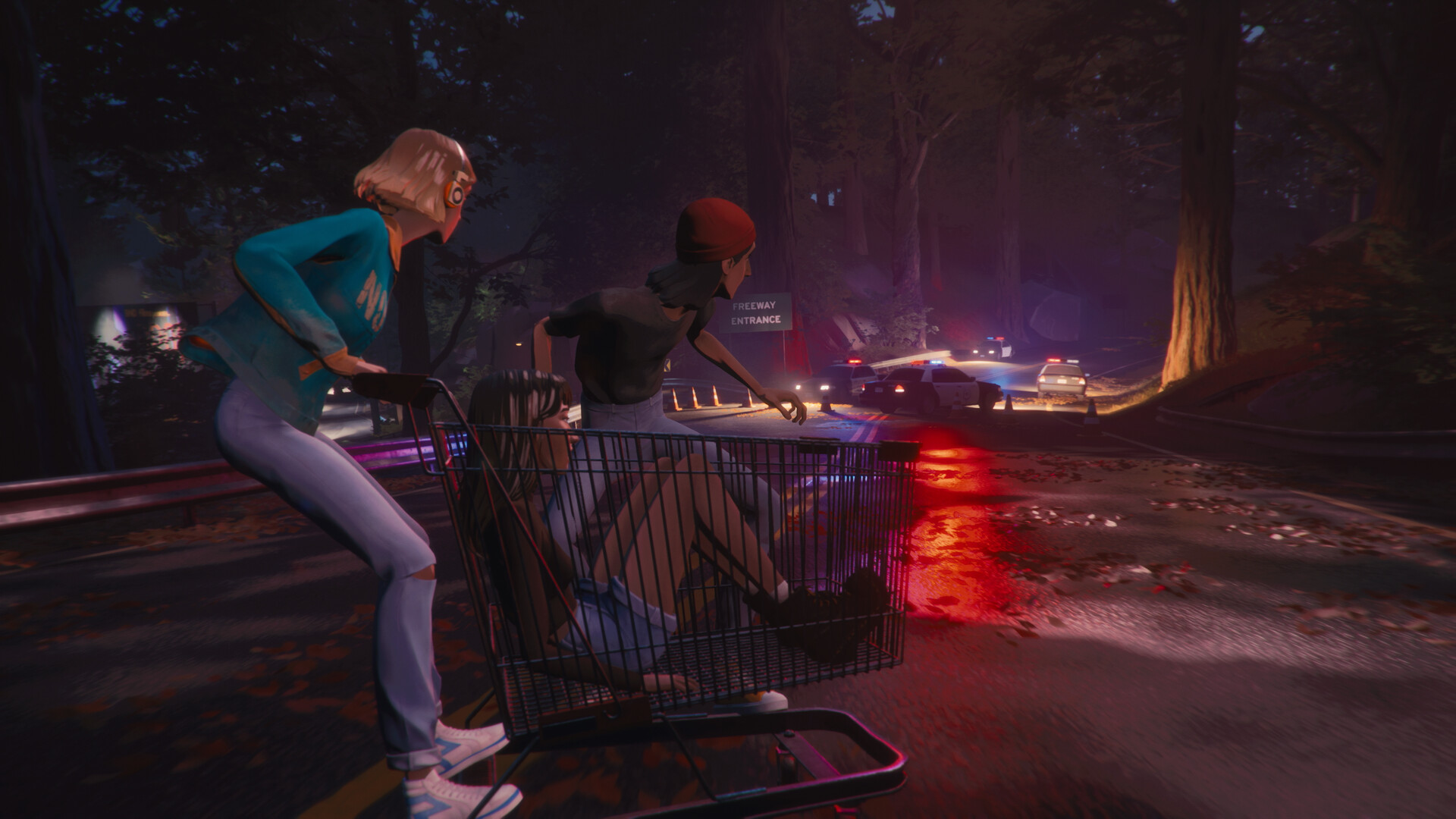
So what do you actually do in Mixtape? The honest answer is "different things in twenty-five different scenes, and most of them are very short." The vignettes range from five-minute setpieces with elaborate camera work and three or four interactive systems to ninety-second moments where you do nothing but tap the A button to make Rockford take a photograph. There's a skating mini-section with momentum-based controls that wouldn't be out of place in Tony Hawk's Underground. There's a sequence where you guide a runaway shopping cart down a hill, dodging traffic, in what amounts to a stripped-down endless-runner. There's a dance scene at a house party where the input is purely rhythm-based — hit the buttons in time with the music, watch the trio dance, fail and they get embarrassed. There's a brief moment of taking Polaroids that is essentially a photo-mode the game refuses to call a photo-mode.
Most of these systems are too thin to stand on their own. None of them is meant to. The point isn't to test your skill at the rhythm minigame; the point is to give you a participatory texture for the song that's playing. You're not supposed to master the skating section. You're supposed to feel like you're skating while DEVO plays. And from that angle — the angle Beethoven & Dinosaur is clearly working at — the system design is more successful than not.
The variety is the part that genuinely surprises. With twenty-five vignettes you'd expect at least three or four to recycle mechanics, but Beethoven & Dinosaur stubbornly keeps inventing new ones. There's a sequence where you play as Cassandra and the entire input set is one button: pressing it moves time forward through a memory you can pause. There's a sequence where you control none of the characters and instead operate the camera on a slow dolly track around a wide pan of a backyard pool party, deciding what to look at as the song plays. There's a sequence where the gameplay is, almost literally, choosing the next song on the cassette. The variety alone is more design ambition than most narrative games pack into their entire run-time.
What this means in practice is that Mixtape is best played in one or two sittings, with a controller, on a screen big enough to do the visual direction justice. It is the worst possible game to "play in chunks on a Switch over the course of three weeks," even though it does technically work that way. Each vignette flows into the next, the narrative beats land hardest when you're not breaking them up with a six-hour gap, and the album metaphor — which the entire game leans on — only really works if you're listening to side A and side B as continuous halves.
For the kind of player who needs a clear failure state, an objective marker, or a leveling system to feel like they're "playing," Mixtape will be a frustrating experience even at five hours. There is one section where pressing the wrong button at the wrong time can fail a vignette, and that section is so out-of-step with the rest of the game's vocabulary that it feels like it slipped in from a different project. Other than that, you cannot lose. You cannot get stuck. You cannot miss content. The game is going where it's going, and it's going to take you with it.
Visual direction: the thing that pulls everything together
The visuals are the unsung secret weapon. Beethoven & Dinosaur's last game, The Artful Escape, was already a visual standout — a 2D-on-3D animated spectacle of glam rock and surreal landscapes — and Mixtape graduates that approach to something closer to feature animation. Character models are stylized but not flat; backgrounds are richly textured paintings that feel hand-built; lighting reacts in real time to the music's intensity, bloom and chromatic aberration ramping up on emotional beats and dropping back to a clean, almost film-stock-grain look during quieter moments.
The art direction never sits still. A scene set at a 4 AM diner is rendered in the saturated, oversaturated palette of a 90s music video. A scene set in a backyard at dusk uses the soft, peach-pink lighting of a low-budget indie film. A scene set on a school football field in the rain uses a muted, almost black-and-white palette that would feel right at home in a Wong Kar-wai picture. The throughline is that every vignette has its own visual identity, and the transitions between them are authored — not procedural, not faded, deliberately authored — to feel like the cuts in a thoughtfully edited concert film.
Animation is where the team really shows off. Character motion is hand-keyed in the most expressive scenes, with deliberate frame-rate drops on certain beats — a held pose for an extra half-second when Cassandra reaches the top of a hill, a single frame of stillness on a character's face right before a song's chorus drops — that read more like animation choices than game-engine constraints. It's almost certainly more expensive to animate this way. It's also one of the things that makes Mixtape feel like an actual film in a way that almost no other game in this corner of the medium pulls off.
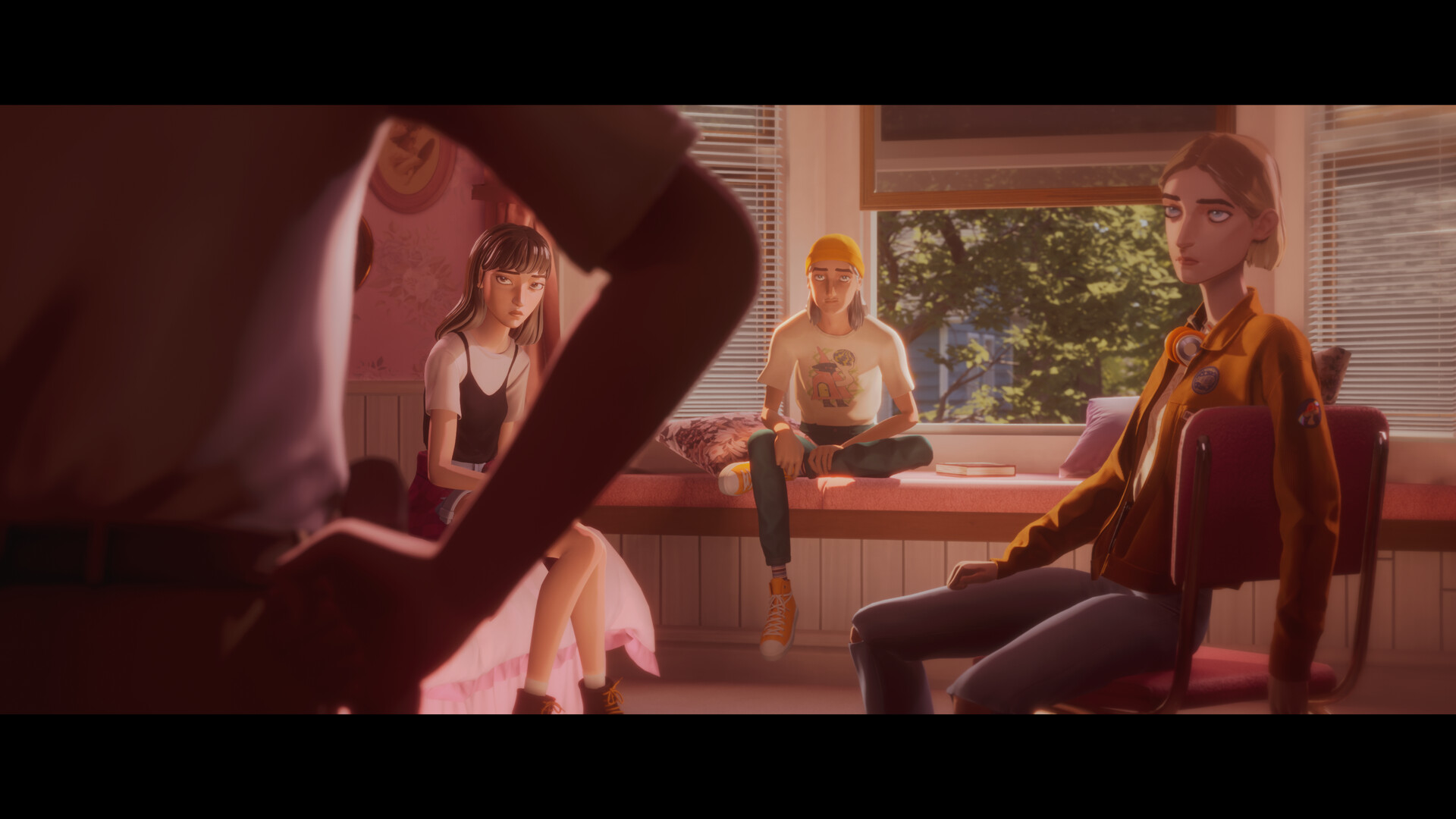
The cinematography deserves its own paragraph. Camera work in Mixtape is deliberate, often static, and frequently breaks the rule that a video game camera should always show the player what they need to see. There's a scene where the trio is having a critical conversation and the camera is set up behind a dirty window, halfway across the room, looking at them through partially-obscured glass. You can't see their faces clearly. You're not supposed to. The conversation is the point, and the framing is meant to give you the sense of overhearing it rather than participating in it. Most games would never make that call. Mixtape makes it constantly.
Pacing, length, and the cost of $20
Mixtape is short. We ran credits at four hours and forty minutes on a single, unbroken playthrough, and we don't think we missed anything substantive. There are a handful of optional vignettes hidden behind specific in-scene interactions — a tape someone gives you that you can choose to put in or not, a side-conversation that triggers a new song — and even with all of them found, the upper bound is around six hours. Replay value is essentially zero except for revisiting individual scenes you want to see again.
For $19.99, that math works. Annapurna has been deliberate with its narrative pricing across the last two years, and Mixtape sits in the sweet spot the publisher has been refining since Stray: short enough to fit a single weekend, long enough to feel like a full album, priced low enough that the length isn't a complaint. If Mixtape were $40, the conversation about its run-time would look very different. At $20, with full Game Pass availability for Xbox players and standalone availability everywhere else, it's a tight package.
That said, the pacing within those five hours has soft spots. The opening forty minutes are immaculate — a clear hook, a clear cast, a clear premise, and three excellent vignettes back-to-back to establish what the game is going to do. The closing forty minutes are even better, with a sustained emotional climax that earns every minute of the build-up. The middle two hours are where things wobble. Two or three vignettes in the second act feel like they're filling space rather than serving the album's arc. They're the moments where the soundtrack has to do disproportionate heavy lifting and the gameplay-as-texture concept exposes its limits. They aren't bad scenes. They're just not as essential as the surrounding tracks make them want to be.
This is a structural problem, not a design failure. Twenty-five vignettes is a lot to keep up at peak intensity for an entire run-time, and the third or fourth song on a side-A pull is rarely the best on the album. The pacing recovers in time for the closing stretch, but the dip is noticeable enough that a player coming in expecting a sustained five-hour high will feel the air go out of the room around the two-hour mark.
Where it doesn't quite land
The cons list for Mixtape is short, but it matters. The biggest one is that the game's commitment to "minimal gameplay as texture" occasionally tips into "no gameplay as oversight." A handful of vignettes have so little for the player to actually do that the controller becomes a liability — you sit there with a pad in your hand, knowing you're going to need to press one button somewhere in the next four minutes, watching the cinematic and trying not to notice that you'd be having a richer experience if you set the controller down. For an album-as-game, that's not a fatal flaw. For some players, it'll be a deal-breaker.
The script's stoner-and-irony layer is the second issue. Mixtape is, at heart, a sincere coming-of-age story, and the sincere parts are excellent. But there's a recurring strain of self-aware humor — characters making jokes about the cliches they're about to enact, fourth-wall-adjacent commentary on what kind of song just played, a couple of moments where the framing winks too hard at the audience — that occasionally undercuts the emotional weight the game has been carefully building. It's a tonal balance Beethoven & Dinosaur mostly nails, but when it slips, it slips into smug. Your tolerance for that kind of voice will determine whether you remember Mixtape as one of the best narrative games of 2026 or as one of the most precious.
The supporting cast is the third and final issue. The script's commitment to its trio is total, and the world outside them is correspondingly thin. There's a sister character with one cutscene who deserved three. A pair of comedic-relief cops who land their joke and then return for a second appearance that doesn't add anything. A girl at the party who clearly was meant to be a bigger presence and ends up with two scenes that feel cut from a longer version of the script. The game's runtime would have benefited from giving some of these supporting beats more room. Most of the time, you're with the trio, and the trio carries the load. But the outside world feels emptier than the writing of the leads would lead you to expect.
None of these cons are deal-breakers. None of them prevent Mixtape from being one of the best-curated narrative experiences released this year. They are, however, the reasons our score sits at 88 rather than in the mid-90s. Mixtape is a 9-out-of-10 album with three or four songs that are slightly less essential than the rest of the tracklist. We don't think that disqualifies it from greatness. We do think it's worth being honest about.
Who this is for, and how it compares
The closest comparison is, fittingly, another Annapurna title: What Remains of Edith Finch, which used a similar vignette structure to tell the story of a single family across multiple generations. Mixtape is structurally similar — short, punchy, gameplay-light, narrative-heavy — but emotionally it lands closer to Life Is Strange in its first season, when the franchise was still about a small group of teenagers in a specific place at a specific time. There's also a real dose of Florence — the 2018 Annapurna mobile game about a relationship told entirely in vignettes — and a clear visual debt to films like Dazed and Confused, Mid90s, and the early-period Sofia Coppola catalog.
If you played The Artful Escape and loved the visual ambition but found the narrative too thin, Mixtape is the answer to that complaint. If you played Edith Finch and wished it were three hours longer with a more sustained emotional throughline, Mixtape is the answer to that one too. If you're the kind of player who needs a skill check or a leveling system to feel engaged, Mixtape is going to be a frustrating five hours. And if you're the kind of player who has ever, in your life, made a mixtape for someone — a literal cassette, a Spotify playlist, a series of links sent in a chat — Mixtape is going to be one of the most pointed, specific games you play this year.
Multiplatform availability helps. Mixtape is on PlayStation 5, Xbox Series X|S, Nintendo Switch 2, PC (via Steam and Epic Games Store), and is included in Xbox Game Pass on day one. Performance across platforms is locked at 60 frames per second, with no apparent compromises on visual fidelity between the console and PC versions. The Switch 2 version, which we briefly spot-checked, looks and runs cleanly — the team has clearly done the platform-specific optimization work the game's visual ambition requires.
The verdict
Mixtape is the rare game that is most accurately described in non-game terms. It is an album. It is a coming-of-age film. It is a 90s mixtape made by someone who clearly loves the format and clearly remembers what mixtapes were actually for. Calling it a "video game" is technically correct and entirely beside the point, in the same way that calling Edith Finch a "walking simulator" is technically correct and entirely beside the point.
The album is great. The trio is great. The licensing is genuinely top-shelf, the visual direction is the most cohesive Annapurna has put its name on in years, and the writing is the rare coming-of-age work that treats teenagers as people rather than archetypes. The gameplay is minimal by design. A handful of the vignettes don't quite earn the songs they ride on. The supporting cast is thin. But none of that is enough to disqualify Mixtape from being one of the best narrative games of 2026, and probably the best 90s-set narrative game ever made.
Beethoven & Dinosaur set out to make an album you could play. They mostly made it. Side B is slightly weaker than side A. The closing track will absolutely make you cry. And the cassette label — the one you see between scenes, hand-written, with a little drawing in the corner — will sit in your head for weeks.
It's not a 10. It's a strong 88. And it's worth every dollar of the twenty.