It has taken ZA/UM six and a half years to follow up Disco Elysium, and for most of those years it looked like the follow-up was never coming at all. The Estonian studio's post-Elysium implosion is the kind of thing that gets written up in business school case studies — founder Robert Kurvitz pushed out, a long civil war over copyright and ownership, a Sea of Solitude sequel scrapped, and the heir-apparent narrative RPG project — the one with all the lore notes and Sea Power demos and concept art — mothballed indefinitely. The new game was not going to be Disco Elysium 2. It was going to be something else, made by what remained of the team, and for two years it was unclear whether something else would arrive at all.
ZERO PARADES: For Dead Spies is the something else. It arrives on May 21 on PC, with a PlayStation 5 release pencilled in for later in the year, and it is not a Disco Elysium sequel in any literal sense — the game itself goes out of its way to plant its feet on different soil. The Revachol of Elysium is gone. The murdered hanged man is gone. Harry du Bois is not coming back. What ZA/UM has built instead is an espionage RPG that draws its DNA from John le Carre rather than James Bond, set in a fictional city in cultural collapse, with a burnt-out spy as your dice-roll-and-internal-monologue vehicle for fifty or so hours of branching philosophical conversation. It has done the impossible: it has earned the comparison, and it has earned it without trying to be the same game.
The Setting: Portofiro, Quisach, and a Cultural Revolution Borrowed From Somewhere Else
Zero Parades is set in Portofiro, a Mediterranean-flavoured city-state in some unmarked alternate twentieth century. The geography reads, depending on which corner of the map you wander into, like a cross between Trieste, Genoa, Casablanca, and a brutalist suburb of Bucharest. The mood is decidedly noir, but it is noir with the air partially sucked out — the streets are quiet, the cafes are crowded with men who do not seem to be drinking anything, the radio plays the same five songs on a loop, and a cultural movement called La Luz has been imported wholesale from somewhere overseas and grafted onto the local population with mixed and sometimes violent results. La Luz wants people to feel something. The people of Portofiro have spent generations training themselves not to.
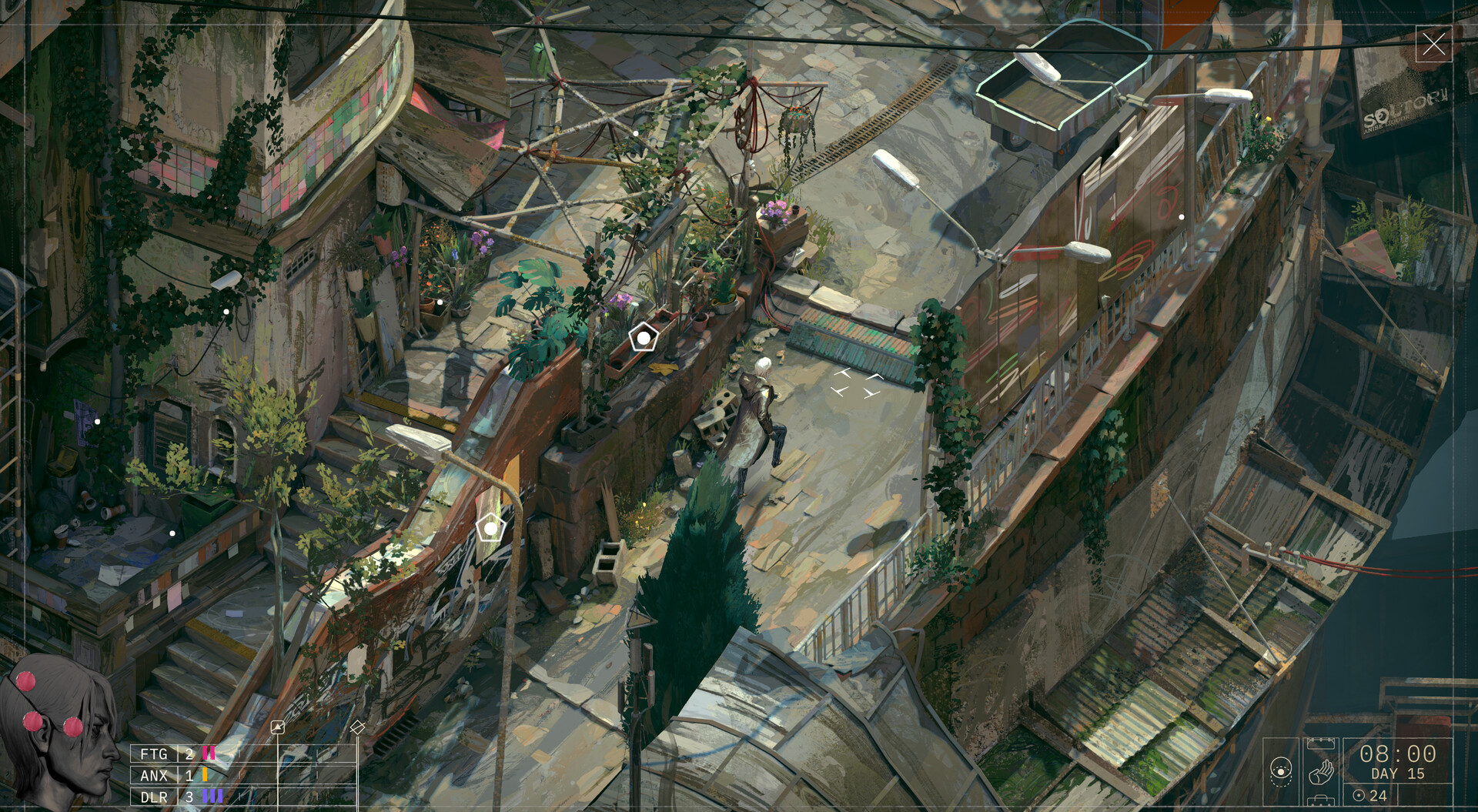
The Quisach district, where most of the early game takes place, is the part of Portofiro that has accepted the cultural transplant the least well. It is a working district running to seed, with abandoned shipyards backing onto rotting apartment blocks, an aging cinema that is now part-cinema and part-shelter, and a tram line that has not been completed because the city government changed twice during construction and the new administrations did not agree about which neighbourhood deserved to be the terminus. You spend a lot of time in Quisach. You spend a lot of time looking at peeling paint and at men in long coats who are pretending to read newspapers. ZA/UM's environment artists, several of whom carried over from Disco Elysium, have made every wall in Quisach feel like it has a private grievance.
This is the kind of setting where intelligence work would not just work but make sense, and that is the conceit Zero Parades runs with. Portofiro sits at a strategic political crossroads. La Luz has been planted here by an unspecified foreign power that wants to use the cultural revolution as a soft-power lever. There are at least three intelligence services operating in the city at any given moment, all of which know about each other, none of which acknowledge each other in print, and all of which assume the others are at least one move ahead. Into this mess walks Cascade.
The Spy: Hershel Wilk, Code Name Cascade, and the Long Apology of a Career
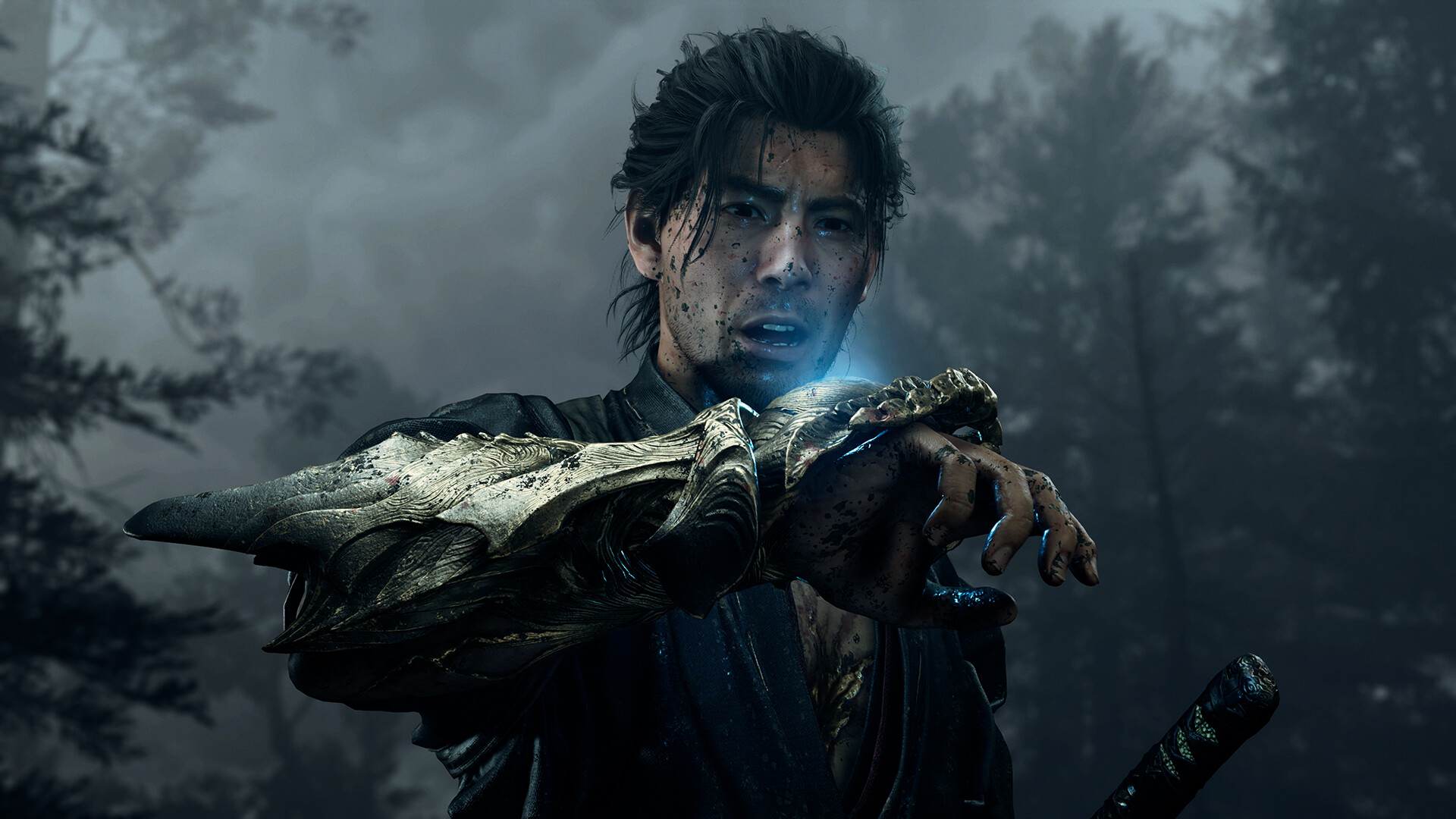
The protagonist of Zero Parades is Hershel Wilk, a woman in her late thirties who has not been an active intelligence officer for the better part of a decade. She is one of the central conceits the game wants you to wrestle with: not an audience-stand-in blank slate, not a roleplay-as-you-wish action hero, but a specific person with a specific past who has been reactivated by her old employer — an outfit called Opera, which is part of a larger and shadowy parent organisation that the game lets you piece together over hours of conversation — for what is openly described as a final assignment. Her code name is Cascade, and the game's dialogue UI will refer to her by that name when she is in spy mode and Hershel when she is dealing with the parts of her past that have not been redacted yet.
What is brilliant about Cascade as a protagonist is that she is not Harry du Bois. Harry was a wreck who had forgotten his name. Cascade is not a wreck. Cascade is a competent professional spy who has, over the course of two failed marriages, one infant daughter she does not have custody of, and one mission that ended with three of her assets dead in a Lisbon hotel room, become an extremely tired person. The pleasure of playing her is the pleasure of watching a brilliant operator work at sixty percent capacity, of seeing her notice a detail across a cafe that you cannot quite parse yet, and of choosing whether she should pretend not to have noticed it, which she usually wants to do. There are stretches of Zero Parades where the game is essentially asking you whether Cascade is allowed to be tired. Most of the time, the answer is no.
The supporting cast around her is the most consistently strong in a narrative RPG since Pillars of Eternity II. The standouts include a belligerent local doctor who knows more than he should about the state's interest in the Quisach district; a phone-sex worker who operates under the working name the Duchess and who is, it turns out, the most well-connected person in the city; and a pop star named Ultra Violeta whose tour has been covering for two months of casual courier work between Portofiro and a port on the other side of the peninsula. There are easily two dozen more of these, all written with the same density, all of them able to derail a conversation for forty-five minutes if you ask the right follow-up.
The Skill Check, Reimagined: Three Faculties, One Burnt Nervous System
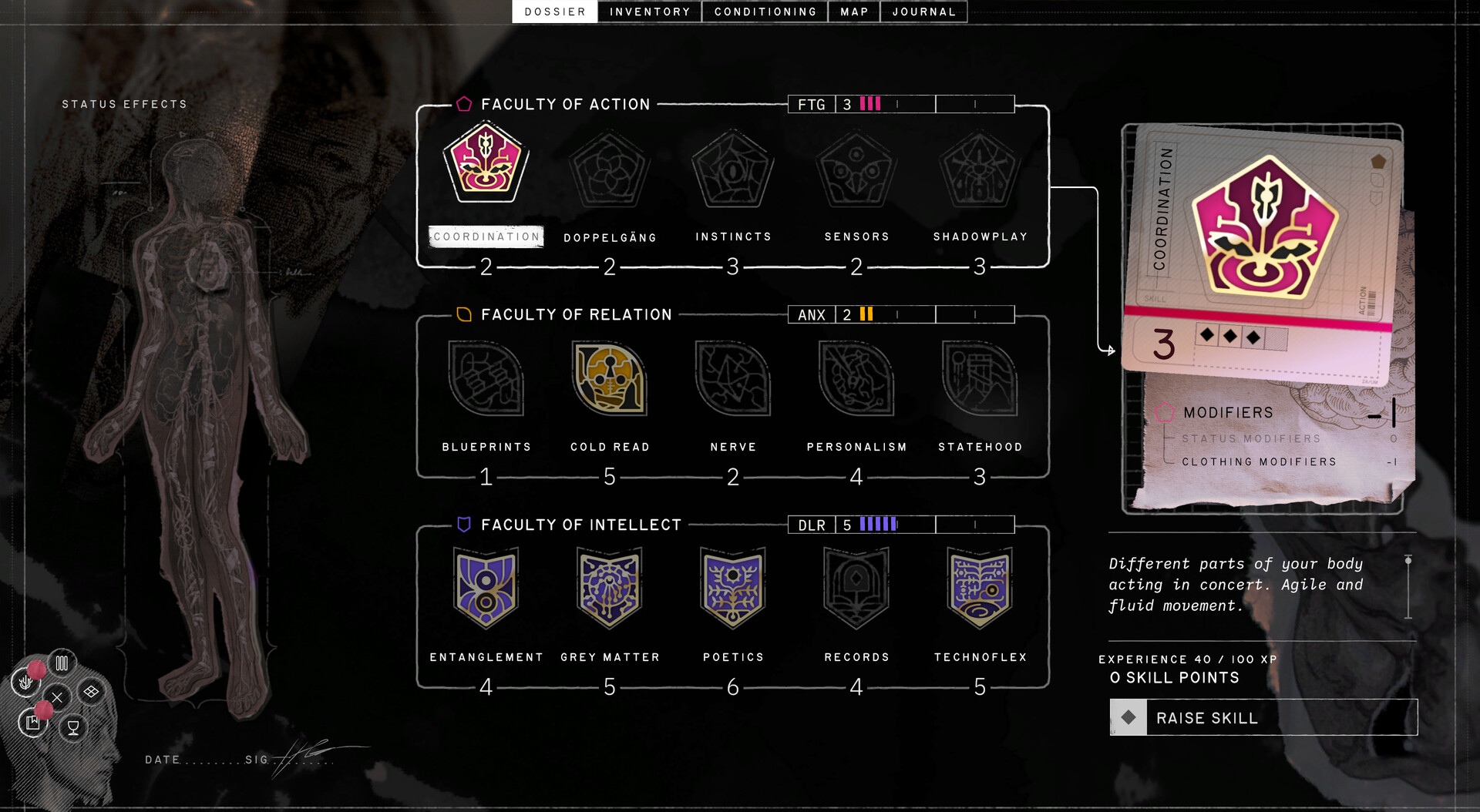
Mechanically, Zero Parades sits in conversation with Disco Elysium but does not copy its homework. The skill check is still the central interaction, and it is still resolved with a die roll modified by your stats. The difference is in the architecture surrounding the roll. Where Disco Elysium spread Harry du Bois across twenty-four personality skills that argued among themselves in his head, Cascade is built around three Faculties: Action, Relation, and Intellect. Each Faculty is broken down further into specific sub-skills — Action contains things like Stealth, Reaction, and Endurance; Relation contains Empathy, Charm, and Intimidation; Intellect contains Cryptography, History, Logic, and a handful of darker tradecraft skills you only unlock later. The result is fewer interrupting voices and more direct rolls, which makes Zero Parades less novel as a piece of UX than Disco Elysium was and more readable as a traditional RPG. It is the right call. Disco Elysium's twenty-four-voices design only worked because Harry was an unreliable narrator at the bottom of a hangover.
Where Zero Parades pulls genuinely new ground is in the way it ties the skill check to the body that is performing it. Each Faculty has a corresponding stress gauge: Fatigue (Action), Anxiety (Relation), and Delirium (Intellect). Every time Cascade rolls a check, you are given a choice about how much effort to throw into it. A standard roll is a flat skill check against a difficulty number. An effortful roll spends a point from the corresponding stress gauge to add an extra die. A truly desperate roll — the kind you make when the mission is collapsing and you have to convince a senior intelligence officer that the gun she is pointing at you is loaded with blanks — will spend a point from all three gauges and add three dice. Push too hard on any one gauge and Cascade hits a breakpoint. Maxed Anxiety triggers a panic attack mid-conversation. Maxed Fatigue makes her physically slow and reduces her Action sub-skills for the next several scenes. Maxed Delirium is the most expensive: she stops being able to remember which of the cover stories she has told to whom, and the game silently swaps some of her dialogue options for hallucinatory ones that lock her into untruths she has not consciously decided to tell.
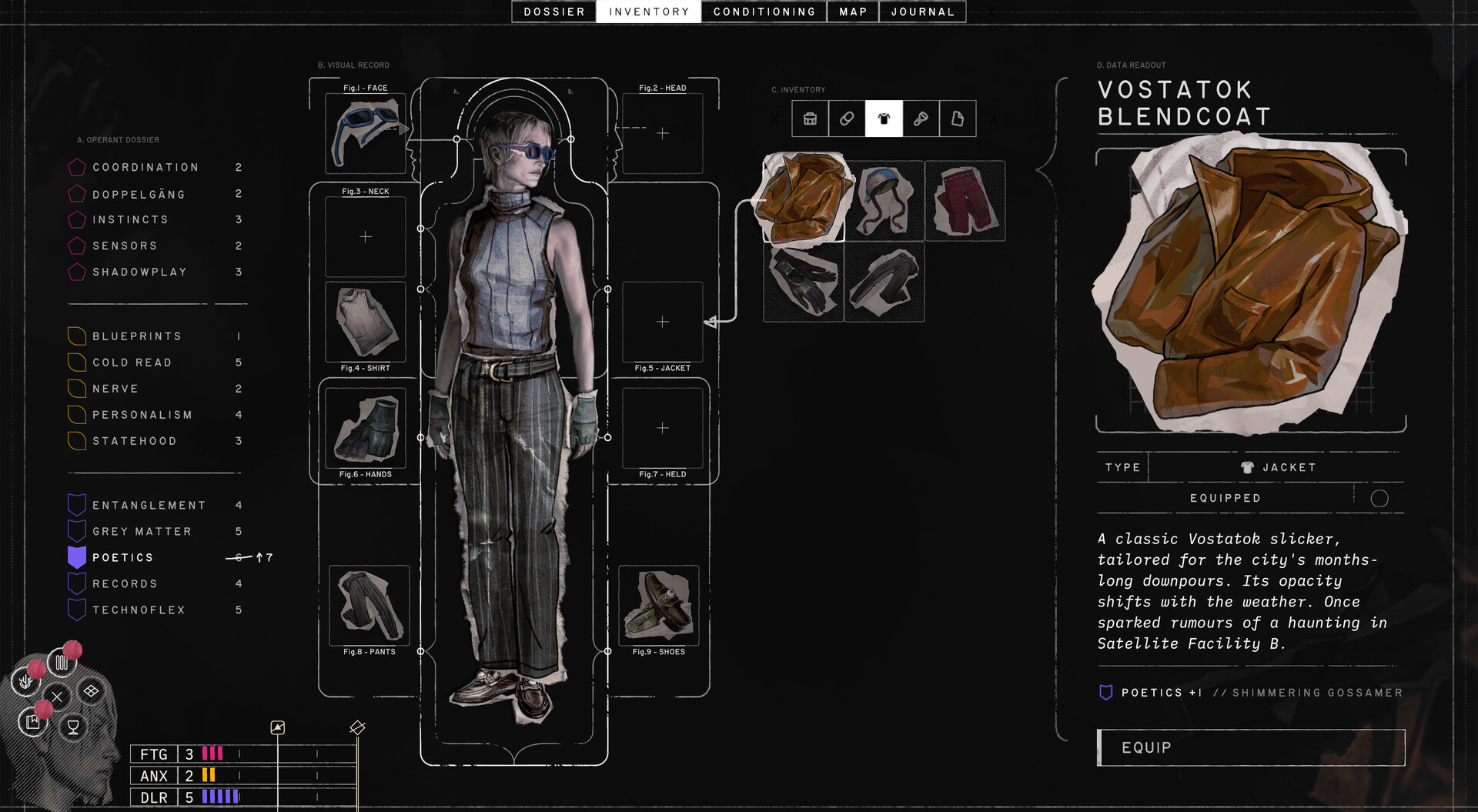
You manage these gauges the way a tired person manages a long day. Cigarettes shave a small amount off Anxiety but raise Fatigue. A drink at the bar in the cinema lowers Delirium but raises Anxiety the morning after. A nap in a safe house clears Fatigue at the cost of two hours of in-game time and one missed event. There are also non-pharmacological options, mostly tied to specific characters: a conversation with Ultra Violeta about her mother lowers Anxiety substantially, but only the first time. Cascade can also accept what the game calls a Conditioning — a set of trained behaviours from her Opera days that act as passive bonuses, granted at character creation and unlockable later, that confer a permanent advantage in exchange for a behavioural constraint. The most common Conditioning, available from the first scene, gives Cascade an extra die on Intimidation rolls in exchange for never permitting her to drink with another spy. Violate the constraint and the bonus goes away for the rest of the run.
Dramatic Encounters and the Smart Way to Build an Action Scene in a Talking Game
The other system Zero Parades is rightly going to be remembered for is the Dramatic Encounter. Disco Elysium had set-piece scenes where dice rolls compounded over several lines of dialogue, but they were essentially long-form skill checks with extra trimming. Dramatic Encounters in Zero Parades are something more structured: chained, four-to-eight-step events where each step asks Cascade to commit to one of two or three approaches before the dice are even rolled, and where the consequence of each commitment cascades down into the available approaches at the next step. The closest reference point I can give you is a tabletop game's combat round, except the combat is a conversation with a foreign defector, or an attempt to bluff your way past a customs officer, or a tense negotiation with a black-market arms dealer whose nephew Cascade went to school with.
The structural genius of the Dramatic Encounter is that it solves the oldest problem in narrative RPGs: how to give the player a moment of genuine tension without resorting to combat. Most cRPGs cheat their way around this by stuffing in a fight scene. Disco Elysium famously had almost no combat at all, which was beautiful but did create a slight muscle-memory ache around the midpoint of the game when you started craving the rhythm of a back-and-forth contest. Dramatic Encounters give Zero Parades its action rhythm. Done well, they feel like watching a thriller play out at half speed, with you nudging Cascade's commitments at each step. Done badly, by you, they feel like watching a thriller you have written and you have written badly. Both of those experiences are interesting to live through.
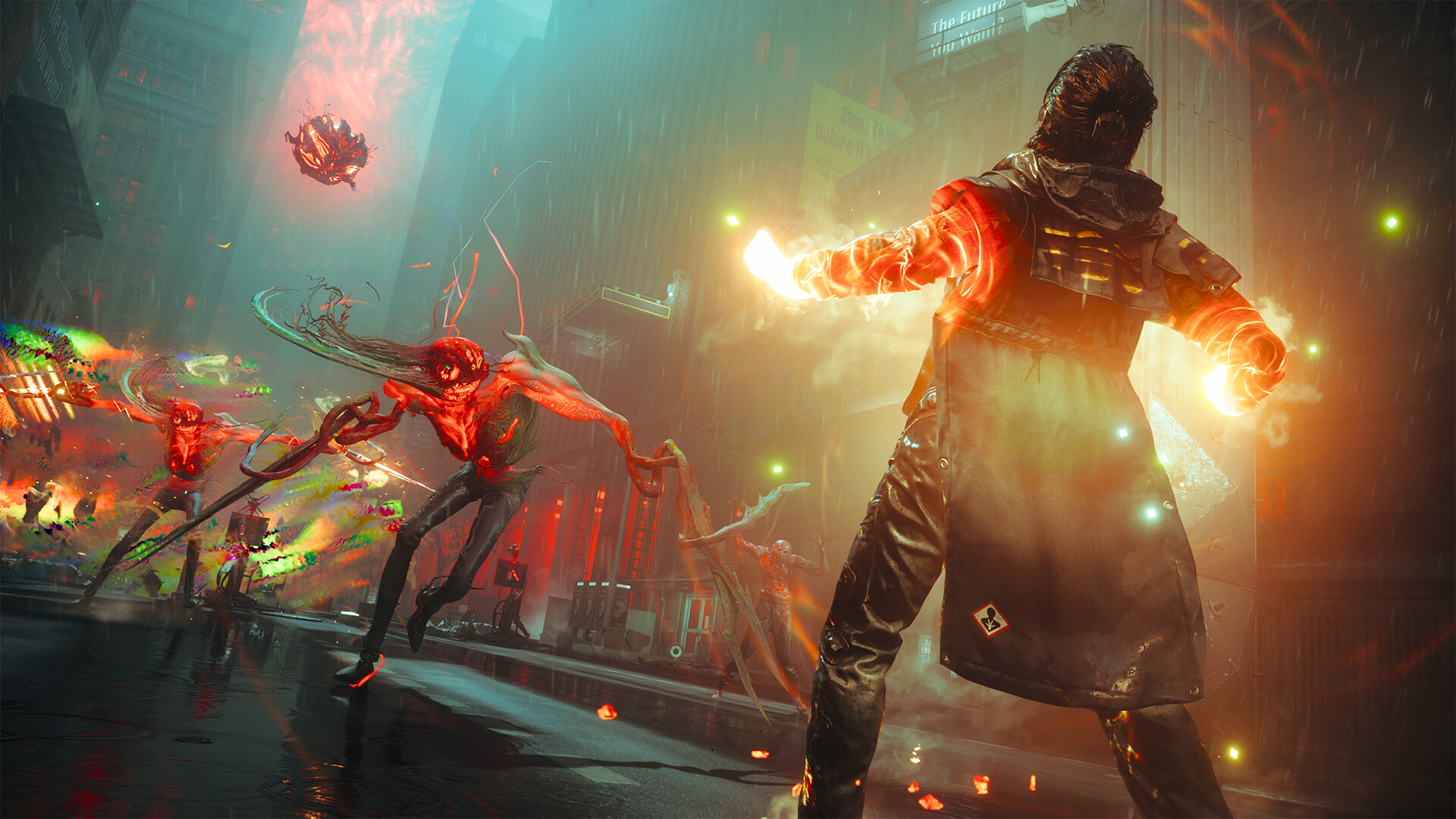
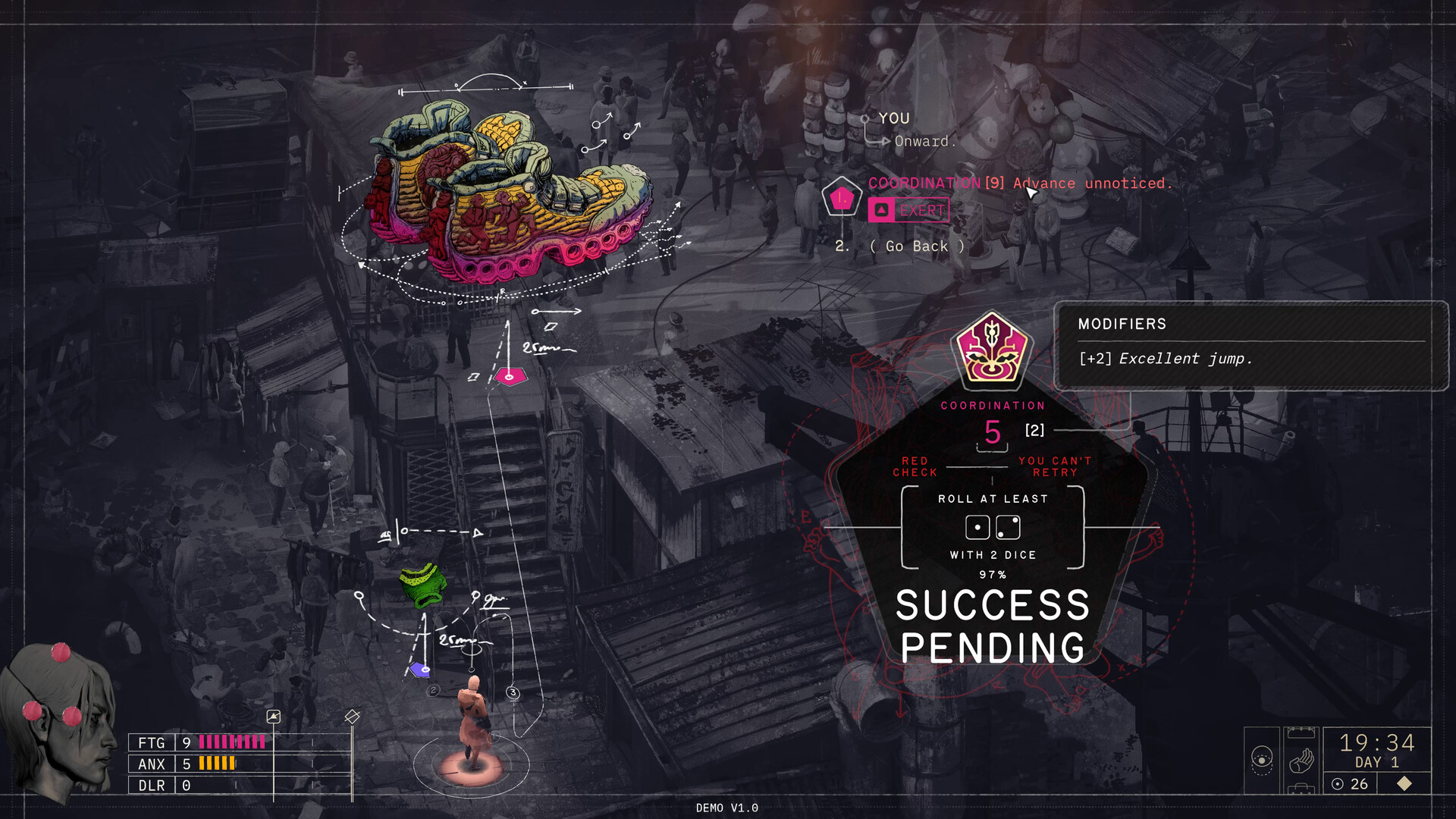
There are also more reactive Action Sequences interspersed through the campaign: time slows, an active scene plays out, and Cascade has a small window in which to commit to a physical action — duck, draw, run, hide, vault, hold — that is then resolved as a skill check against a Faculty-determined difficulty. Action Sequences are where the game leans hardest on the Action Faculty, and they are the closest thing Zero Parades has to combat.
The Writing: Lynchian Without Being Vague, Le Carre Without Being Dry
The thing that finally separates Zero Parades from the wave of post-Elysium cRPGs that have been trying to bottle the lightning since 2019 is the writing. Sinamae and Watson have inherited from the Disco Elysium house style a willingness to let conversations sit, to let characters make philosophical sidebar arguments that have nothing to do with the case, and to make the player work for the texture of the world rather than handing it over in encyclopedic codex entries. They have also, crucially, made the prose less self-consciously beautiful than Robert Kurvitz's. Disco Elysium's prose at its peak was the best writing in the medium and at its worst was a parody of itself, drunk on its own metaphors. Zero Parades is plainer-faced. It earns its lyrical moments by holding them back for the right beats.
The result is a script that has the patience of John le Carre — the willingness to spend three pages on a conversation about pension entitlements between two retired spies because the pension is, secretly, the thing they actually want to talk about — with the absurdist current of David Lynch lying somewhere underneath. You will, at certain points, walk into a room and find a man in a yellow suit eating an entire raw onion. The reason for the onion will, eventually, matter. The yellow suit will not. Zero Parades is comfortable letting that distinction sit. Disco Elysium would have wrapped a metaphor around the suit. Zero Parades just lets the man eat the onion.
The other thing the writing does, that very few narrative RPGs have ever pulled off, is build a credible woman protagonist who is not a roleplay-as-anything cipher. Cascade has a sexuality, a sense of humor, a body, a specific kind of tiredness that women in their late thirties will recognize, and a relationship with motherhood that the game refuses to either weaponize for drama or quietly suppress to keep her sleek. There is a long sequence in the second act where she sees a child Cascade's daughter's age in a market, and the game gives you four different ways to handle it, none of them obvious and none of them wrong.
Art Direction, Music, and the Disco Elysium DNA That Did Survive the Schism
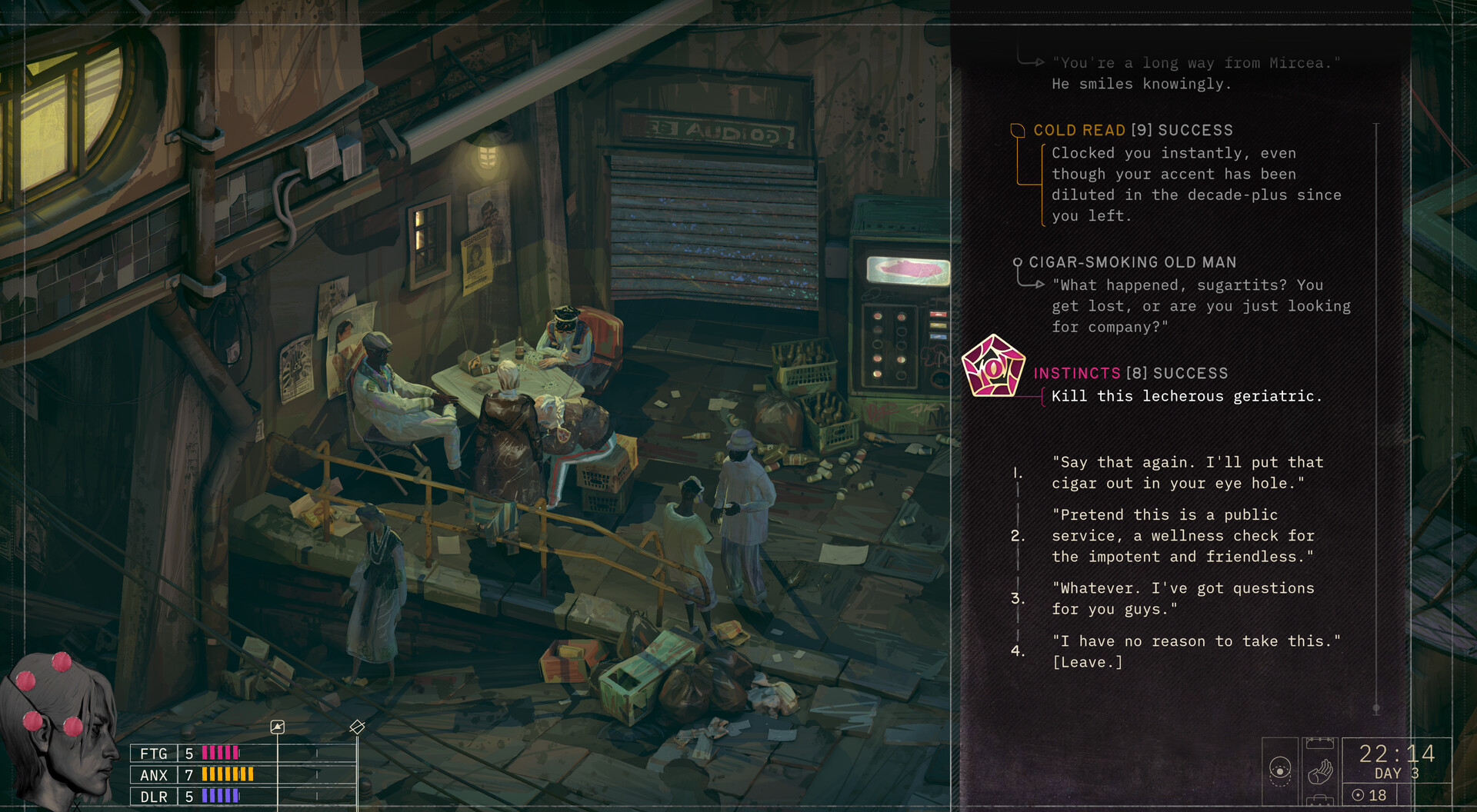
Visually, Zero Parades looks like a Disco Elysium sequel even when it is not pretending to be one. The isometric perspective is back; the painterly hand-drawn backgrounds are back; the character portraits with their distended noses and unhappy eyes are back. The art director, Aleksander Rostov, was one of the public faces of the post-Elysium ZA/UM rebuild, and his fingerprints are everywhere. The palette has shifted — less of the rusted oranges and sea-greens of Revachol, more in the way of pale yellows, faded reds, and a particular shade of stained concrete grey — but the underlying philosophy is the same: a world rendered with the patience of a watercolourist, with every shadow placed by hand.
Music is the one area where the comparison gets a bit awkward. The Disco Elysium soundtrack was scored by Sea Power, and the soundtrack was a substantial part of why Elysium felt the way it felt. Sea Power are not on Zero Parades. The score is by a smaller ensemble billed in the credits as the Portofiro Conservatory, which is almost certainly a pseudonym, with a handful of guest tracks from Estonian and Italian artists. It is good, often very good, but it is not what Sea Power did. It is more anxious, more chamber-music-influenced, with violin lines that sit just behind dialogue and then push out into rooms when the encounter shifts. There are two stretches in the third act where the music does something genuinely audacious. There are also a handful of cafe scenes where it sits a touch generically in the background. It is, broadly, a more grown-up score than Elysium's, which is the right call for a more grown-up story.
The voice acting is mostly excellent. Cascade is voiced by Lucy Beecher, a relative newcomer, who carries the full weight of the campaign with a performance that is by turns brittle, dry, and surprising. The supporting cast is uneven in the way most fully-voiced cRPGs are uneven — one or two performances tilt into accent caricature, which a fully-voiced production of this size always risks — but the central two-handers, especially the conversations between Cascade and the Duchess, are some of the best acted dialogues in a game in years. The game shipped with about thirty hours of fully voiced content, with the rest delivered as text-only. The voiced content is the dramatic spine. The text is the bones.
Length, Replay Value, and What Branches
A first run will take most players between forty-five and sixty hours, depending on how completist they are about side conversations. The skill of the writing is such that the critical path still feels rich, but you will miss perhaps thirty percent of the texture of the world if you do not stop for the conversations.
Replay value is real but uneven. The game has three major narrative branches and a handful of smaller variations layered on top of them. The major branches are gated by Faculty choices and by which Conditionings you take. There is also an extensive end-game branch — I will not spoil it — that opens up only if you have permitted Cascade to violate at least two Conditionings during the campaign, which most players will not do on a first run because the bonuses are too good. Letting Cascade throw her Conditionings out one by one across the campaign changes the back half of the game substantially and leads to a separate ending, not merely a shaded variant. ZA/UM have hidden a lot of game inside the second playthrough.
The Case Against It
There is a real argument against Zero Parades, and it is worth putting plainly before you buy: that the game does not commit to its espionage concept hard enough to be convincing as a spy story — that it remains, at its heart, a philosophical conversation simulator with espionage paintwork, and that the paintwork peels under examination. I do not buy that argument. I think the game is making a deliberate choice to be a le Carre game rather than a Bond game, and that the le Carre lineage absolutely justifies the introspective texture. But it is the objection I would take most seriously, and it is a useful counterweight if you bounce off the first six hours — which some players will.
Where It Stumbles
Zero Parades is not without rough edges, and they are concentrated mostly in the opening four hours and the tutorialisation of the systems. The Faculty system is much easier to read than Disco Elysium's twenty-four-voice arrangement, but the Conditioning system, the stress-gauge cost-benefit math, and the Dramatic Encounter commitment grammar all want a more careful introduction than the game gives them. There is a written manual hidden in the pause menu — a charming touch — but it is too easy to miss. Cascade will get stuck inside a panic attack she could have avoided if the tutorial had been a little more direct about what the orange ring on the Anxiety gauge meant. Once you know what the systems are doing, they are deeply rewarding. The first ten hours, on a first run, will require some patience and the willingness to look up a wiki or two.
There are also a handful of dialogue inconsistencies that creep in depending on the order you explore Portofiro. ZA/UM's branching is mostly bulletproof, but not entirely. A handful of patch notes after launch should clear most of these up.
The Action Sequence design is, by ZA/UM's standards, the weakest single mechanic in the game. There are not enough of them, the difficulty curve on them is uneven, and a couple of them feel a little vestigial — like the team built the system to demonstrate that they could and then did not have anywhere obvious to use it. The two best Action Sequences in the game are extraordinary. The middle five are merely fine. The bottom four are skippable in a way nothing else in Zero Parades is.
And one structural note that deserves flagging more loudly than it usually gets: Zero Parades will occasionally introduce a major character with no on-ramp at all. The black-market arms dealer in act two simply walks into a scene as if you have been working with him for six chapters. He has not been mentioned. The dialogue does not lampshade his arrival. You roll with it because you are inside a Le Carre pastiche and Le Carre would do the same thing, but the game does not always earn the cold open. A handful of these characters would have benefited from a sentence somewhere setting them up.
Accessibility and Controls
Subtitles for voiced content are on by default and re-flow nicely. There is a colorblind mode for the dice-roll UI — a small thing, but a generous one — and a full set of input bindings for both keyboard-and-mouse and gamepad. The gamepad implementation is genuinely the best for a cRPG outside of Larian's work on Baldur's Gate 3. The radial menus, the contextual triggers, the snap-to-NPC navigation are all clean.
So Where Does Zero Parades Land
Zero Parades does not replace Disco Elysium, and it does not try to. It is a different game, made by a different (if overlapping) team, set in a different place, telling a different kind of story. The reason it earns the comparison anyway is that it does the central thing Disco Elysium did so well — takes a genre cliche, in this case the spy thriller rather than the murder mystery, and rebuilds it from the inside as a study in tiredness and choice — and it does it without imitating its predecessor's surface tics. The stress system is a smarter mechanical idea than the twenty-four-voice setup. The Dramatic Encounter is a smarter way to build tension than any combat scene Elysium ever staged. The writing is plainer, more confident, and more economical, and it tells a smaller, more specific story very well rather than a bigger, more sprawling one ambitiously.
It is also, importantly, a game that an entirely different audience can pick up cold. You do not need to have played Disco Elysium to enjoy Zero Parades. You do not need to know the post-Elysium ZA/UM saga, or care about Robert Kurvitz, or have an opinion about Estonian cRPG studio politics. If you have ever wanted a game that gave you Tinker Tailor Soldier Spy as a slow-burning skill-check RPG with a woman in her late thirties at the center, this is that game. If you have never wanted that, Zero Parades will not convert you. The closing question is whether the offer is something you have been waiting for or something you can comfortably skip, and only you can answer that one.
For us, the answer is firm: Zero Parades is one of the strongest narrative RPGs of the decade, the best follow-up ZA/UM could realistically have shipped given the circumstances they shipped it in, and one of the very few new releases this year that we expect to still be in active conversation among genre fans in 2030. It is not a perfect game. The first ten hours need a kinder tutorial, the Action Sequences need a rebalance, and the handful of dialogue inconsistencies need a launch patch. But the things that matter — the writing, the characters, the systems, the world, the way the dice roll feels like part of an argument Cascade is having with herself — are at the very top of the form. Six and a half years was a long wait. Zero Parades was worth waiting for.