Firaxis picked the Civilization franchise's 35th birthday to answer the question Civilization VII players have been asking since launch: what happens after the Modern Age ends? At a developer panel from PAX West in Seattle, creative director Ed Beach laid out two pieces of content that will carry the strategy game well past its current finish line — a free update called Arc of Tomorrow that adds an entirely new fourth Age, and Civilization VII: Earthrise, the game's first paid expansion, which pushes humanity off the planet entirely.
Both are dated for 2027, and Firaxis was careful to say the timing and the details are still soft. But the shape of the plan is clear, and it is a bigger swing than anything the studio has attempted on this game so far — Beach describes Arc of Tomorrow as being even bigger in scope than Test of Time, the sweeping May overhaul that pulled Civilization VII to its highest Steam concurrent count in more than a year.
The Atomic Age finally extends the timeline
Civilization VII shipped with three Ages — Antiquity, Exploration and Modern — and that structure has been the most-argued-about thing in the game since February 2025. The Modern Age stops somewhere around the middle of the twentieth century, which meant the tanks and biplanes you unlock late are also where the story ends.
Arc of Tomorrow adds a fourth: the Atomic Age, running roughly from the 1950s into the near future. It is not a bolt-on. Firaxis is building out period-specific tech and civic trees, new Triumphs and social policies, narrative events, modern urban architecture, a new music set, and new civilizations and leaders to go with it. Gandhi returns as a playable leader option.
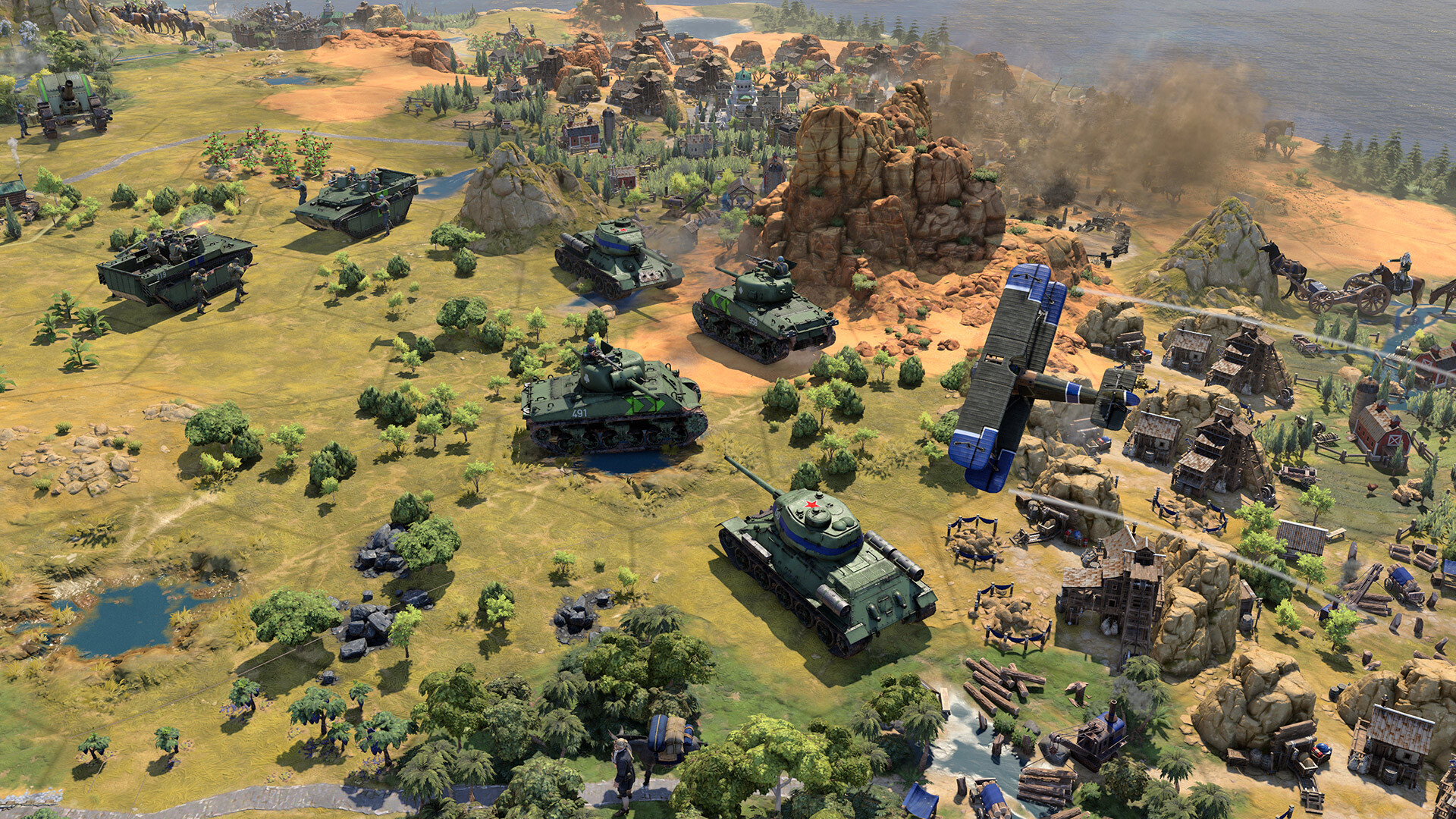
The mechanical additions are where it gets interesting. Nuclear gameplay is being expanded with both offensive and defensive options — a notable choice for an Age themed around the bomb. A new settlement independence tool lets you convert your own settlements into City-States. Film Crews arrive as a way to produce Great Works of Film, extending the culture game into the twentieth century's dominant medium. And a Manufactured Goods system layers commodity recipes on top of the resource economy, so raw materials feed into finished products rather than just ticking up a yield.
Arc of Tomorrow is free for anyone who owns Civilization VII and will be delivered in-game automatically when it lands.
Earthrise takes Civ to orbit — and back down to the ground
The paid half of the announcement is Civilization VII: Earthrise, and its pitch is unusually specific for a Civ expansion: it is about humanity's relationship with space and with the environment, and it is designed to touch every Age rather than bolt content onto the end.
In Antiquity and Exploration, that means mapping celestial bodies and slowly building an understanding of the solar system. The Modern Age brings early orbital missions around Earth and the Moon. By the Atomic Age you are founding a space agency and running missions out across the solar system. Firaxis notes that some of the expansion's content has to be unlocked through gameplay rather than simply switched on.

The environmental side is the part that will change how games actually play. Earthrise adds the ability to alter terrain, mitigation tools for Natural Disasters, and biome-specific bonuses for civilizations — which turns the map itself from a starting condition into something you negotiate with over the course of a campaign. It is the closest Civ has come to a proper climate layer since Civilization VI's Gathering Storm.
Earthrise already has a wishlist page, and 2K is describing it as the first paid expansion rather than the only one.
Update 1.5.0 lands first, and it has the map everyone wanted
Before any of that, there is a much nearer patch. Update 1.5.0 arrives later in September and leads with the request Firaxis has been fielding since launch: a True Start Location Earth map. Exactly as in Civilization VI, it generates the real world's land, features and resources, and spawns your civ where it actually began, with Natural Wonders shuffled into plausible real-world spots each game so a familiar map does not go stale.
The rest of 1.5.0 is quality-of-life work, but the useful kind. Two more map types — Terra Incognita and Shuffle — are moving to the Voronoi generation algorithm for more natural-looking, more varied terrain. Map loading and generation get faster and resource placement more varied. Diplomacy gains an option to spend Influence to stay in an alliance without being dragged into an ally's war, which quietly fixes one of the game's most reliable sources of frustration. And the UI pass touches plot tooltips, settlement banners, game setup, and adds a tile ruler for planning cities and towns.
Firaxis also flagged that the update cadence will get lighter after 1.5.0 while the team shifts onto the longer-term work — so expect targeted fixes rather than another Test of Time-scale drop between now and Arc of Tomorrow.
Whether it moves the needle is a different question
Civilization VII remains a divisive game. Its Steam user reviews still sit at Mixed, hovering around half positive, and Test of Time — for all the player numbers it brought back — did not really change that verdict. Adding a fourth Age is the single most direct response Firaxis could make to the loudest structural complaint about the game, and doing it for free is the right call. But it is a 2027 answer to a 2025 problem.
What is more encouraging is the design brief Beach described: extend the story of human history to the present day and beyond, make Civilization VII a richer and more complete experience, and build a first expansion that affects gameplay through all Ages. That third goal in particular reads as an acknowledgement that the Ages system needs content threaded through it, not stacked on top of it.
Sid Meier's Civilization VII is out now on PC, PlayStation 5, Xbox Series X|S, Nintendo Switch and Switch 2, and it is free to play on Steam through September 10 if you want to see where the game currently stands before committing to the roadmap.