Some studios spend a decade chasing the same idea and never catch it. Draw Me A Pixel caught lightning twice. There Is No Game: Wrong Dimension began life as a game-jam joke about a narrator insisting you close the application, and it grew into a million-selling, award-winning love letter to the absurd elasticity of the medium. Following that act was always going to be the hardest puzzle the studio ever set itself. Crushed In Time, out now on PC, is the answer — and it is the rare follow-up that understands the original's magic well enough to refuse to simply repeat it.
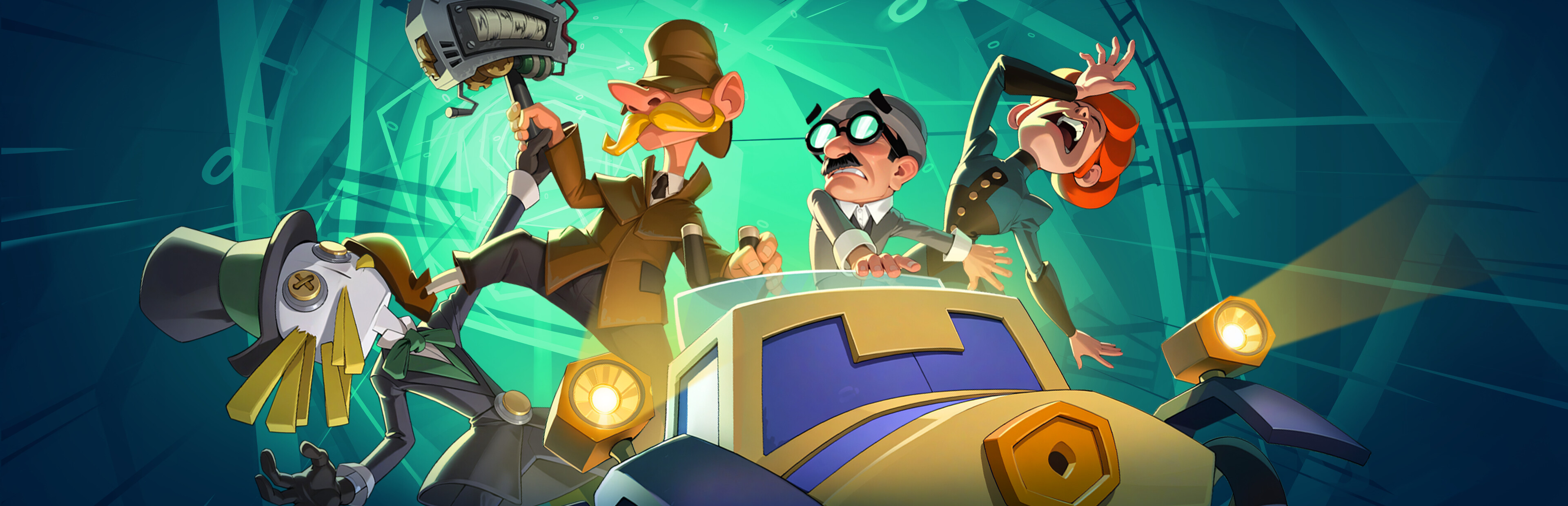
This is a spin-off rather than a numbered sequel, and the distinction matters. Where Wrong Dimension hurled you across genres and franchises, Crushed In Time narrows its focus to a single, deliciously self-aware premise: Sherlock Holmes and Dr Watson are characters in a video game, that game is the one you are playing, and something has gone catastrophically wrong with its development. To fix it, the famous detectives must travel backwards and forwards through the game's own production pipeline, tumbling through prototypes, placeholder art, and half-finished levels in search of a colleague who has vanished from the build. It is meta-fiction as detective story, and it is committed to the bit in a way few games dare to be.
A mystery about its own making
The setup sounds like a writers'-room dare, and in a sense it is. You are not solving the murder of Sir So-and-So in a fog-bound manor; you are investigating the disappearance of a character from this very game, and the crime scene is the codebase. Holmes treats the missing-person case with his usual theatrical certainty. Watson, as ever, is the audience surrogate — bewildered, faintly exasperated, and quietly the more competent of the pair. The joke that the game keeps returning to is that Holmes, the supposed genius, is far less a brilliant deductive mind than a man being shoved around by forces he doesn't understand: namely, the game's own broken machinery and the unseen developers tinkering with it.
That framing gives the writers license to do almost anything. A level can fall apart mid-scene because an asset failed to load. A character can speak in placeholder "lorem ipsum" until you find their real dialogue. Time travel isn't explained with pseudo-science; it's explained as scrubbing back and forth along a development timeline, visiting the game at earlier and later milestones. The further you push into it, the more the production-pipeline metaphor pays off, because the puzzles begin to depend on the difference between how something worked in an old build and how it works in the current one. It is the kind of conceit that could have been a one-note gag, and the achievement of Crushed In Time is that it sustains the idea across the whole runtime without the seams showing.
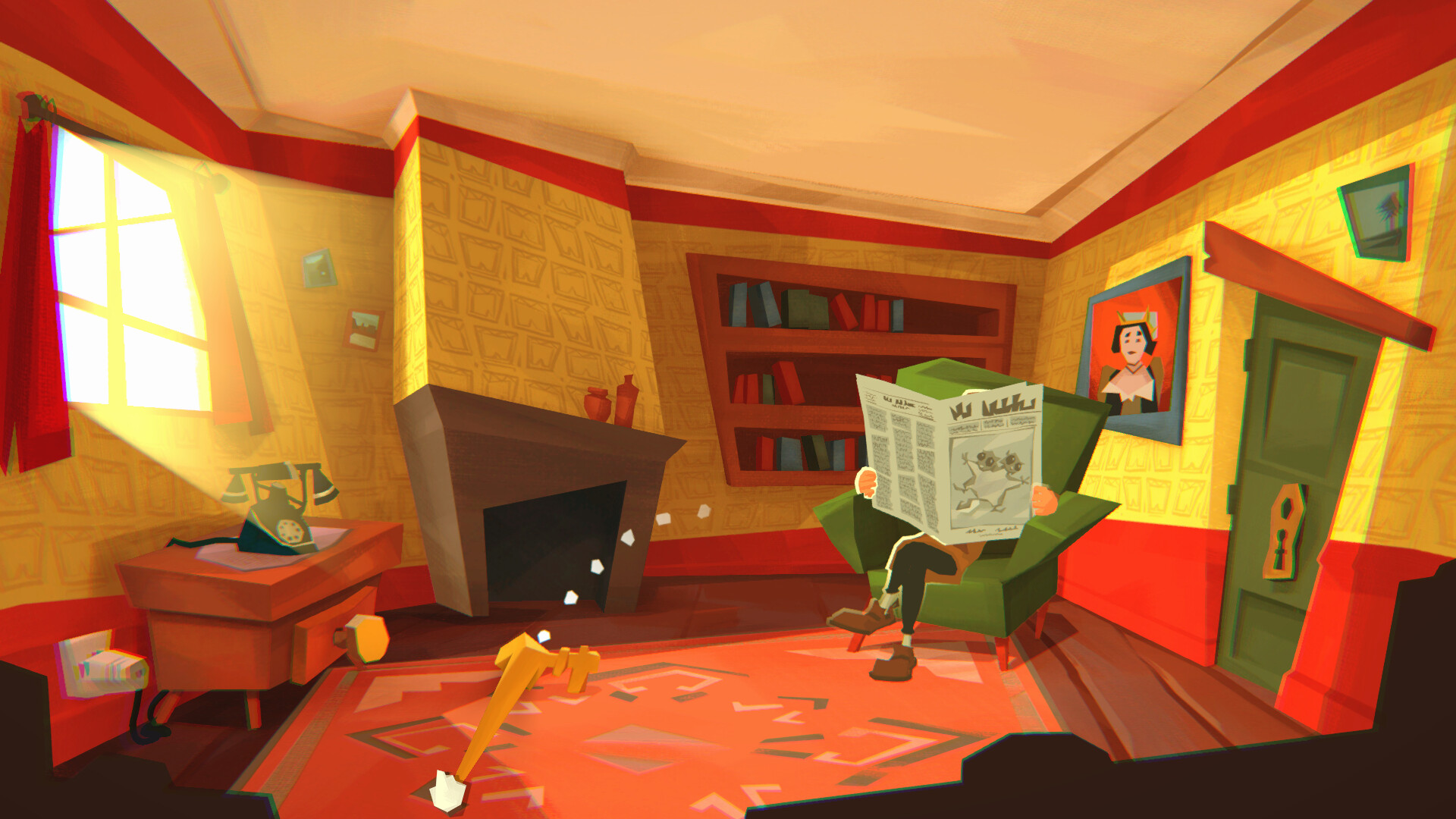
Grab, pull, release: the elastic hook
If the premise is the soul of Crushed In Time, the mechanic is its body. Draw Me A Pixel built the entire game around a single verb the studio describes as "elastic": you grab elements of the scene, pull them, and release. Everything is stretchy. The world behaves less like a static painted backdrop and more like a sheet of rubber you can yank, snap, and ping. Pull a curtain and it recoils. Stretch a rope between two points and let it fling an object across the room. Grab a character and drag them, protesting, somewhere they very much did not want to go.
What sounds gimmicky in description turns out to be genuinely novel in the hand, and that is the headline. Point-and-click adventures have spent forty years refining the same fundamental loop — examine, collect, combine, use — and most modern entries innovate at the margins. Crushed In Time changes the actual physical grammar of interaction. Because objects stretch and rebound, timing and trajectory suddenly matter in a genre that almost never asks for either. You are not only working out what to do with an object; you are working out the arc, the tension, and the moment of release. It introduces a light, playful dexterity layer to puzzles that have historically been purely cerebral, and it does so without ever tipping into the twitchy reflex-testing that would betray the genre's contemplative pleasures.
It is also, transparently, a mechanic designed with touchscreens in mind. The pull-and-release gesture maps perfectly onto a finger dragging across glass, and the studio has already confirmed iOS, Android, and Nintendo Switch versions are coming later in 2026. On PC with a mouse it works very well; I suspect on a phone or a Switch in handheld mode it will feel even more intuitive, the elastic snapping back against your fingertip. That cross-platform foresight is baked into the design rather than bolted on, and it shows.
Puzzles that earn their laughs
A novel verb is only as good as the puzzles built on top of it, and here Crushed In Time mostly excels. The best sequences use the elastic mechanic and the development-timeline conceit together: you stretch something in a later build of the level so that it lands correctly in an earlier one, or you yank a fully-rendered object back to a stage where everything else is still grey blockout geometry. The puzzles ask you to think across two axes at once — physical elasticity and temporal state — and when a solution clicks, it lands with that particular click-of-the-tumbler satisfaction that the genre lives and dies on.
The difficulty curve is gentle but not insulting. This is an adventure built to be finished, not one that hides progress behind a moon-logic wall and dares you to consult a guide. Solutions are usually reachable through observation and experimentation, and the game is generous about letting you flail with the elastic mechanic until something works — failure is rarely punished, and the act of yanking the scenery around is entertaining enough that fruitless experimentation never feels like wasted time. Veterans of the genre may find a handful of the mid-game puzzles a touch breezy. Newcomers, and there will be many drawn in by the predecessor's reputation, will find it welcoming.

The writing is the star
Draw Me A Pixel made its name on comic timing, and Crushed In Time is, first and foremost, very funny. The humour lives in the same absurdist, fourth-wall-pulverising register as The Stanley Parable and the Monkey Island games — knowing without being smug, silly without being lazy. Jokes are built into the architecture of the game rather than sprinkled on top of it. A gag about an unfinished level isn't a line of dialogue; it's a whole environment of missing textures and floating debug text that you have to physically wrestle into shape. The game is constantly making fun of itself, of you, and of the conventions of both detective fiction and game development, and it does so with affection rather than cynicism.
Holmes and Watson are a perfectly judged double act. Holmes' bluster — his insistence that he has it all figured out while the world literally crumbles around him — is the engine of most of the comedy, and Watson's dry, long-suffering counterpoint keeps it from becoming exhausting. The supporting cast, drawn from the game's fictional development team and the odd escaped franchise reference, gives the writers room to riff. For returning fans there's a thick layer of easter eggs and callbacks to Wrong Dimension and the studio's earlier work, dense enough to reward a second look but never so self-referential that a newcomer feels locked out of the joke.
If there's a narrative caveat, it's this: anyone arriving expecting a genuine Sherlock Holmes mystery — a fair-play whodunit with clues to assemble and a culprit to deduce — will be disconcerted. This is not that game, and it never pretends to be for long. Holmes is the butt of the joke as often as he is the hero, the "investigation" is a scaffold for comedy and puzzles rather than a deduction engine, and the satisfaction on offer is comedic and mechanical rather than detective-fiction-shaped. Go in wanting that and you'll have a wonderful time. Go in wanting Sherlock Holmes: Chapter One and you'll be bewildered.
A handsome, well-produced package
Visually, Crushed In Time wears a bright, colourful, cartoonish style that blends 2D and 3D elements into something tactile and toy-like — which is exactly right for a game about physically grabbing and stretching the world. The elasticity isn't just a mechanic; it's an animation principle, and watching the scenery deform, wobble, and snap back gives the whole thing a delightful squash-and-stretch liveliness reminiscent of classic hand-drawn animation. It is a great-looking game in motion in a way screenshots can only hint at.
Production values are higher than the indie price tag suggests. The game ships with full voice acting — professionally recorded, not the placeholder-quality work that sometimes haunts smaller adventures — and supports ten languages, with full audio and subtitles across the major ones, including French, German, Spanish, Japanese, Korean, Simplified Chinese, Russian, Italian, and Brazilian Portuguese. There are 46 Steam achievements for completionists, and a Deluxe edition that bundles the soundtrack for the handful of extra shekels it costs. For a studio of Draw Me A Pixel's size, this is a remarkably polished, internationally accessible release.
How long, and how much
For a meticulously hand-crafted, fully voiced comedic adventure, the length is generous, and crucially it is the kind of game where the runtime is dense with bespoke content rather than padded with filler. There is no busywork here; every scene is built by hand for a specific joke or puzzle, which is precisely why these games take years to make and cost what they cost to produce.
At launch the game carries a small introductory discount — twenty percent off through late June — which makes an already fair price an easy recommendation. Even at full price it sits comfortably in the impulse-buy bracket for the quality on offer, and the Deluxe edition's soundtrack is a tempting add-on given how much character the music brings to the production.
Who it's for — and who it isn't
If you loved There Is No Game: Wrong Dimension, you can stop reading and go buy this; it is made with the same hands, the same wit, and the same restless creativity, and it will not disappoint you. If you have never played a Draw Me A Pixel game but you enjoy The Stanley Parable, Untitled Goose Game, the modern Monkey Island revival, or any comedy game that treats the medium itself as the punchline, this should rocket up your list. The elastic mechanic alone is worth experiencing, because there is genuinely nothing else in the point-and-click space that plays quite like it.
The people who should hesitate are easy to identify. If your idea of a good adventure game is a stern, logic-heavy mystery where you assemble clues and outwit a villain, the comedy framing will frustrate you. If you have no patience for fourth-wall-breaking meta humour — if a game winking at its own development pipeline makes you roll your eyes rather than grin — then no amount of polish will win you over, because the meta-ness is not a layer you can ignore; it is the entire foundation. And if you bounce off light dexterity in your puzzles, the stretch-and-release timing will occasionally chafe, though it never demands much.
Verdict
Crushed In Time is the best kind of follow-up: one that honours what made its predecessor special by being confidently, cheerfully its own thing. Draw Me A Pixel has taken the riskiest possible swing — a meta-comedy about its own development, built around a brand-new interaction verb, starring a Sherlock Holmes who is the joke rather than the genius — and connected with almost all of it. The elastic mechanic is a genuine contribution to a venerable genre, the writing is as sharp and warm as anything the studio has produced, and the production values punch well above the price tag.
It is not flawless, and it is not for everyone. The detective framing promises a mystery the game has no interest in delivering, a few mid-game puzzles slacken the tension, and the relentless meta humour is a love-it-or-leave-it proposition by design. But these are the "flaws" of a game with a strong point of view, and a strong point of view is exactly what makes Crushed In Time worth your time. Two for two, Draw Me A Pixel. Whatever you stretch next, we'll be there to pull it.