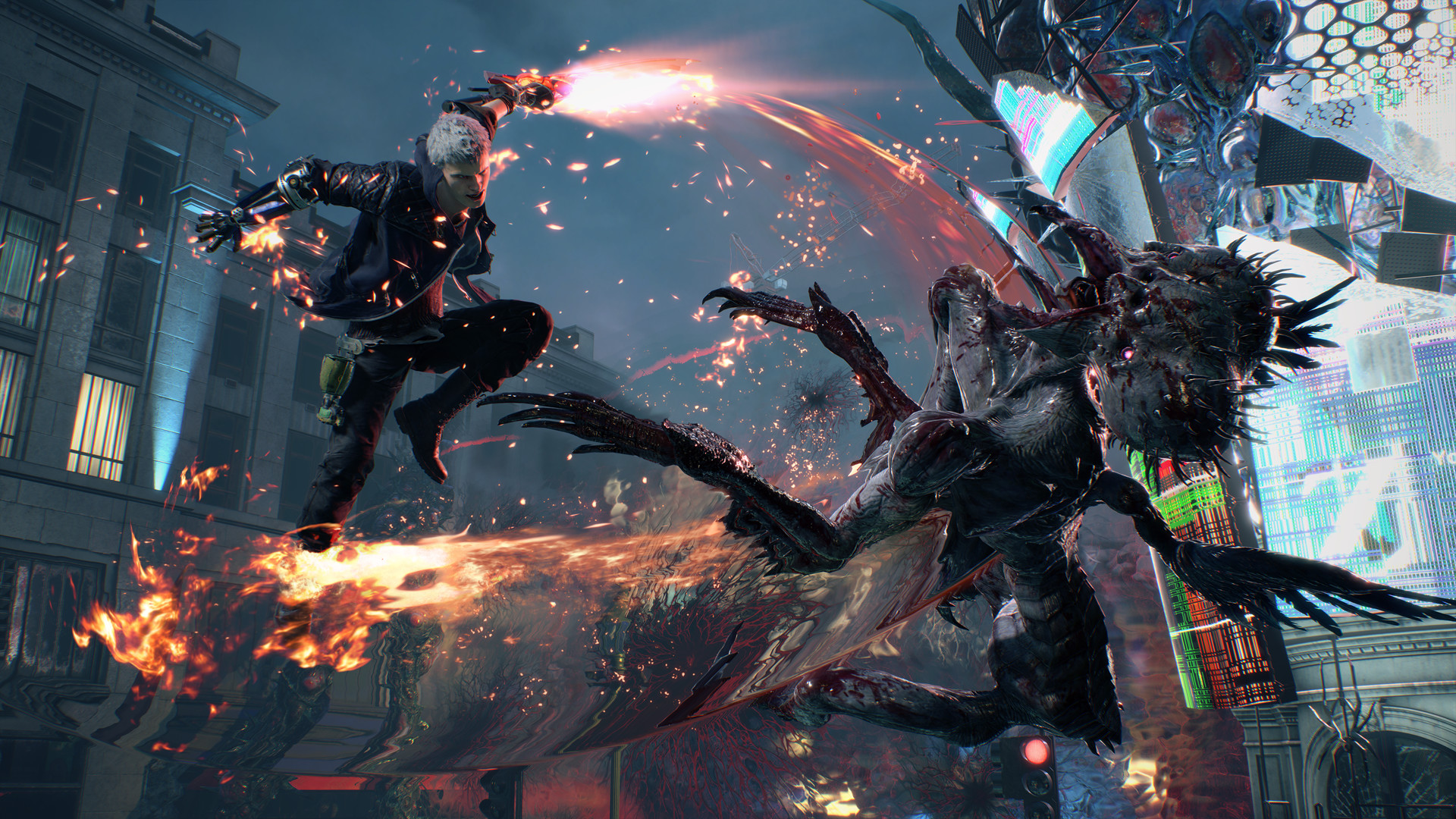
There is a particular feeling that Devil May Cry 5 produces that almost no other game can. It is the moment you stop thinking about which buttons to press, when juggling a demon in the air with Nero while yanking yourself toward it on the Wire Snatch, swapping to a Devil Breaker mid-combo, and landing a perfectly timed Exceed rev on the Red Queen, all in the space of two seconds. The letters in the top-right corner climb from D to C to B to A, and then those three glorious S ranks light up, the soundtrack screams, and you feel, briefly, like the coolest person alive. Seven years after its 2019 debut, that feeling has not aged a day. The only question the Devil Hunter Edition has to answer is whether it survives the trip to a handheld - and the answer, with a couple of asterisks, is a resounding yes.
Devil May Cry 5: Devil Hunter Edition launched digitally on Nintendo Switch 2 on June 23, 2026, with a physical edition following on August 28. Capcom priced it aggressively at an introductory $29.99 until July 7, after which it settles at $39.99. That launch discount matters more than it might sound, because the central tension of this release is value: what you are buying is one of the greatest action games ever made, faithfully ported and running beautifully, but trimmed of a few features that the most demanding fans consider essential. Whether that trade is worth it depends entirely on what you want from it.
Seven years on, and still schooling the genre
It is worth restating just how good the base game is, because the years have only sharpened the point. Devil May Cry 5 arrived in 2019 as the long-awaited return of Capcom's flagship character-action series after more than a decade away from the mainline numbering, and it did the near-impossible: it pleased the hardcore, welcomed newcomers, and looked like a million dollars doing it, thanks to the RE Engine. In the time since, a wave of imitators and successors have tried to capture its particular alchemy of depth, spectacle and swagger. Most have fallen short. Play DMC5 today and you understand why - the combat ceiling is so absurdly high that you can pour hundreds of hours into it and still discover new tech, yet the floor is welcoming enough that a first-timer can mash their way to a satisfying victory on the lower difficulties.
The structure is classic Capcom: roughly twenty story missions of escalating spectacle, each a self-contained arena gauntlet that rewards you with a letter grade based on how stylishly, quickly and cleanly you fought. That grade feeds a currency of Red Orbs you spend on new moves, which in turn open up new ways to earn higher grades. It is a perfect little skill-progression loop, and the mission-based format turns out to be a stealth advantage on a portable system - more on that shortly.

Three protagonists, four playstyles, one masterclass
What elevates DMC5 above even its own illustrious lineage is that it is essentially three or four games in one. You rotate between protagonists as the story demands, and each one rewires the experience so completely that mastering all of them feels like learning separate fighting games.
Nero is the entry point and arguably the most versatile, built around his Devil Breaker prosthetic arms. Each Breaker is a consumable gadget with its own properties - Gerbera for evasive dashes and reflected projectiles, Punch Line for a rocket you can surf, Overture for raw electric burst damage - and because using them is a one-way street (you destroy a Breaker to fire its special move, then cycle to the next), Nero turns into a puzzle of resource management layered on top of his sword-and-gun fundamentals. His Exceed system, which rewards a perfectly timed throttle rev to supercharge sword swings, is the kind of mechanic that separates the button-mashers from the artists.
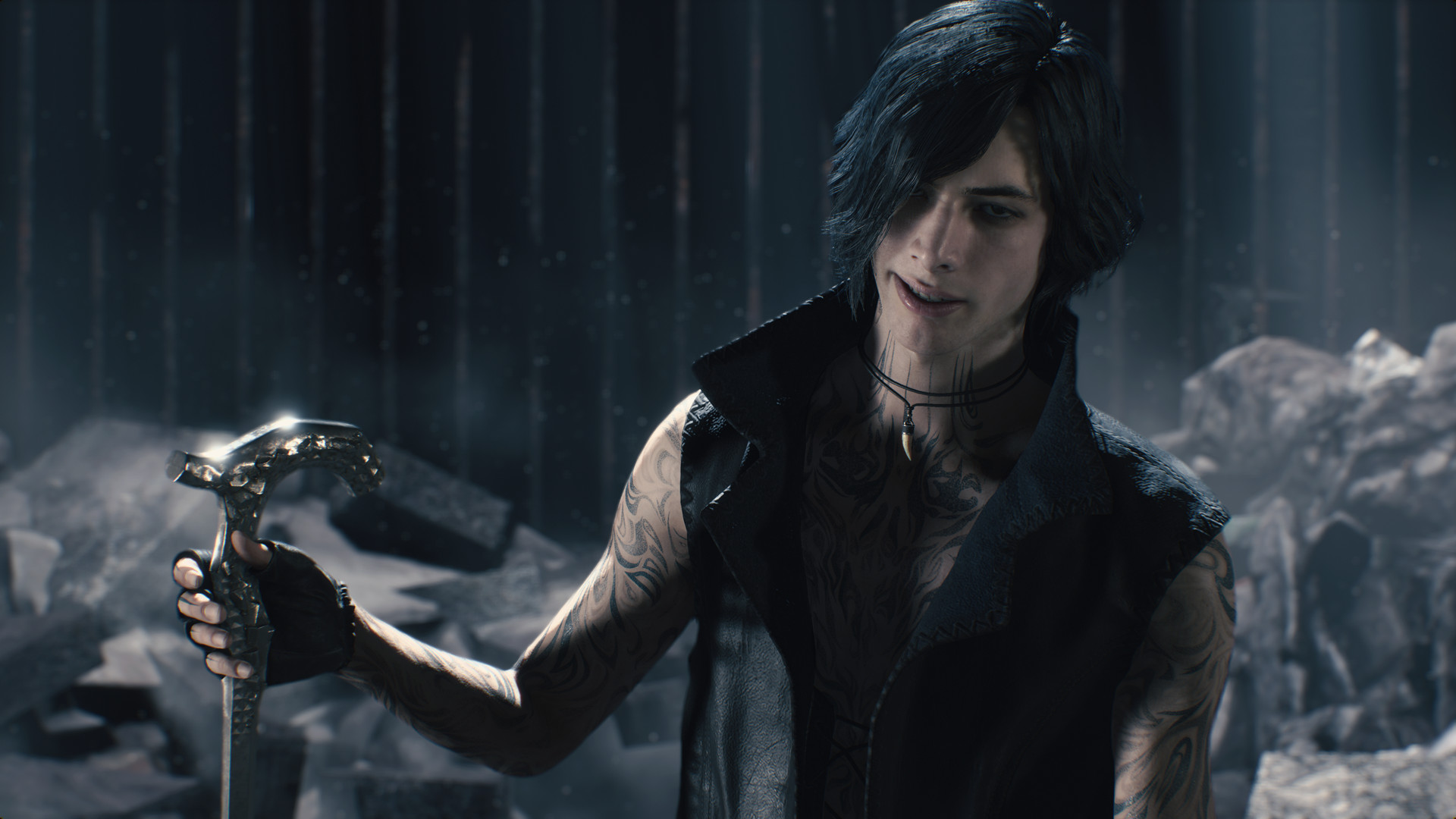
V is the wild card and the most divisive. Frail and unwilling to dirty his own hands, he commands a trio of demonic familiars - the panther Shadow, the bird Griffon, and the hulking Nightmare - while reciting poetry from the sidelines, then strolls in to finish stunned enemies with his cane. He is a summoner in a brawler, a deliberate change of pace that some adore for its strategic distance and others find fiddly. Even with the years to soften opinions, V remains the one most likely to be called the weakest to actually pilot, and this port does nothing to change that calculus.
And then there is Dante, the reason people have devoted years of their lives to this series. Dante is overwhelming in the best way - four melee styles, four weapon-and-firearm loadouts, and four combat Styles (Trickster, Swordmaster, Gunslinger, Royalguard) that you can switch between on the fly. The sheer combinatorial depth of a fully kitted Dante is the genre's Everest, and DMC5 hands you the whole mountain.
Vergil is in the box, and that is a big deal
Crucially, the Devil Hunter Edition includes Vergil as a fully playable character at no extra cost. This was originally paid DLC on other platforms, and his addition is what justifies the Edition name. Vergil is pure aggression distilled - the Yamato, the Beowulf gauntlets, the Mirage Edge summoned swords, and the Concentration gauge that rewards measured, precise play over flailing. Having him in the package from day one means Switch 2 owners get what is, for many, the definitive Devil May Cry power fantasy without a second purchase. The Edition also folds in extra costume colours, taunts and a generous selection of battle tracks, so there is plenty here for returning players to tinker with.

The story, the spectacle, the soundtrack
Narratively, DMC5 is gleefully, knowingly over the top. A giant demonic tree called the Qliphoth has erupted in Red Grave City, feeding on human blood, and a mysterious figure known as Urizen sits at its root. The mystery of who Urizen is, how V fits into the picture, and where Dante and Nero have been, unspools across a campaign packed with operatic cutscenes, motion-captured performances that toe the line between earnest and ridiculous, and one of the best needle-drops in gaming when Nero's theme Devil Trigger kicks in at full volume. None of it is high literature, and it does not want to be. It is a heavy-metal album cover come to life, and it commits to that energy so completely that it loops back around to being genuinely affecting by the finale.
The presentation has held up remarkably well. The RE Engine character models, the gore, the particle work on every Devil Trigger transformation - it all still reads as modern, which is a big reason this port lands as well as it does. You are not playing a game that looks seven years old. You are playing a game that looked ahead of its time and has aged into a comfortable, confident handsomeness.
The Switch 2 port: what works, brilliantly
Here is the headline for the hardware question: Devil May Cry 5 runs at a locked 60 frames per second on Switch 2 in both docked and handheld modes. For a precision action game that lives and dies on frame-perfect inputs, parries and just-frame techniques, this is not a nice-to-have - it is the entire ballgame. A 30fps DMC5 would have been a non-starter, robbing the combat of the responsiveness that makes it sing. Capcom understood the assignment and made smooth performance the priority, and the result is a port that feels right in the hands from the first encounter.
The handheld experience, in particular, is a revelation. DMC5 turns out to be an almost perfect portable game, and not in a way anyone necessarily predicted back in 2019. Its mission-based structure means you can drop in for a single ten-minute mission, chase a better letter grade, and put it down - or lose three hours to the Bloody Palace survival mode, the addictive endless gauntlet that pits you against waves of enemies across a hundred floors. On the Switch 2 screen, with the combat humming at 60fps, it is enormously easy to pick up and brutally hard to put down. The short feedback loops of the grading system are tailor-made for handheld sessions.

The compromises: where it stops short of definitive
This is where the asterisks come in, and where honest buyers need to pay attention. The Devil Hunter Edition is an excellent port of the base game plus Vergil - but it is not the full PlayStation 5 and Xbox Series Special Edition, and the gaps are real.
There is no 120fps mode and no 4K output; the smooth 60fps comes at a resolution that is perfectly serviceable but visibly softer than the current-gen versions, especially docked on a large television. More notably for the hardcore, two beloved modes are gone. Turbo Mode, which cranks the game speed up by around twenty percent for an even more frantic flow, is absent. And the bigger loss is Legendary Dark Knight Mode, the high-difficulty mode that floods the screen with dramatically increased enemy counts. Beyond being a brutal endgame challenge, Legendary Dark Knight was the most efficient way to farm Red Orbs and a favourite playground for combo specialists, and its absence is the cut that stings the most. These modes leaned on the raw horsepower of the PS5 and Series X to push the engine to absurd levels, and that headroom simply is not there on Nintendo's handheld, so the omissions are understandable - but they are omissions all the same.
There are minor visual rough edges too. Hair rendering can look a little fuzzy, certain transparency and particle effects lose definition, and in the busiest, most chaotic encounters the handheld image can get noisy. None of it undermines the moment-to-moment feel, and you will forget about it the instant a fight gets going, but a side-by-side with the current-gen Special Edition makes the difference clear.
So who is this actually for?
The buying decision sorts cleanly into a few groups. If you have never played Devil May Cry 5 and you own a Switch 2, this is an unhesitating recommendation - you are getting one of the finest action games ever made, with Vergil included, running at a rock-solid 60fps, for a launch price of thirty dollars. That is an outstanding deal and an easy entry into one of the medium's deepest combat systems.
If you are a returning fan who wants DMC5 specifically to play it on the go, this is also a comfortable yes; the handheld experience is fantastic and the portability genuinely changes how you engage with the grading loop. The only group that should hesitate is the dedicated devotee who considers Legendary Dark Knight and Turbo Mode non-negotiable, or who already owns the Special Edition on a current-gen console and is chasing the absolute technical best. For them, this is a convenient second copy rather than an upgrade, and the full $39.99 price after the introductory window asks a fair bit for a 2019 game minus a couple of modes.
The shape of the package
That nuance is the whole review in miniature: this is a great game given a great-but-not-perfect port. The handheld conversion gets the things that matter right and stops just short of definitive, and the value of the package hinges entirely on how much you personally weigh the missing modes against the convenience of having DMC5 anywhere.
The combat sandbox runs deeper than any tutorial admits
It is worth dwelling on just how much game is hiding underneath the surface, because it directly informs the value question. The Style ranking system - the letters that climb from D up to the triple-S of SSS, labelled with phrases like Dope, Crazy and Savage - is not just a vanity meter. It rewards variety, punishing you for spamming the same move and pushing you to weave together attacks, taunts, jump-cancels and weapon swaps. Taunting in the middle of a fight, of all things, builds your Style meter faster, which means the game literally incentivises showboating in the face of danger. That single design choice tells you everything about the philosophy here: DMC5 wants you to be expressive, not efficient.
Dante is the deepest expression of that idea. The ability to hot-swap between Trickster (mobility and dodges), Swordmaster (extended melee combos), Gunslinger (ranged showmanship) and Royalguard (a high-risk parry-and-counter stance that stores damage and unleashes it in a devastating Release) means a single encounter can be approached a dozen ways. Layer in real-time weapon switching across his arsenal - the Rebellion, the demonic Devil Sword Dante, the Cavaliere motorcycle-swords, the Balrog fists-and-feet, the Cerberus nunchaku-staff-and-flail - and you have a combat toolset so broad that even years of high-level play has not fully mapped its limits. The Switch 2 port preserves every bit of that depth intact; nothing about the systems has been trimmed, only the resolution and the two extra modes.
And once the credits roll, the real game arguably begins. Bloody Palace, the hundred-floor survival gauntlet, is where dedicated players sink the bulk of their hours, racing a timer through escalating waves to test pure execution. Cleaning up the higher difficulties, chasing S-ranks on every mission with every character, and learning Vergil from scratch can extend a thirty-something-hour campaign into hundreds of hours of self-directed mastery. For a portable you will own for years, that long tail is a significant part of the appeal.
Capcom's porting pedigree pays off
None of this would matter if the conversion were shoddy, but Capcom has quietly become one of the most reliable porting houses in the business, and its RE Engine has proven unusually adaptable to Nintendo's new hardware. Switch 2 owners have already seen strong showings from the studio's other RE Engine titles, and Devil Hunter Edition slots neatly into that track record. Load times are brisk, the controls map cleanly to the Switch 2 pad with responsive triggers that matter for Nero's Exceed revs and Dante's Gunslinger work, and the game feels mechanically identical to its counterparts elsewhere - which, for a game defined by frame-tight execution, is the highest compliment you can pay a port. There is no input lag tax, no mushy feeling, none of the subtle wrongness that can creep into a lazy conversion. It plays like Devil May Cry 5, full stop.
The decision to chase a locked 60fps rather than a higher resolution was clearly the right call, and it is the through-line of the entire release. Capcom looked at a precision action game on a handheld and concluded, correctly, that frame rate is sacred and everything else is negotiable. You feel the wisdom of that priority every time you nail a Royalguard Release or thread a perfect dodge at the last possible frame.
Difficulty, accessibility and the long tail
For newcomers worried that the series' fearsome reputation will lock them out, DMC5 is more welcoming than its hardcore image suggests. The difficulty ladder runs from Human and Devil Hunter for first-timers all the way up to Son of Sparda, Dante Must Die and the punishing Heaven or Hell, with each higher tier unlocking after you clear the one below. An optional Auto Assist mode will even chain stylish combos from simple inputs for players who just want to feel cool without mastering the timing, lowering the barrier without diluting the ceiling for everyone else. It is a genuinely thoughtful on-ramp, and it means the Switch 2 audience - which skews broader than the typical character-action crowd - has a real path into the game.
The audio deserves its own mention, too. The character themes - Nero's Devil Trigger, Vergil's Bury the Light - are dynamic battle tracks that intensify as your Style rank climbs, so the music itself becomes a feedback loop for how well you are playing. Hitting SSS and hearing the vocals kick in at full force is one of gaming's great little dopamine hits, and it survives the move to handheld speakers or, better still, a good pair of headphones on the go completely intact.
The verdict
Devil May Cry 5 did not need to prove anything in 2026; it remains the high-water mark for stylish character action, a game whose combat system is still being explored and still humbling the competition seven years later. The Devil Hunter Edition does not reinvent it, nor does it deliver the absolute technical ceiling - the loss of Legendary Dark Knight Mode and Turbo Mode, plus the softer resolution, keep it a half-step from definitive. But what it does deliver is the thing that matters most: that intoxicating, letter-grade-chasing combat, locked at a buttery 60fps, in your hands on a train, on a couch, anywhere. As a portable home for one of the best action games ever made, with Vergil thrown in and a launch price that undercuts expectations, it is an easy game to recommend and an even easier one to lose yourself in. SSStylish, as ever.