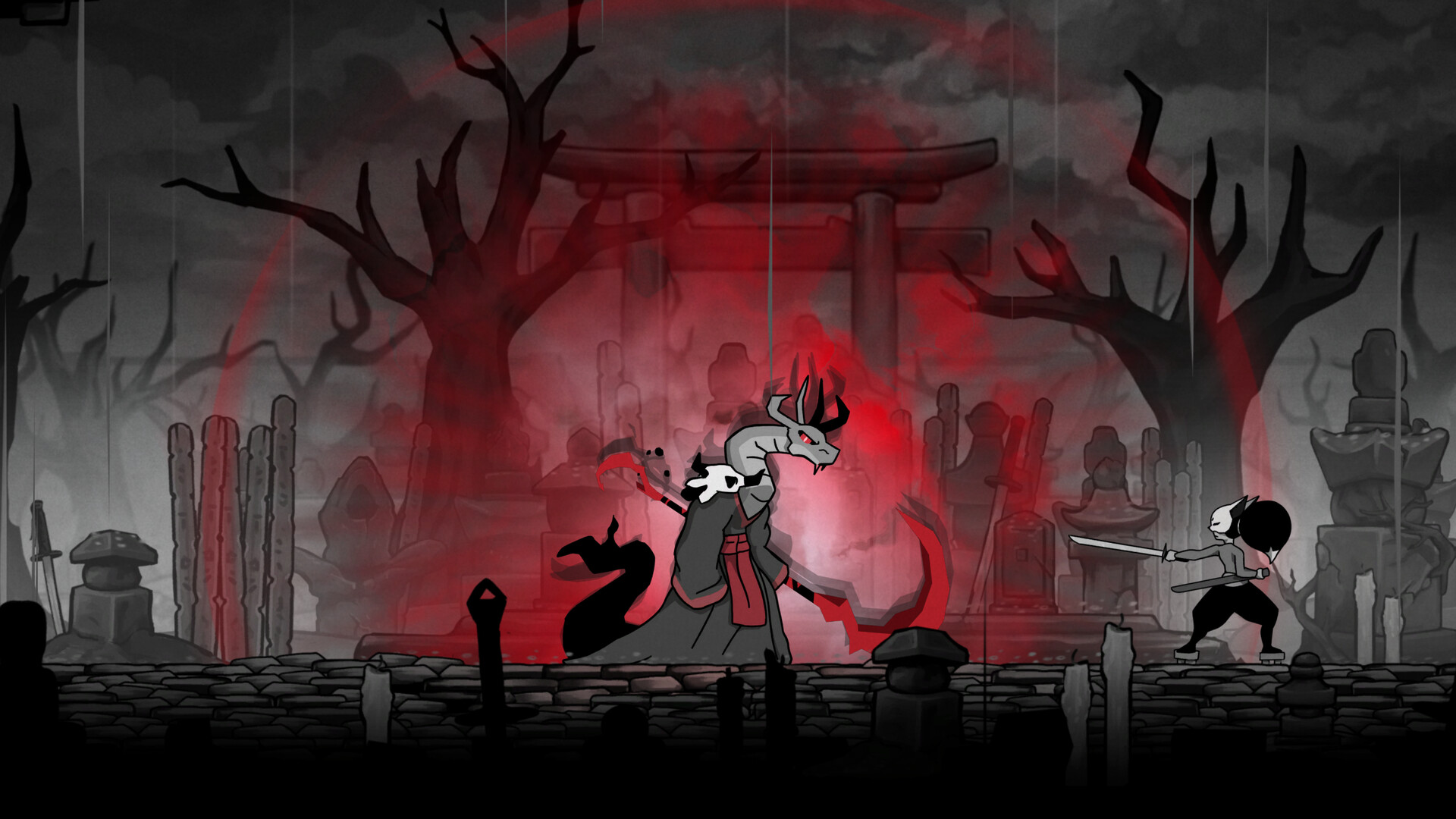
There is a very old idea at the center of Gurei. It is the idea, borrowed from chanbara cinema and from the folklore that cinema itself borrowed from, that a duel is decided in the space of a breath — that everything before the cut is patience, and everything after it is consequence. Gurei, the debut release from the small Brazilian studio Lobo Sagaz and published by Astrolabe Games, builds an entire boss-rush action game around that single idea, and it does so with a confidence that belies its size. It launched on PC via Steam on July 22, 2026, priced at a modest $15.99, with console versions still to come. It is one of the most focused, best-realized small action games of the year, and also one that will actively repel a large chunk of the people who try it. That is not a flaw. That is the design working exactly as intended.
Who Is Rei, and What Is a Kami
You play as Rei, a human spirit bound to a punishing duty: hunting down and defeating the Kami, mystical entities of nature drawn from Japanese folklore, in order to claim their power. Gurei doesn't over-explain itself. There is no sprawling cutscene-driven plot. Much of the story is told through mood — through the hush before a fight starts, through the specific, deliberate way each Kami is introduced on-screen, through the visual language of its world. It's closer to a folk tale retold through combat encounters than a narrative game in any conventional sense, and that restraint is one of its quiet strengths. Gurei never once tries to be more than it is, and it never pads its runtime with lore dumps it doesn't need. Lobo Sagaz is a small independent studio, and Gurei carries a lot of the hallmarks of a small team pouring years into a singular vision rather than chasing scope for its own sake — every system in the game exists because it directly serves the central duel-and-sequence idea, and there is very little sense of a feature added just because a bigger studio would have included it. That focus is rare, and it shows in how little of Gurei feels like filler.
What it is, at its core, is a series of individual duels, each built and paced like its own self-contained short film with a beginning, an escalation, and a single decisive climax. And unlike most boss-rush games, which march you through a fixed gauntlet in a fixed order and dare you to survive it, Gurei hands you the entire roster up front and lets you choose your own path through it from the very first minute.
The Order You Choose Is the Difficulty You Get
This is Gurei's single smartest design decision, and the one that elevates it above a well-made but familiar boss-rush into something genuinely novel. You are free to fight the Kami in any order you like. But the game runs on a dynamic difficulty system tied directly to your choices: the very same Kami that goes down in under a minute if you fight it first can become the single most punishing encounter in the game if you save it for last. Health pools scale. Damage output scales. Attack patterns gain entirely new, more dangerous moves the longer you put a fight off, sometimes changing the entire shape of the encounter rather than simply padding its numbers.
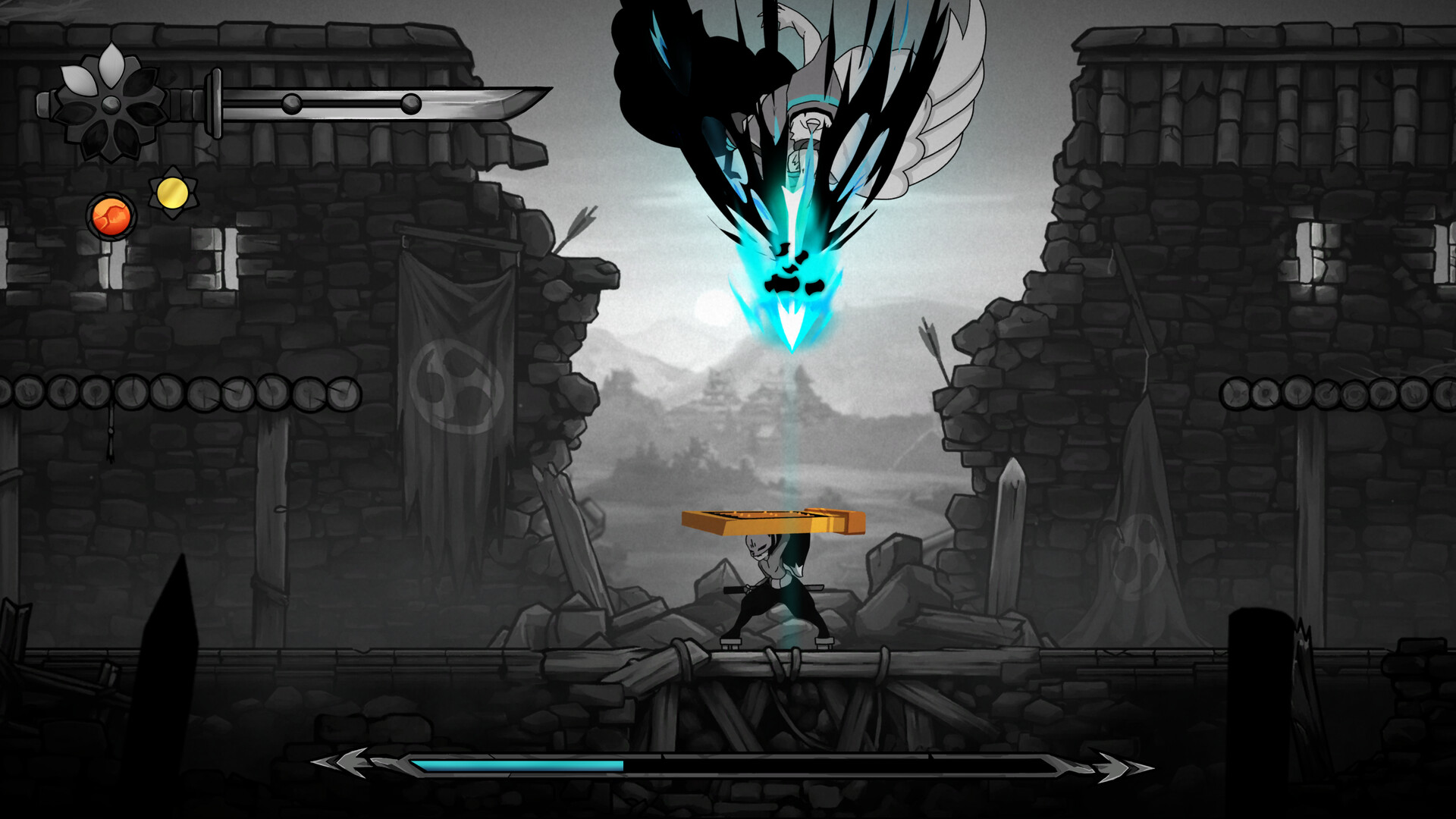
The effect this has on pacing is hard to overstate, and it's worth sitting with for a moment, because it's the thing that separates Gurei from a dozen superficially similar boss-rush indies. In most games of this type, replaying the whole roster in a different order is a curiosity at best — a novelty for a second playthrough once the "real" challenge is behind you. In Gurei, it's the entire game, present from your very first decision. Every run is a genuinely different difficulty curve depending on which fights you front-load and which you save, and there is real strategic thought to be had here rather than pure trial and error. Rushing toward the boss you find easiest first, hoping to bank an early ability advantage before tackling the fights you fear, is a real, viable strategy. So is deliberately front-loading the fight that scares you most while it's still at its weakest and most forgiving, and accepting that an easier boss will simply cost you more later as a trade. There's no objectively correct answer, but there is a smarter and a dumber sequencing decision for your specific skill set and your specific weaknesses as a player, and working that out becomes its own meta-game layered directly on top of the sword work — a second, quieter puzzle running underneath the obvious one.
Combat: Sword, Dodge, Head Stomp, Repeat — Until It Isn't That Simple Anymore
The base combat kit is deliberately small. Rei has sword attacks, a dodge, and a head-stomp maneuver that lets her punish over-extended enemies, plus the expected movement options for repositioning around an arena. On paper this reads like a stripped-down moveset, and for the first Kami or two, it plays like one — simple, direct, almost austere, closer to the opening hour of a From Software game before the toolkit expands. But Gurei isn't interested in staying that way for long, and the loop that keeps you coming back is the way every single defeated Kami permanently grants Rei a new ability for the rest of that playthrough.
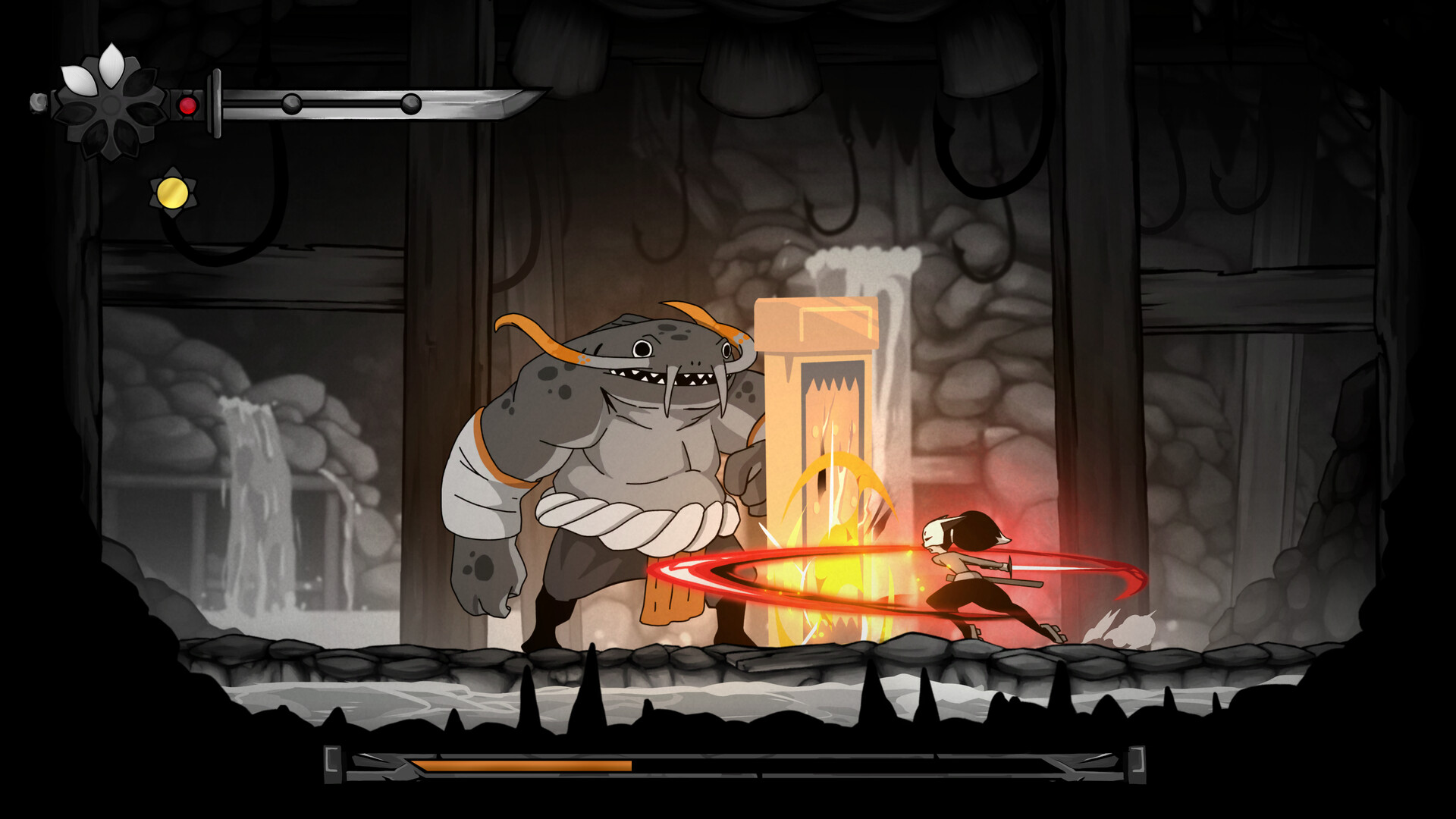
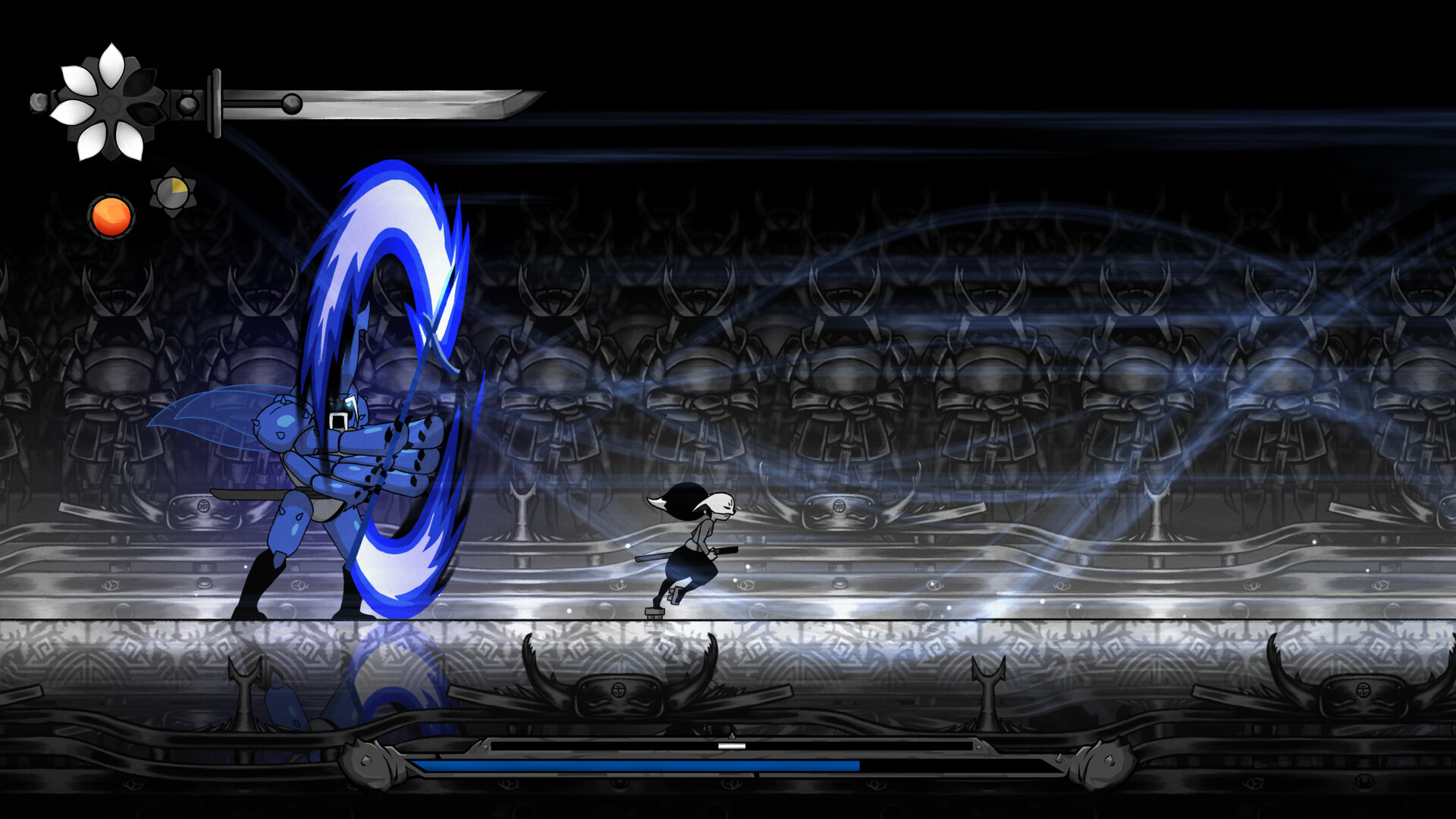
These aren't cosmetic unlocks tucked into a menu you'll forget about. The Frog Kami grants a genuine healing ability, letting you claw back health mid-fight rather than committing to a flawless run from the first hit onward — a small mercy that changes how aggressively you're willing to play everything that comes after it. The Monkey Kami hands you a summonable decoy, an entirely new layer of misdirection you can use to bait out a dangerous read-and-punish attack from a later boss that would otherwise be nearly impossible to safely scout. Other Kami grant a stronger dash for closing distance instantly and punishing whiffed attacks, a weapon capable of outright executing a staggered enemy to end a war of attrition early, a shield for blocking through an attack you'd otherwise be forced to dodge around, and a last-chance mechanic that kicks in automatically the moment your health finally bottoms out, buying you one final, desperate window to turn a fight around. There is real mechanical depth sitting under the minimalist surface, and by the time you've claimed four or five Kami abilities, the "simple" combat system from the opening hour barely resembles what you're actually doing an hour later. Sword, dodge, and head stomp are still the foundation, but the building on top of that foundation grows more elaborate with every Kami you put down.
The Bosses Themselves
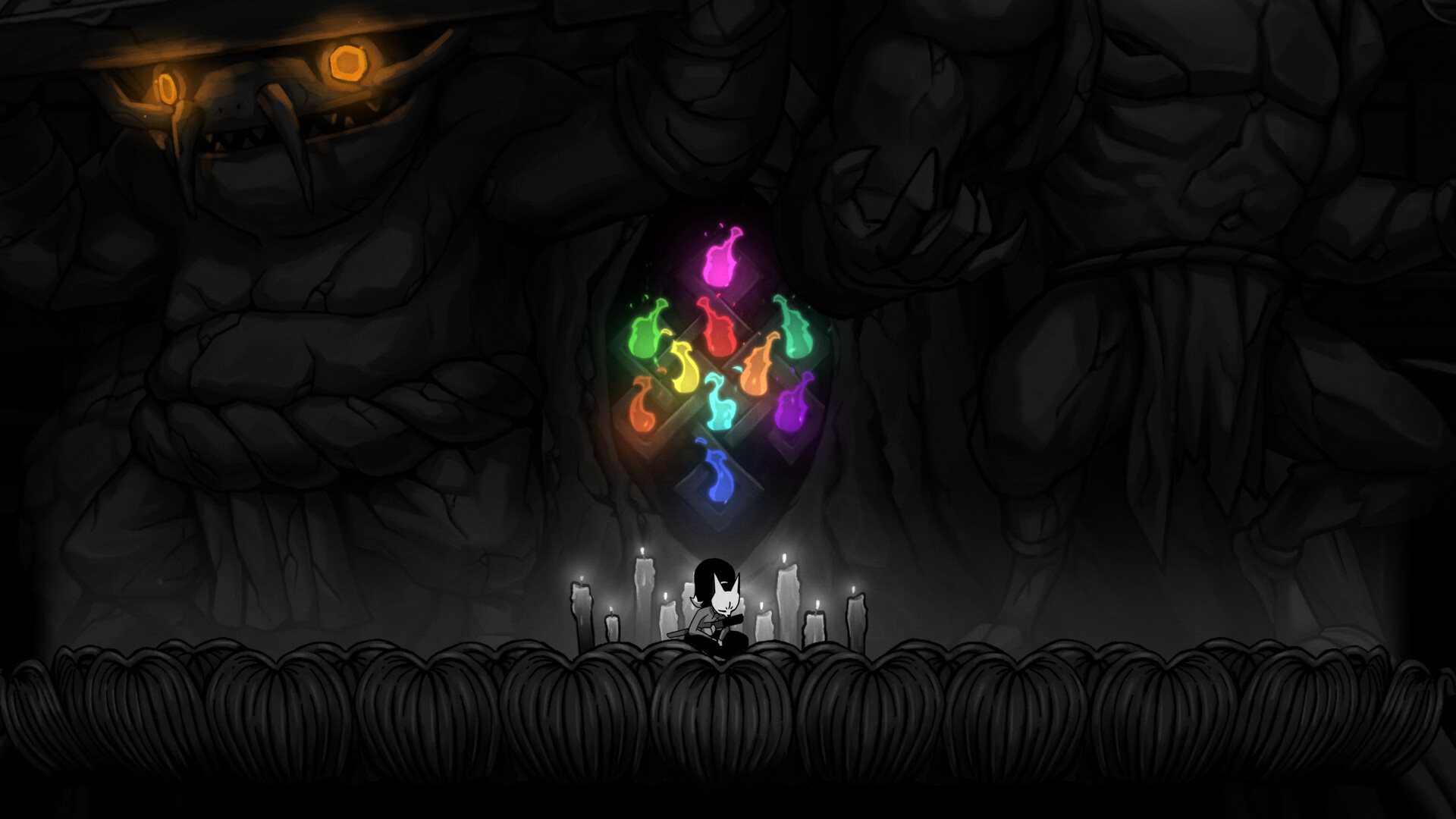
None of the systemic cleverness would matter if the individual duels weren't good. Every Kami fight is built around a single clear gimmick, well-telegraphed and fair even at its most aggressive, and the roster avoids the trap of reusing the same two or three attack shapes with a fresh coat of paint. One standout is a boss that swaps possession between multiple mobs mid-fight, forcing you to constantly re-read which body currently holds the actual threat instead of fixating on a single silhouette the way every instinct in an action game trains you to. Another, an unnervingly agile cat spirit, punishes a single missed dodge so hard that it can unravel an entire run's momentum in one exchange — the kind of fight that teaches you humility whether you want the lesson or not.
What ties the roster together, gimmicks and all, is a consistent design philosophy: attacks are readable if you're paying attention, windups are honest rather than deceptive, and losing almost always feels like it was your read that failed rather than the game cheating you out of a fair fight. That's the single hardest needle to thread in this entire genre, and Gurei threads it more often than it doesn't, even in its punishing back half.
How Gurei Stacks Up Against Its Genre Peers
It's worth placing Gurei against the games it's clearly in conversation with, because the comparison flatters it more than it hurts it. Where Furi leaned into a synth-drenched, hallucinatory sci-fi presentation and a strictly linear gauntlet, Gurei's non-linear structure gives it a strategic dimension Furi never attempted. Where Cuphead wrapped brutal boss patterns in a deliberately jaunty, cartoonish tone that softened the sting of repeated failure, Gurei leans the opposite direction — its grey, mournful presentation makes every death feel weighty rather than slapstick, for better and for worse depending on your taste. And where a boss-rush mode bolted onto a larger Metroidvania like Hollow Knight exists as optional endgame content for players who've already mastered the base game's systems, Gurei is boss-rush difficulty from the opening minute, with none of the earlier hours most games use to gently ramp a player up to that intensity. It is, in other words, a game built entirely out of the part of other games that most players treat as the reward for finishing everything else first. That's a genuinely unusual pitch, and Gurei commits to it completely rather than hedging with an easier early game to widen its audience.
A Grey World, Lit Up by What's Trying to Kill You
Visually, Gurei commits to a striking, slightly austere choice: a muted, largely grey color palette for its world and its heroine, deliberately restrained so that the vivid, otherworldly colors of each Kami's abilities and attacks explode off the screen by contrast the instant a fight begins. It's a smart piece of environmental storytelling as much as an aesthetic one — the world is grey because Rei's duty has drained it, and the Kami, monstrous as they are, are the last things left burning with real color and life in it. The hand-drawn animation throughout is fluid and full of weight, exactly the kind of presentation that sells the chanbara-inspired rhythm of stillness followed by sudden violence that the combat is built around from the ground up. Frame-by-frame, it's some of the most purposeful indie animation work of the year; nothing moves without meaning, and every Kami's silhouette is instantly readable even in the chaos of a late fight.
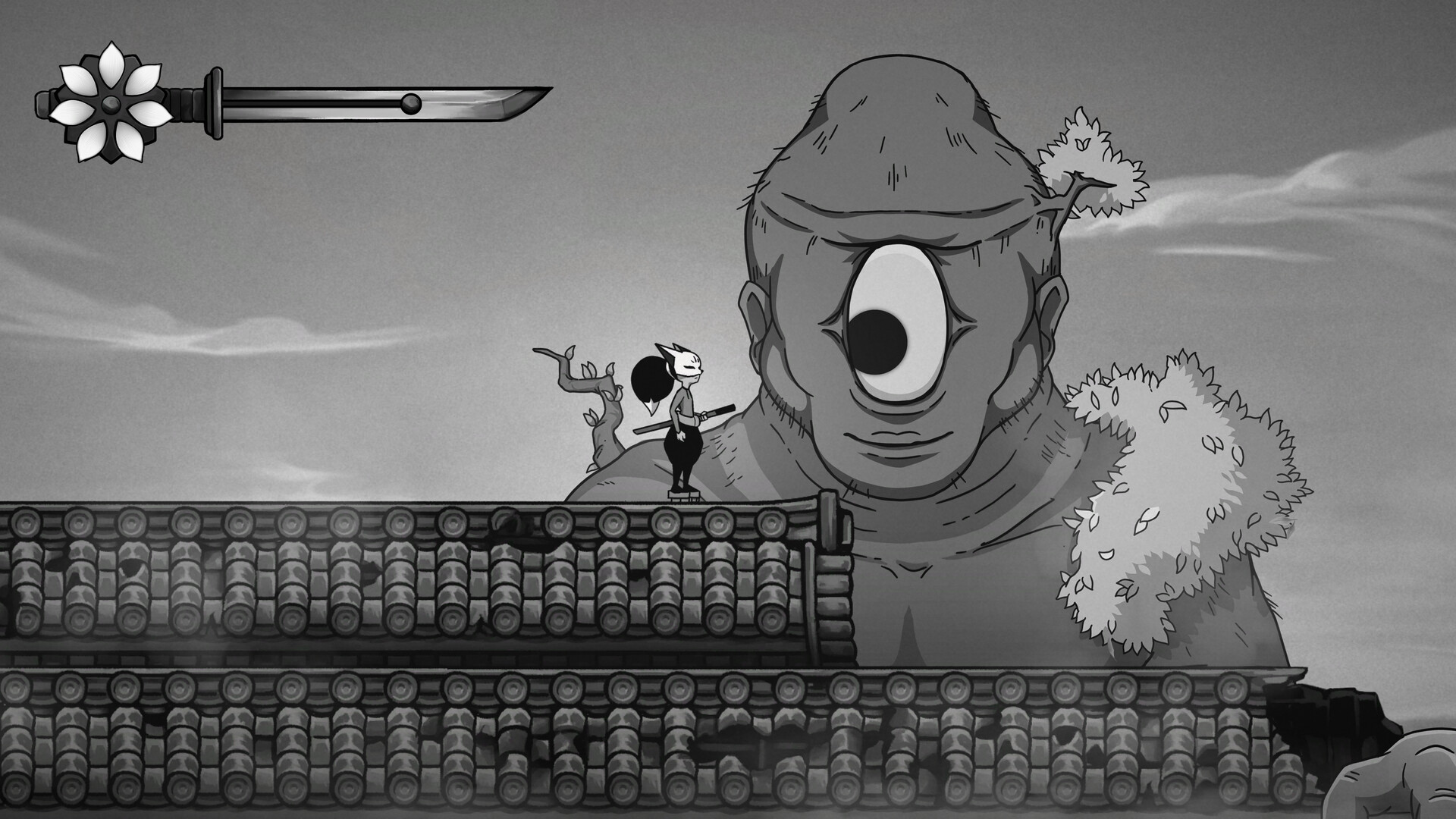
The soundtrack matches that intentionality rather than coasting on atmosphere alone. Rather than a single looping combat theme stretched across the whole game, each Kami has been given its own distinct musical identity, and the shift in score from fight to fight does real, tangible work in making every encounter feel distinct even when the underlying mechanical shape — approach, read, punish, repeat — stays consistent across the entire roster. It's a small production touch that a lot of games this size would have skipped, and Gurei is clearly better for not skipping it.
Short, Stingy, and Built to Be Replayed
Here's the part of Gurei that will make or break it for a lot of players, and the part that any prospective buyer needs to understand clearly before purchasing: a clean, no-death run through the entire roster takes somewhere in the neighborhood of twenty to thirty minutes. That is not a typo, and it is not padded runtime disguised as content — it's the entire point of the design. Gurei is stingy with lives by design, and the honest expectation for most players is to be stuck on a single problem Kami for multiple hours before the pattern finally clicks and the fight collapses into something that feels almost trivially easy in hindsight, the way a magic trick looks obvious the moment you know how it's done. The twenty-minute "true" length of the game and the many-hours-long actual playtime most people will log getting there are not in tension with each other; they're the exact same design decision viewed from two different angles, and understanding that going in will save you some frustration.
That structure won't be for everyone, and it shouldn't try to be, because trying to be everything to everyone is exactly what would have diluted the thing that makes Gurei worth talking about. If your idea of a satisfying difficulty curve involves permanent account-level upgrades that persist regardless of how a run goes, an expanding arsenal you carry between attempts without needing to re-earn it, or simply more forgiving margins the longer you sink hours into a game, Gurei is going to feel needlessly cruel rather than fairly demanding. It offers no easy mode, no accessibility difficulty slider, and no meta-progression that survives a full reset. What it offers instead is the promise that the only thing standing between you and every single Kami is your own improvement as a player — which is either the most honest pitch a boss-rush game can make, or an immediate dealbreaker, depending entirely on what you personally walked in looking for.
Where It Falls Short
Gurei's ambitions are narrow by design, and mostly it's better for that focus — but the narrowness does cost it in a couple of concrete places worth flagging. The roster, while consistently well-crafted, is not enormous, and players who bounce off the difficulty early will find comparatively little else to do; there's no economy or crafting system to tinker with between attempts while you work up the nerve to try again. The order-based difficulty system, brilliant as it is, also means the game front-loads almost all of its instruction onto you implicitly rather than explicitly — there's minimal in-game guidance about exactly how drastically a delayed fight will scale, and a first-time player can accidentally back themselves into a brutal, poorly-understood final stretch without fully grasping why until it's already too late to course-correct. A little more transparency about the real stakes of sequencing, even just a soft warning before you commit to leaving a Kami for later, would have gone a long way without undercutting the design's cleverness or its difficulty.
It's also worth being upfront that Gurei is, for now, PC-only. Console ports have been promised but carry no firm date at launch, so anyone hoping to duel the Kami from a couch is going to be waiting an unspecified amount of time to find out when that changes.
Who Should Actually Buy This
Given all of that, it's worth being direct about the audience this is and isn't for, because a $15.99 impulse buy based on the gorgeous screenshots alone is the fastest way to end up disappointed with an otherwise excellent game. If you finished Sekiro and immediately wanted more of just the boss fights with nothing in between, if you've ever wished a Soulslike's postgame boss-rush mode was the entire game instead of a bonus feature, or if the idea of a twenty-minute "true" run backed by many hours of failure sounds thrilling rather than exhausting, Gurei is close to essential at its price point. If you value narrative, exploration, or a gentler difficulty on-ramp more than you value pure mechanical mastery, this is very likely not your game, and no amount of the gorgeous hand-drawn art will change that math for you. Gurei is not interested in convincing the second group otherwise, and that clarity of purpose is itself worth respecting even from outside its target audience. Even the menus reflect that restraint — there is no crafting screen, no currency to manage between attempts, and no equipment loadout to fuss over before a fight. The only inventory that matters is the one in your head: which Kami abilities you carry, and which fight you have left for last.
The Verdict
Gurei is a small game with one genuinely excellent idea, executed with a level of craft and confidence that punches well above its budget and its two-person-studio origins. The order-based difficulty system turns a familiar genre into something that plays differently every time you sit down with it, the hand-drawn presentation is gorgeous in a way that's inseparable from its themes rather than decoration bolted on top, and the boss design is fair even when it's merciless. It will not convert players who need a gentler on-ramp into difficult action games, and it doesn't want to — Gurei knows precisely who it's for, and it never once apologizes for leaving everyone else behind. For the audience it's built for, this is an easy recommendation and one of the strongest indie boss-rushes of the year. For anyone else, it's worth knowing exactly what you're walking into before you pick up the blade.