TAITO has announced Lufia I & II: The Sinistrals Saga, a single package that brings both 16-bit Lufia role-playing games to PlayStation 5, Switch 2, Switch and PC. The collection is dated for 2027, the Steam page is already live with a wishlist button, and the screenshots attached to it show the games running with a visibly reworked interface rather than a straight emulator wrapper. Clear River Games is publishing alongside TAITO, and the release is planned for Japan, North America and Europe together.
Two games, one box, thirty years late
The collection pairs Lufia & the Fortress of Doom with Lufia II: Rise of the Sinistrals. The first is the 1993 game about a descendant of a legendary hero and the young woman travelling with him, both pinned under a prophecy neither of them chose. The second, released two years later, is its prequel, following Maxim from an ordinary swordsman in a small town to the hero the first game spends its entire runtime referencing. Playing them in release order means watching the ending of a story before you see the beginning of it, which is exactly the trick the pair has always pulled, and packaging them together finally makes that structure the default rather than an accident of what you found in a bargain bin.
TAITO describes the work as having been "ported lovingly and enhanced for modern play," which is the kind of phrasing that can cover anything from a resolution bump to a full systems pass. Nothing more specific has been detailed yet. What the store page does confirm is a single-player game with Steam Achievements, full controller support, Steam Cloud saves and Family Sharing, in English, Japanese, Korean, French, German, Spanish, Simplified Chinese and Traditional Chinese.
What the screenshots actually show
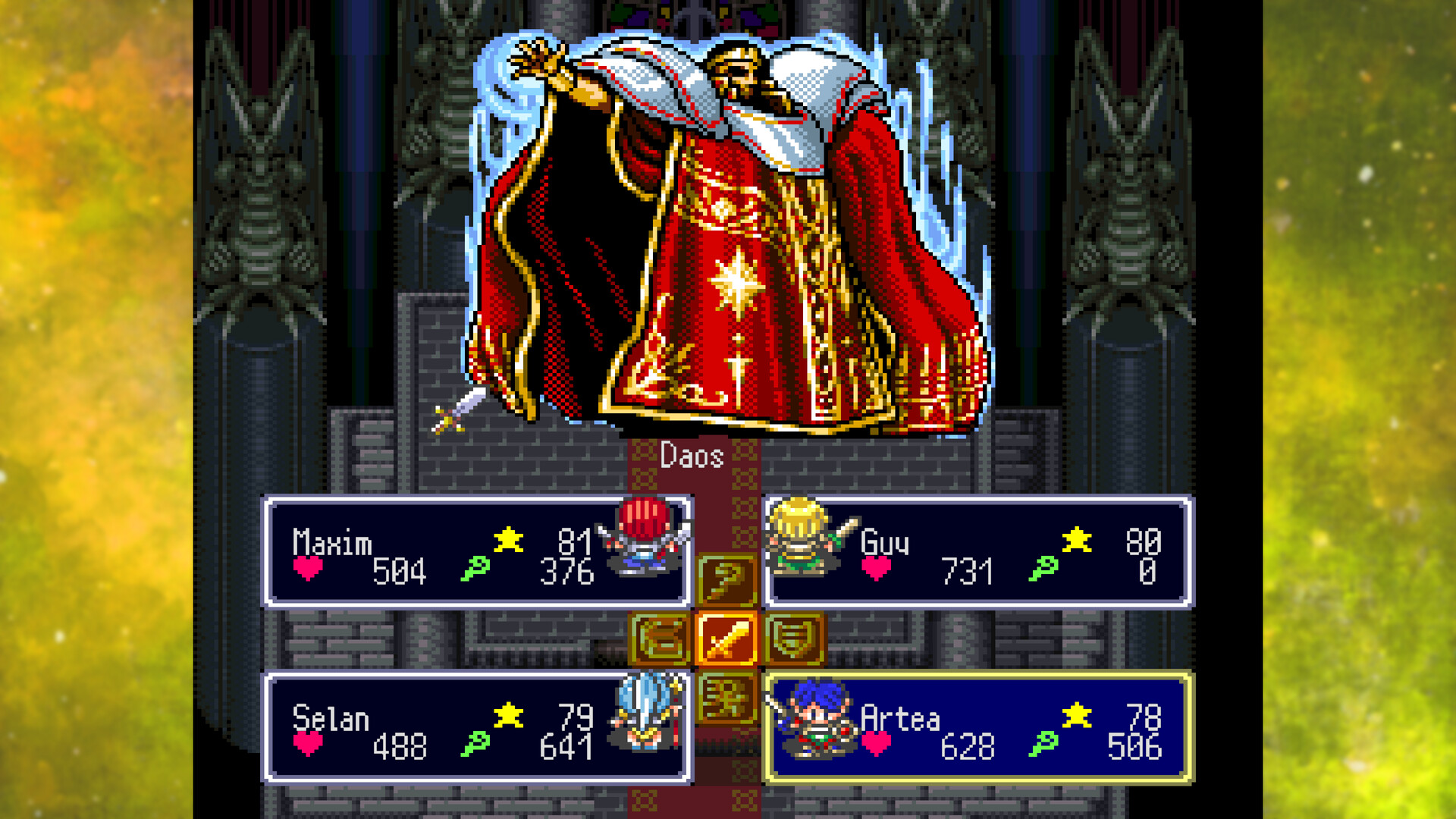
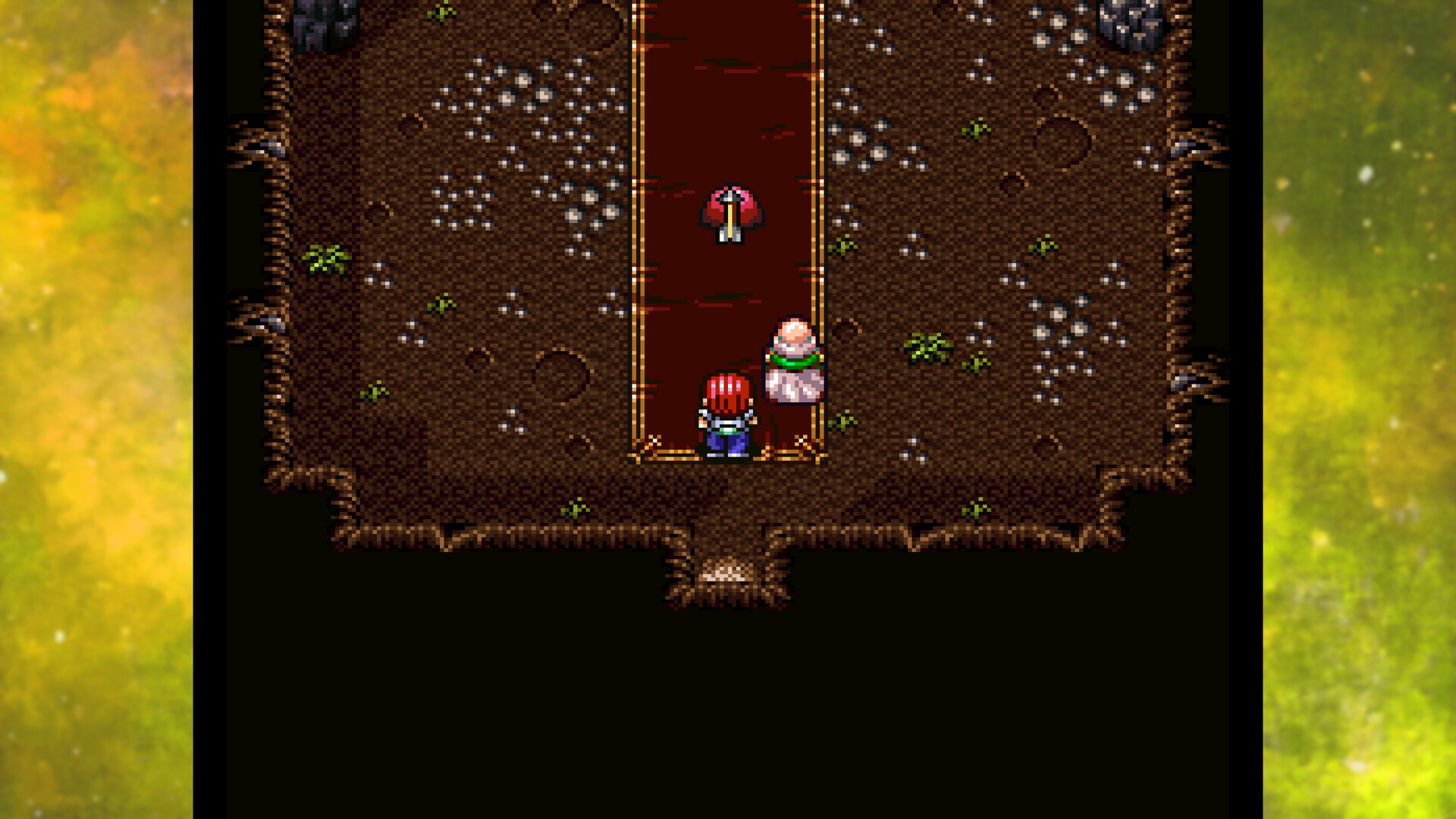
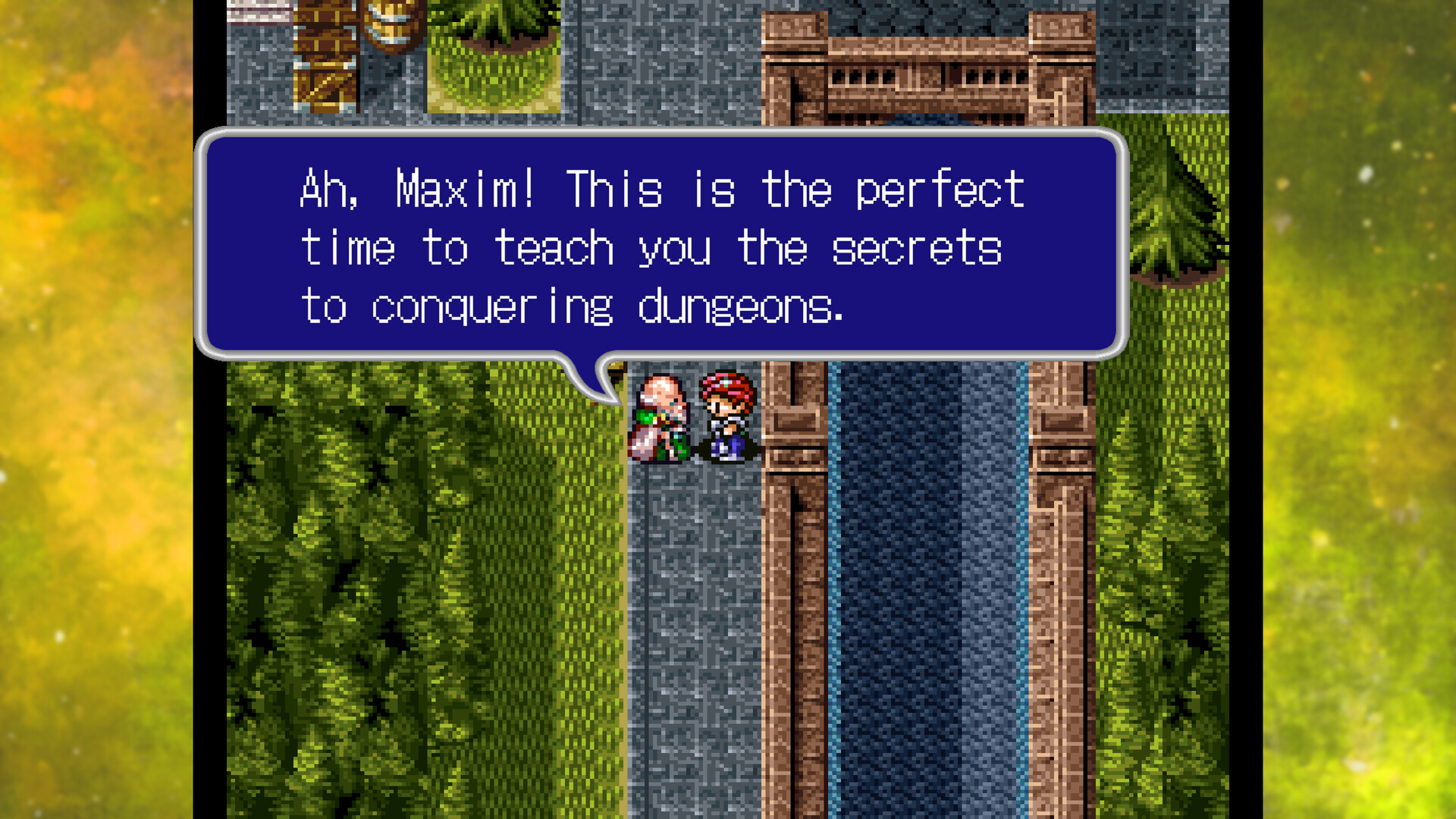
Five images are up, all of them from the second game, and they are more informative than the blurb. The presentation keeps the original 4:3 frame and fills the sides with decorative border art instead of stretching the sprites, which is the right call for pixel work of this vintage. The sprites themselves look untouched and unsmoothed.
The interface is where the changes are. Battles now put commands on a compact cross-shaped wheel in the centre of the screen rather than a stacked text menu, and party status sits in rounded panels with heart and droplet icons standing in for the old HP and MP labels. Dialogue arrives in a soft-cornered speech bubble anchored to whoever is talking, not a rectangle bolted to the bottom of the display. One shot shows the opening confrontation with Daos, the four heroes lined up at absurdly high levels in a fight the game has no intention of letting you win. Another shows Maxim at level two, swinging at a Red Jelly, with the same wheel and a new bar layout that tracks HP, MP, CM and IP separately.
The part that made Lufia II a cult pick
The reason this announcement carries weight well beyond nostalgia is the design of the second game, which did several things in 1995 that the genre around it was not doing. Enemies are not random encounters fired off by a step counter. They stand on the dungeon floor as sprites and move one tile for every tile you move, which turns an ordinary corridor into a positioning problem and lets a careful player walk past a fight entirely. Thirty years of role-playing games have since arrived at the same conclusion, usually presenting it as a modern quality-of-life feature.
Its dungeons are built as puzzle boxes rather than corridors with treasure in them. Maxim picks up a set of field tools, a hook, arrows, bombs and a hammer among them, and rooms are designed around using them on switches, blocks and gaps. Get a room into an unsolvable state and you can reset it and start over, a concession that keeps the puzzles from becoming a reload loop. Equipment carries IP abilities that charge as you take damage, so a weapon is a set of moves and not just an attack number. Capsule monsters travel with the party as a sixth member that you feed items to evolve rather than level up conventionally.
And then there is the Ancient Cave, an optional randomised dungeon that strips your party back to nothing at the entrance and asks you to descend ninety-nine floors on what you find on the way down. It is a roguelike bolted into a story-driven console RPG, in a year when almost nothing on a home console was doing that, and it is the single feature most likely to keep someone playing this collection long after the credits.
What it will take to run
The PC requirements are exactly what you would hope for from a 16-bit collection and nothing more. The minimum spec asks for 64-bit Windows 10, a Core i5 6400, 8GB of RAM, Intel HD Graphics 530 and 1GB of storage. The recommended spec moves up to a Core i5-9400F or Ryzen 5 3600 with a GTX 1060 or Radeon RX 580, DirectX 11 and 2GB of space. Integrated graphics clearing the minimum bar means this will run on effectively any laptop made in the last decade, and a 2GB install is small enough that the Switch and Switch 2 versions should be an easy download too.
The catch is the calendar
The release window is "2027" and nothing narrower, which is a long runway for a collection whose store page is already showing finished-looking screenshots. That gap usually means either console certification across four platforms or work still going on behind the enhancement line that TAITO has not wanted to describe yet. Either way, there is plenty of room between now and then for a proper feature breakdown, and the open questions are worth asking: whether the script has been revisited, whether the Ancient Cave keeps its original brutality, and whether the first game gets the same interface work as the second, given that every screenshot released so far comes from the sequel.
For a series whose last new entry was a Nintendo DS action-RPG reimagining in 2010, and whose developer, Neverland, closed in 2013, simply having both original games available to buy on current hardware is a bigger deal than the modest presentation suggests. Wishlisting is open on Steam now.