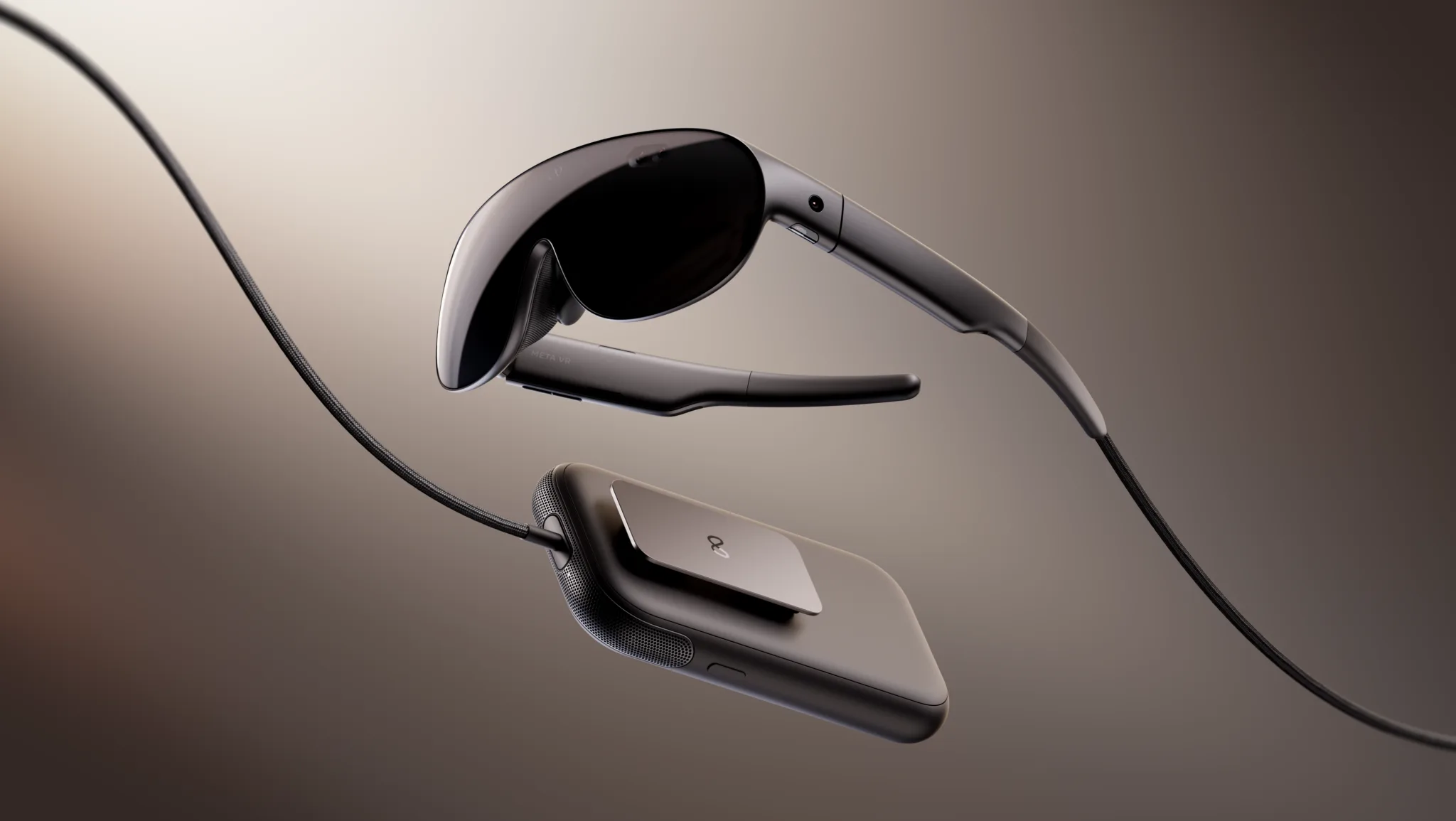
Meta used its Connect 2026 keynote on September 23 to show the headset it has been working toward for years. Meta VR Glasses weigh about 100 grams, drop controllers entirely, and arrive in spring 2027 for $1,299.99. For anyone who plays on a Quest, the more important part is the software: Meta also announced a set of games built for the new device, led by the biggest Beat Saber update in the game's history and new hand-tracked versions of Tetris Effect and Phoenix Wright: Ace Attorney.
A headset that wants to be a pair of glasses
By Meta's own figures, the VR Glasses are about five times lighter than a Quest 3. The company got the weight down by moving most of the hardware off your head. The battery and processors sit in a separate puck on a braided cable, and you clip it to a belt, drop it in a pocket, or leave it in a bag. What stays on your face is a wraparound visor on glasses-style arms, which is what the official product shot above shows.
Inside is what Meta calls a 5K Infinite Display, built on micro-OLED panels. That is the same kind of panel tech that premium headsets from other companies have used to push sharpness and contrast, and it sits a clear step above the LCD panels in the Quest 3 and 3S. Meta is selling the device as a cinema, a workspace and a console in one frame. It can put up several large virtual screens, turn a table or desk into a keyboard and touchpad, and extend the display of other devices you connect to it. Streaming apps including Disney+, YouTube, HBO Max and Prime Video are named at launch, and you can ask Meta AI to arrange your windows or start a film.
No controllers, by design
The key detail for games is input. You drive the VR Glasses with your eyes and hand gestures, not with Touch controllers. That is a big shift for a platform whose best-known games were built around motion controllers with triggers and buttons, and it explains why Meta's games announcements lean so hard on hand tracking. Meta says the new lineup was built from the ground up so it can be played without controllers on the VR Glasses and, where the player wants, with them on Quest 3 and 3S.
So the Glasses are not a Quest replacement in the plain sense. At more than twice the price of the pricier Quest 3 model, and with a control scheme that rules out a large share of the existing catalogue in its current form, they are aimed at a narrower audience. The Quest line carries on alongside them, and most of the new games are shipping on both.
Beat Saber's biggest update, and a new way to play it
Beat Saber leads the lineup. Next spring, alongside the hardware, Meta's flagship rhythm game gets what the company calls its biggest update ever, with its first visual overhaul and new logo in close to a decade. The headline is Flux, a new mode built around high-fidelity hand tracking. There are no sabers in your hands: you channel energy between your palms to cut through notes, and build up Jolt Energy for bonus points as you go.

Flux launches with 35 songs, and Meta says it can be played with hand tracking or with Touch Plus controllers on Quest. The update also brings a reworked campaign and a new progression system that hands out sabers, notes and profile badges as rewards. Meta frames it as the first step in turning Beat Saber into a rhythm platform with several modes, not a single game with song packs.
Tetris Effect and Ace Attorney come to mixed reality
The most interesting third-party reveal is Tetris Effect: Mixed Realities, from publisher Enhance with developers Monstars and Resonair, the team behind the original Tetris Effect. You play it with your hands, grabbing each Tetrimino and guiding it into place. The game also reads the geometry of the room you are standing in and uses the passthrough cameras, lighting and effects to wrap its settings around your real space. Settings shown so far include a deep-sea aquarium and a remote space station. It is due in 2027 on Meta VR Glasses and Quest 3.
Capcom's Phoenix Wright: Ace Attorney – Dual Destinies is getting a VR version for Meta VR Glasses and Quest 3 and 3S in 2027. Evidence is presented with hand tracking, crime scenes can be investigated in 3D, and you can shout the series' famous "Objection!" out loud to trigger it through voice activation. Marvelous's Story of Seasons: Your Wonderful Life is also coming to both devices, rebuilt around hand tracking for farm work like milking cows and shearing sheep.
The rest of the lineup
SEGA and Two Point Studios are bringing Two Point Hospital to the VR Glasses and Quest 3 and 3S, run with hand tracking on the Glasses and with controllers optional on Quest. Dragon Grove, a 3D puzzle and plant-growing game that Meta says was designed from the ground up for the VR Glasses, is due in spring 2027. Dice Throne Digital is a free-to-play dice-and-card battler with cross-play across the VR Glasses, Quest, mobile and PC in early 2027, and Cardmada is a tactical card battler where poker-style hands fire cannons, controlled with your hands and eyes.
The fitness app Supernatural returns to the Horizon Store this fall and will be available on day one on the VR Glasses. For Quest owners who are not buying new hardware, there is still news. PAYDAY: Aces High comes to Quest 3 and 3S later this year with cross-play against the PC VR version and an open playtest starting October 19, and Hot Dogs, Horseshoes and Hand Grenades 2 lands on Quest on November 12.
What to watch before spring
Meta has given a price and a season but no exact date, no pre-order window and no full spec sheet for the puck, so battery life and performance are still open questions. The bigger question for players is catalogue: how much of the existing Quest library will work on a device with no controllers, and how quickly developers will adapt. The launch lineup suggests Meta knows this, since almost every game it showed is built to work either way. Expect more details, and probably more games, before the VR Glasses ship next spring.