Capcom has spelled out how the Nintendo Switch 2 version of Dragon's Dogma 2: Dark Arisen gets its smoothness, and the answer is frame generation. Speaking in a run of Tokyo Game Show 2026 interviews ahead of the October 9 release, producer Naoto Oyama and director Kento Kinoshita confirmed that the Switch 2 build targets a 30fps base in both handheld and docked play, then interpolates to deliver motion equivalent to 60fps. It is the first Capcom game to use frame generation on Nintendo's console.
A 30fps base, doubled
The framing matters here, because frame generation is not the same thing as a 60fps render. Oyama was explicit that 30 frames per second is the target the game is actually rendering at, in handheld mode and in TV mode alike. Turning frame generation on activates a function that inserts interpolated frames between the rendered ones, which is what produces the 60fps-equivalent look on screen.
The technology itself is not new to the game. Capcom brought over the AMD FSR frame generation implementation that already exists in the PC version of Dragon's Dogma 2 and adapted it to Switch 2 hardware. What is new is that this is the studio's first time shipping it on the console at all, which makes the Switch 2 port something of a test case for how the rest of Capcom's RE Engine catalogue might approach the platform.
Oyama also said the optimisation goal was stable operation at 30fps or better rather than a hard cap, and that TV mode can climb above that baseline in some scenes. He described the results of the port as having come in ahead of what the team expected going in.
Why the interpolation is capped at 2x
The obvious question with any frame generation setup is input latency, since interpolated frames cannot respond to a controller. Capcom's answer was to stop at doubling. Oyama said the team deliberately limited interpolation to 2x rather than pushing to higher multiples, because stacking more generated frames between rendered ones increases the delay a player can actually feel.
Beyond that ceiling, the team spent time on what Oyama described as adjustment and refinement aimed at minimising the sensation of lag. That is a meaningful design choice for a game built around timing-sensitive melee, grappling onto the backs of monsters and pawn commands issued mid-fight. A griffin shaking a Warrior off its spine is not a scenario where an extra frame or two of latency goes unnoticed.
Ghosting, and the option to turn it off
Capcom is also being upfront about where the technique breaks down. Oyama acknowledged that artifacts such as ghosting can appear during effect animations and on UI elements, which are exactly the cases interpolation handles worst: fast-moving particle effects and overlaid menu graphics give the algorithm very little coherent motion to work from.
Rather than bake it in, the retail version will let players toggle FSR frame generation on and off at any time. Anyone who would rather have a clean 30fps image with no interpolation artifacts can simply switch it off; anyone who prefers the smoother presentation and does not mind the occasional shimmer around a spell effect can leave it running. It is a sensible way to ship a technology that is still novel on the hardware.
Kinoshita and Oyama were speaking as part of a wider round of TGS 2026 developer interviews about the Switch 2 build, which is the version of Dark Arisen carrying the heaviest technical questions given that the original game was a notoriously demanding release on PC and current-generation consoles at launch in March 2024.
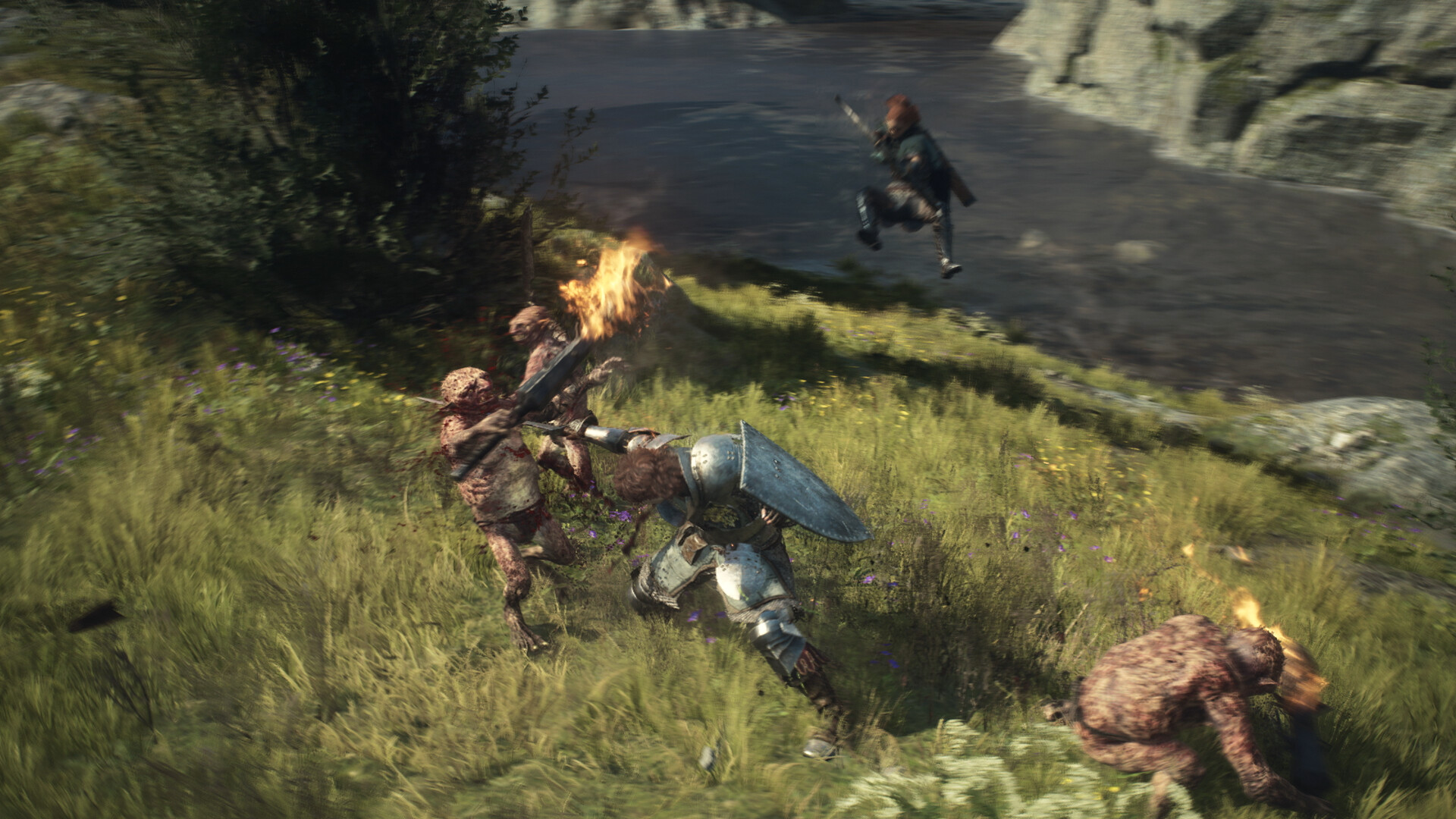
Corrupted monsters in the new dungeons
The same interviews turned up more on the expansion's content. Kinoshita detailed a new enemy category called corrupted monsters, which appear in the additional dungeons and do not simply behave like reskinned versions of the creatures already in the game. He used ogres as the example, saying that a corrupted ogre shows surprising changes in behaviour compared to the familiar version, so encounters players think they have memorised do not play out the way they expect.
Kinoshita also described how the team split its resources to make that work: the animation staff concentrated on the entirely new creatures found in Norgan, while designers and programmers built out the AI behaviours that distinguish corrupted variants from their base forms. That division explains why the corrupted monsters lean on behavioural changes rather than new movesets built from scratch.
October 9, on four platforms
Dragon's Dogma 2: Dark Arisen arrives on October 9, 2026 for Nintendo Switch 2, PlayStation 5, Xbox Series X|S and PC. The Switch 2 release is the one that turns the frame generation conversation into something concrete rather than theoretical, and it is also the first time the game has been available on a Nintendo platform at all.
For anyone weighing the Switch 2 version against the others, the shape of the trade is now clear: a 30fps render with optional interpolation to a 60fps-equivalent presentation, doubling only, with a toggle for the cases where the artifacts bother you more than the judder does. Capcom putting that detail on the record three weeks before launch, rather than letting players discover it in the options menu, is the right call.