
Seven years after the Federal Bureau of Control locked its doors behind Jesse Faden, Remedy is handing the keys to her brother. CONTROL Resonant takes Dylan Faden out of confinement and drops him into a Manhattan that is coming apart at the seams, and in doing so it takes the studio's strangest, most architecturally obsessed game and moves it outdoors. That single decision reshapes almost everything, and it is the thing worth thinking hardest about before you commit.
Dylan was always the more dangerous Faden
The first game framed Dylan as a threat in a containment cell, a man whose abilities the Bureau understood well enough to fear and not well enough to use. Making him the player character is the boldest structural choice here, and it is a smarter one than it first appears. Jesse arrived at the Oldest House as an outsider looking for answers, which made her the perfect lens for a game built on discovery. Dylan already knows what the Bureau is. He has been on the receiving end of it. A sequel that put you back in the shoes of a curious newcomer would have been repeating itself; a sequel led by someone with a grievance changes what the fiction can be about.
Remedy is explicit that the throughline is Dylan's fight to hold on to his humanity as he moves from test subject to what the studio itself calls a paranatural superweapon. That framing carries an obvious risk. Power fantasies about weaponised men tend to flatten into wish fulfilment, and the original's greatest strength was the way its bureaucratic absurdity kept undercutting its own cosmic horror. The memos, the case files, the deadpan institutional voice: those were the joke and the dread at once. Whether that register survives a protagonist who has every reason to be furious at the institution is the question the campaign has to answer.
Jesse is the hook, and the debt
Remedy has been careful about how it frames the first game's protagonist. Dylan is not only fighting a cosmic entity; he is looking for his sister, now the Bureau's Director, as he tries to understand what has spilled out beyond the Oldest House. Making Jesse a goal rather than a guide is a neat piece of structural design. It gives an open map a personal destination, which is precisely what open maps usually lack, and it keeps the first game present without making it a prerequisite.
It also creates an obligation. Jesse earned a lot of goodwill, and a sequel that uses her as a quest marker and little else would feel like a bait-and-switch to the people most likely to buy this on day one. The Faden siblings have one of the more genuinely strange relationships in the medium — two children of the same incident, one recruited and one imprisoned by the same organisation. A story that takes Dylan's side without flattening Jesse into a waypoint is the harder, better version of this, and it is the part of the campaign carrying the most narrative risk.
Leaving the Oldest House is the real gamble
It is difficult to overstate how much of the 2019 game's identity lived in one building. The Oldest House was the setting, the antagonist and the structure all at once — a brutalist office block that reorganised itself while you were inside it, where a fire door could open onto a quarry and a hallway could stop being a hallway. It gave Control a sense of place that very few games manage, and it made exploration feel like trespassing.
Resonant trades that for multiple zones of a ravaged Manhattan, described as expansive and open. This is the pivot that will define how people feel about the game. An open city solves problems the first game genuinely had: it was cramped, its map was famously hard to read, and backtracking through identical corridors was its weakest stretch. But the compressed, claustrophobic weirdness was inseparable from those same corridors. Warping a real city is a different creative act from inventing an impossible building — it is easier to make legible and much harder to make uncanny, because the player already knows what a street is supposed to do.
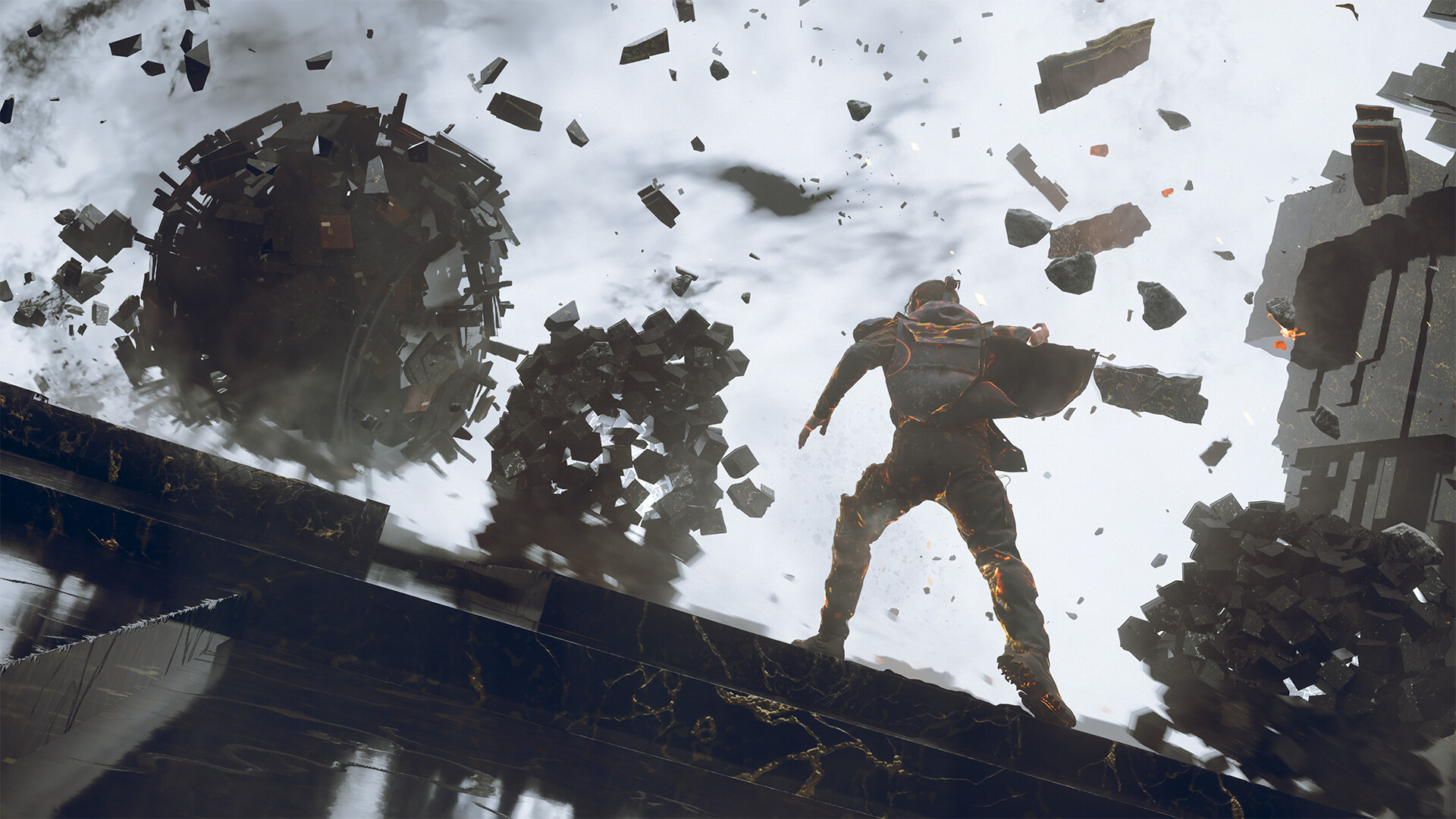
What the material shows suggests Remedy knows exactly where the risk is. The city is not a backdrop with encounters sprinkled on it; it is folded, tilted and broken, with gravity anomalies distorting the vertical and horizontal planes. Traversal and combat are both meant to happen on surfaces that will not stay put. That is the Oldest House logic applied at city scale rather than abandoned, and it is the most encouraging thing about the design.
The Aberrant rewires what a fight is
Control's combat had a distinctive rhythm: float, yank a chunk of masonry out of the air, throw it, dodge, let the Service Weapon reshape itself into whatever the next twenty seconds needed. It was a ranged game punctuated by telekinesis, and it worked because the Service Weapon was as much a character as a gun.
Resonant replaces that centrepiece with the Aberrant, a shapeshifting melee weapon that becomes a two-handed hammer for heavy, committed blows or splits into dual blades for speed and precision. Combined with elemental abilities and environmental kills, the stated intent is to pull encounters in close. This is a real change in genre feel, not a new coat of paint. Ranged combat lets you manage space; melee forces you into it. Every enemy design, every arena and every defensive option has to be rebuilt around that, and a game that gets the trade wrong ends up feeling worse than its predecessor while technically doing more.

The enemy roster is built to justify it. Alongside the returning Hiss, Resonant introduces the Mold, an invasive micro-organism, plus other paranatural threats described as constantly evolving. Two distinct corrupting forces rather than one gives the encounter designers a reason to vary shape and tempo, which is exactly what a melee-forward game needs if it is going to stay interesting across an expansive map. A single enemy faction wears thin fast when you are standing inside it.
Powers you shape rather than simply unlock
Remedy is positioning this as an action-adventure RPG, and the progression language backs that up: a deep system that defines how Dylan adapts to emerging threats, with choices that shape how his abilities manifest and grow. The first game had upgrades, but they were largely a matter of turning numbers up. A branching build system would give the open structure something to feed — a reason to detour, a reason for two players to end up with meaningfully different Dylans.
It also raises the stakes on encounter balance. Open zones plus player-authored builds is a combination that can quietly break a game's difficulty curve in either direction. The presence of adjustable difficulty as a supported option suggests Remedy is aware that not every build will land where the designers assumed.
What it wants from your machine
The PC requirements are honest about ambition. The minimum is a GTX 1070, an RX 5600 XT or an Intel Arc A580 alongside an i5-8500 or Ryzen 5 3500 and 16GB of RAM. The recommended tier moves to an RTX 3060 Ti, an RX 6700 XT or an Arc B580 with an i7-10700 or Ryzen 7 3700X, still on 16GB. Both tiers demand 120GB of storage and both list an SSD as required, not suggested.
That 120GB figure and the hard SSD requirement are the two numbers to take seriously. A game streaming an open, geometrically unstable city cannot afford to wait on a mechanical drive, and Remedy declining to offer an HDD fallback reads as a design constraint rather than a marketing flourish. If you are running an older machine with a spinning disk, this is not a game you can negotiate with.
Single-player, and unusually well equipped for comfort
Resonant is single-player only, with full controller support and DualSense features on PlayStation. Worth flagging for anyone who found the first game physically difficult to play: the supported options include camera comfort settings, colour alternatives, contrast controls, custom volume controls, adjustable difficulty, a keyboard-only option, play without timed input, save anytime, and subtitle options, with HDR available.
That is a substantial list, and camera comfort in particular matters here. A game whose central conceit is rotating the floor out from under you is a motion-sickness risk by construction, and the original had stretches that proved it. Shipping those controls as standard rather than as a patch six months later is the right call.
How much homework does it expect?
This is the question that will decide whether Resonant reaches past the people who already own a Remedy game. Control did not arrive alone. It arrived with an expansion that formally tied it to Alan Wake, and the studio has kept building outward since — a second Alan Wake, a co-op spin-off set inside the Bureau. The connective tissue is a genuine creative achievement and also, increasingly, a barrier. Every crossover raises the cost of entry for a newcomer who just wants to buy the game with the interesting screenshots.
Resonant has a structural advantage its predecessors did not: an amnesiac-adjacent protagonist with a legitimate reason to be told things. Dylan has spent years in a cell. Anyone explaining the current state of the Bureau to him is also explaining it to the player, without the contrivance of a character asking questions they should already know the answers to. Whether Remedy uses that licence to onboard newcomers or to reward veterans with references is the difference between a game that grows the audience and one that services it.
The honest expectation to set: you will not be lost without having played Control, but you will get considerably more out of the Bureau's institutional absurdity if you have. The first game is cheap, widely available, and a good deal shorter than this one is shaping up to be. If you are on the fence, it remains the better starting point.
What you are actually buying
CONTROL Resonant launches on 24 September 2026 for PlayStation 5, Xbox Series X|S and PC, with a standard edition and a Digital Deluxe that adds a digital artbook, the soundtrack, a wallet artifact, a starter resource bundle and an AWE mission outfit. Pre-orders carry a Hiss Corruption outfit and a Pickpocket's Tool artifact. The Deluxe extras are cosmetic and convenience items rather than content, which is the honest version of a deluxe tier and worth noting in a year where that is not guaranteed.
The verdict
Resonant is the rare sequel that has identified its predecessor's actual weaknesses — the illegible map, the corridor fatigue, the ranged combat that settled into a groove — and gone after all of them at once. The ambition is not in doubt. Dylan is a more interesting protagonist than a second Jesse campaign would have been, the Mold gives the bestiary somewhere to go, and pushing gravity anomalies out of a single building and into a city is the correct way to scale Control's ideas rather than dilute them.
The reservation is the same as the ambition. The Oldest House was the best thing about Control, and no open city, however warped, gets to inherit that for free. Melee-forward combat is a genuine identity change, not an addition, and it has to be better than what it replaced rather than merely different. This is a studio spending its strongest asset on a bet that it can rebuild that asset at a larger scale. On the evidence of what Remedy has built and shown, it is a bet worth taking seriously — and one worth watching closely in its opening hours, because this is a game whose structure will either click early or not at all.
If you loved Control specifically for the building, temper your expectations and go in ready to meet a different game rather than a larger version of the one you remember. If you loved it for the tone, the telekinesis and the willingness to be genuinely odd about institutional power, everything here points in the right direction and there is a good deal more of it. And if you bounced off the original because the map defeated you or the corridors blurred together, this is the entry in the series most likely to change your mind — provided the SSD and the 120GB are not a problem, because on that point Remedy is not negotiating.